


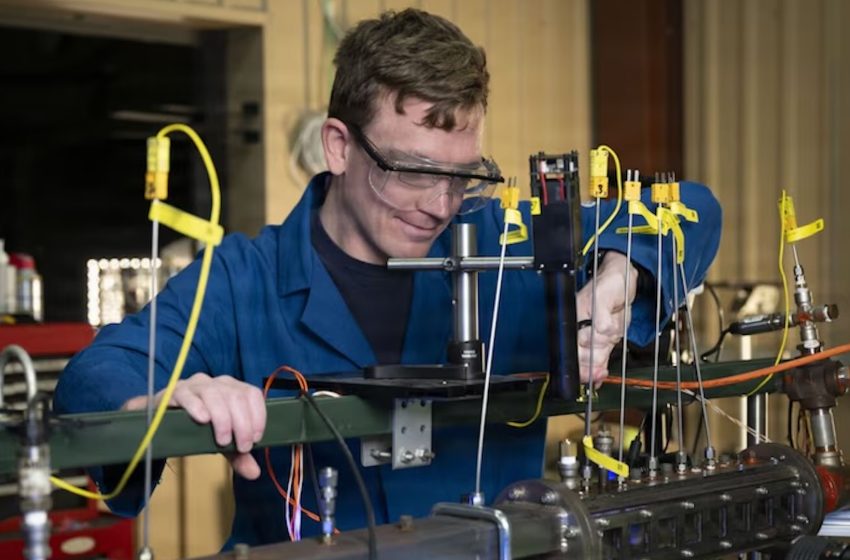
Scientists take first look inside one of world’s most extreme engines
Scientists at the US Naval Research Laboratory (NRL) have achieved significant progress in the development of advanced solid-fuel ramjet (SFRJ) technology, according to a new announcement.
The team set out to shed light on the internal operations of the high-performance propulsion systems. To achieve this goal, they moved away from traditional trial-and-error methods toward more precise, data-informed measurement. They used optical diagnostic techniques to “see inside” the combustors of SFRJs, one of the most extreme engines ever built.
Enabling a 200-300% increase in range
Solid-fuel ramjets are air-breathing engines that rely on atmospheric oxygen for combustion rather than carrying an oxidizer. This offers substantial advantages in energy efficiency and compactness.
“If you replace all the oxidizer and instead use oxygen from the air to burn your fuel, you can increase range by up to 200 to 300% in the same form factor,” Brian Bojko, a combustion scientist at NRL, explained in a press statement.
While SFRJ offers great efficiency, a major hurdle in its development has been the inability to directly observe the complex processes within the combustor. This is due to extreme heat, soot, high-speed flows, and particle-laden conditions that make measurements difficult.
To overcome these challenges, the NRL researchers implemented specialized optical diagnostic techniques. These methods involve precise observation and measurement of flame temperatures, fuel regression rates, vapor transport from the solid fuel surface, as well as the behavior of decomposition products. According to Bojko, measuring flame temperature is particularly important, as most models assume combustion efficiency rather than measuring it.
“These diagnostics give us new data we simply didn’t have before,” said David Kessler, a senior computational scientist at NRL. “They allow us to measure gas-phase species and temperatures in an environment where traditional probes just don’t work.”
In a first, the researchers also visualized fuel vapor released from the solid surface before ignition. This provided insight into the way complex hydrocarbon species mix and evolve before combustion.
Combining experimental observations with simulations
The team examined baseline fuels like hydroxyl-terminated polybutadiene (HTPB). They are also investigating enhanced composite formulations incorporating energetic additives, such as metal particles. With these additions, they aimed to increase the energy density of the solid fuel while maintaining the same volume. This would translate to a greater operational range for future high-speed platforms.
The researchers combined these experimental observations with high-fidelity computational simulations—such as Detached Eddy Simulation (DES) and Large Eddy Simulation (LES). In doing so, the researchers validated models that better capture unsteady and intricate flow dynamics. This contrasts with simpler, traditional approaches that provide approximate results but miss critical details in heat transfer, recirculation zones, and chemical reactions.
“In solid-fuel ramjets, you don’t have direct control over the mass flow rate like you do with liquid systems,” Bojko explained. “The heat from combustion actually drives the gasification of the solid fuel, so pressure, temperature, and airflow all feed back into how the engine behaves.”
Bojko also highlighted the team’s shift in design philosophy as an important step. “A lot of the design has been kind of Edisonian,” he explained. “You take a guess, test it, and iterate. But without seeing the physics inside the combustor, it’s hard to know if you’re getting the right answer for the right reason.”
David Kessler, a senior computational scientist at NRL, emphasized the value of the new data: “These diagnostics give us new data we simply didn’t have before. They allow us to measure gas-phase species and temperatures in an environment where traditional probes just don’t work.”
The advancements are expected to reduce development risks and costs by allowing more efficient virtual prototyping before full-scale testing. This could accelerate the maturation of SFRJ technology for next-generation high-speed defense systems.
While current experiments use small-scale, optically accessible setups for detailed analysis, ongoing efforts aim to extend these insights to larger real-world tests. Through their research, the NRL team is pushing the boundaries of propulsion to support longer-range, faster aerial capabilities.
First Appeared on
Source link






