


This Giant Star Fooled the Entire Astronomy World, Here’s What’s Really Going On
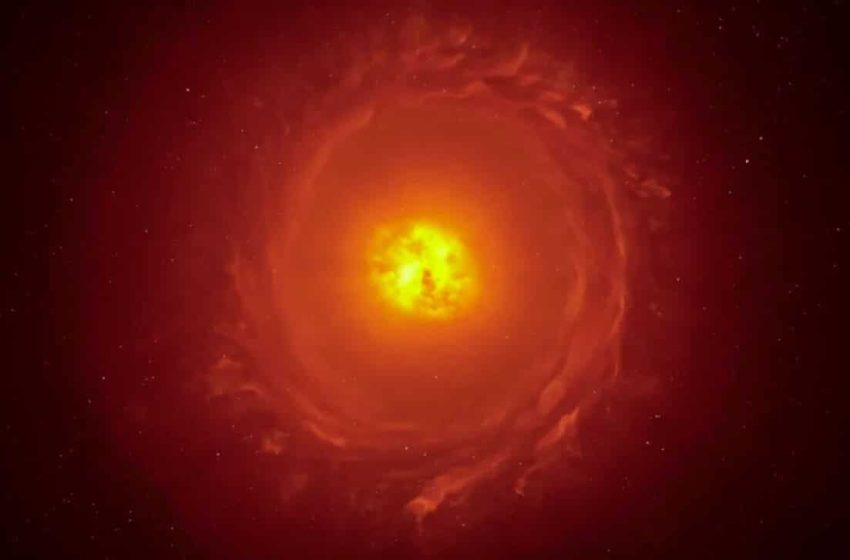
Located in the Large Magellanic Cloud, WOH G64 is a red supergiant and one of the most luminous, dust-enshrouded stars in its galaxy. In recent years, its unusual dimming and changing spectral features led some astronomers to suggest it was shifting into a yellow hypergiant phase, a rare and unstable stage that can precede a stellar explosion.
In 2024, the appearance of a new dust cloud around the star seemed to reinforce the idea that something major was unfolding. However, fresh observations from a team led by Dr. Jacco van Loon at Keele University challenge that narrative. While some thought they were witnessing a massive star in its final moments, the new data point to a more complex reality: WOH G64 is not on the verge of dying.
Spectral Data Tell a Different Story
Between November 2024 and December 2025, Jacco van Loon’s team used the Southern African Large Telescope (SALT) to collect detailed optical spectra of WOH G64. What they found contradicted previous assumptions. Instead of confirming a temperature increase typical of yellow hypergiants, the data showed strong absorption bands from titanium oxide molecules, a clear indication the star’s atmosphere remains relatively cool.
According to Keele University’s statement, these molecules cannot survive in the hotter environments of a yellow hypergiant. That meant WOH G64 had not undergone the suspected transformation. Instead, something else was interfering with its outer layers and producing the puzzling emissions.
The Missing Companion Star Finally Revealed
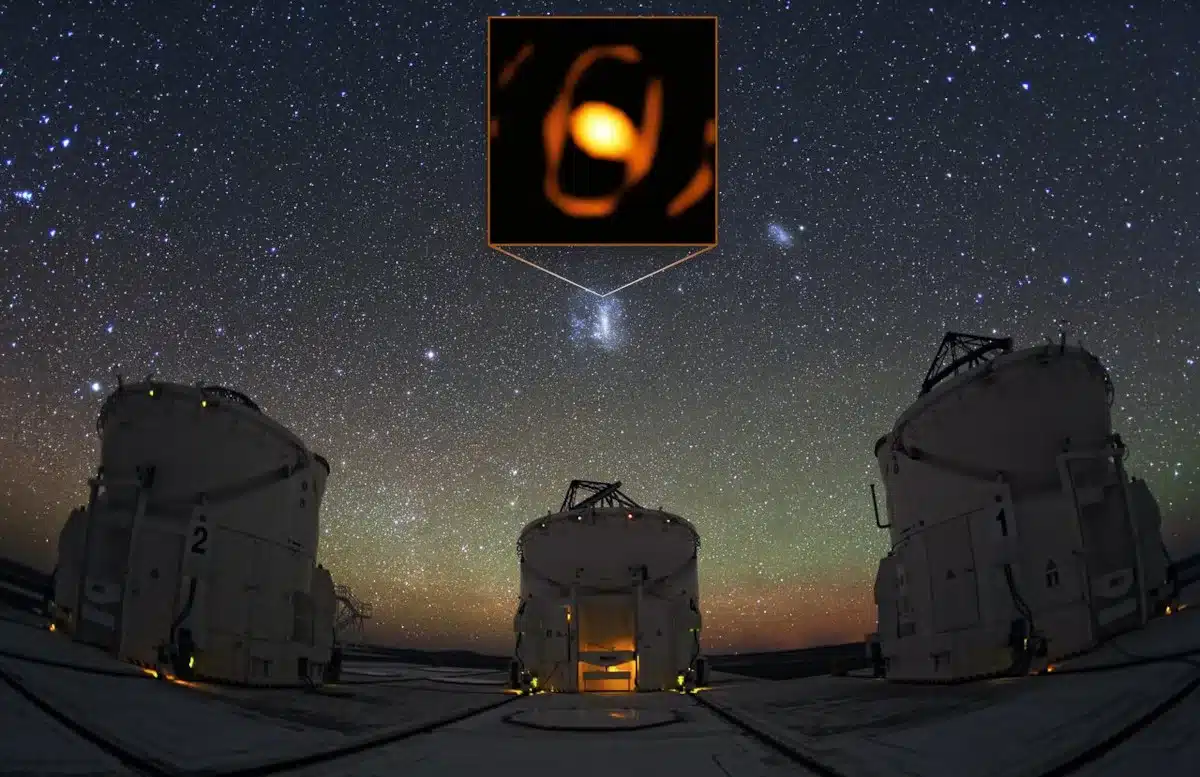
Rather than a single star in flux, WOH G64 turned out to be part of a binary system. The team’s analysis revealed that a hotter, smaller companion star orbits the red supergiant and periodically interacts with its extended atmosphere.
“The atmosphere of the red supergiant is being stretched out by the approach of the companion star, but it has not been stripped altogether. It persists,” explainedvan Loon.
According to the official report, some of the star’s disrupted material even appears to form a disc around the hot companion, which contributes to the strange spectral emissions. The recently formed dust cloud, once thought to signal imminent collapse, is now believed to be the result of this turbulent transfer of stellar material.
Binary Interaction Mimics Stellar Death
This discovery highlights how binary interactions can imitate the hallmarks of a dying star. In WOH G64’s case, nearly every major indicator: fading light, spectral shifts, dust formation, was caused by its companion star. What looked like a transition to the final evolutionary stage was, in fact, a dynamic but stable process.
“We are essentially witnessing a ‘phoenix’ rising from the ashes,” said van Loon, describing the ongoing transformation driven not by internal change but by external influence.
The star will still meet a supernova fate, but the new data argue against an imminent collapse. Careful follow-up work, designed to account for heavy dust obscuration, revealed that earlier spectral “signals” were likely misleading.
First Appeared on
Source link






