


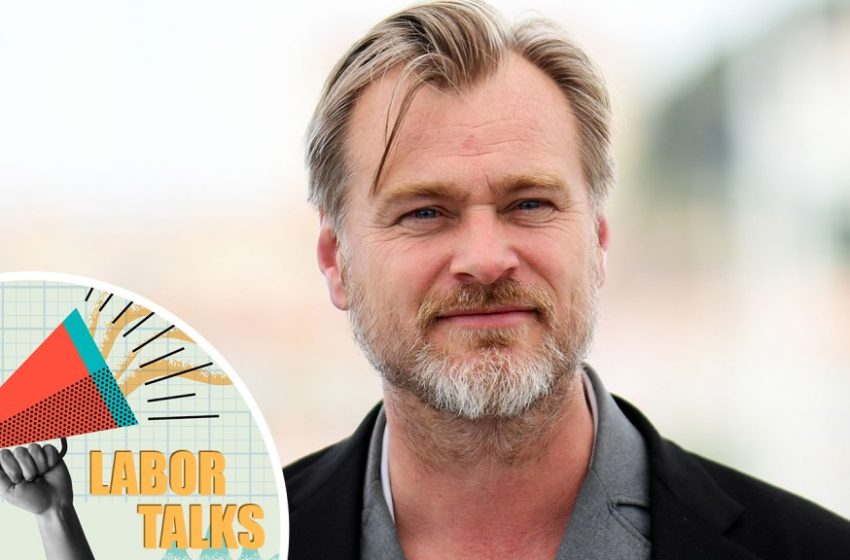
DGA President Christopher Nolan On Warner Bros Sale
Just over a month after the Directors Guild vowed to meet with the companies seeking to acquire Warner Bros, the guild’s president Christopher Nolan confirms that the union has held discussions with both Netflix and Paramount over its concerns about the legendary company being swallowed by a competitor.
As for how those talks are going? Stay tuned, he says. The DGA isn’t quite ready to pick a side or outright oppose either sale just yet.
“I don’t really want to speak to the specifics of the conversations we’ve had, but publicly you’ve seen a shift from both companies to embrace, for example, theatrical windows, things like that,” Nolan told reporters from Deadline, Variety and The Hollywood Reporter during a recent interview. “I mean, there are encouraging noises, but that’s not the same as commitment.”
While he acknowledges “in an ideal world it would continue to function as an independent buyer [and] distributor. That would be the best thing for all members,” he also urged that union leadership is “trying to evaluate the reality of this situation.”
RELATED: Netflix Switches To All-Cash Bid For Warner Bros.
Netflix recently switched its agreement with Warner Bros. Discovery to an all-cash deal, removing the stock option but continuing to value the company’s studio and streaming assets at at $27.75 per share. While the deal is already signed, Paramount Skydance has still emerged as a serious contender in this battle, having made a hostile bid for all of Warner Bros. Discovery, including the cable networks. There have been concerns raised regarding the idea of either suitor controlling any part of the company.
Nolan describes the meetings with Netflix and Paramount as “productive,” but explains that “”we’re sort of in the thick of it” on dissecting the issues at stake.
While there are a host of concerns, the chief among them differ for each company. Fears about the health of theatrical distribution have dominated the conversation when it comes to Netflix, even though co-CEO Ted Sarandos has vowed “Warner Bros films will be released in theaters with a 45-day window, just like they are today.” Paramount Skydance critics have raised alarm bells about the Trump-friendly Ellison family having control over another cable news network if it were to acquire CNN.
Nolan, who has served on DGA leadership for years prior to running for president last year, directed a bulk of his concern toward the reality that either acquisition spells more media consolidation on the horizon for an already struggling industry.
“A merger is going to mean loss of jobs. It’s going to mean consolidation. We all know that. We can all look at history to see that our interest right now is in trying to get to grips with, how can we try and ameliorate some of these concerns? How can we try and look at these companies and secure some kind of meaningful commitments from them, in terms of how to ensure that Warner Bros. — a fantastic, historic 100-year-old company with its incredible library, with its incredible employees — can see the best chance of survival and a potential to thrive,” the Interstellar director explained. “So, whether from Paramount, whether from Netflix, we’re interested in more about the specifics of how they get around these things, what consolidation will do, what the impacts on our members will be, and we’re deep in those conversations.”
For the record, on the theatrical front, Nolan presses: “We strongly take the position that we need a 60-day theatrical window, such as Disney, who’s the most successful theatrical distributor. That’s what they do, and that’s what everybody should be doing.”
He’s not ignorant to the consequences of minimizing the theatrical window, pointing out that “when we analyze our residual space, the residuals from the licensing of theatrically released films is still our single largest category that contributes towards our health plan.” However, he acknowledges that the problems don’t end there.
“When you add up what our members contribute to television, obviously that’s the major part of it, and that’s where, in the shifting streaming landscape, a lot of the major issues are with the deal,” he said. “The reality is, we have very, very significant concerns about how this is all going to happen. It’s a very worrying time for the industry. The loss of a major studio is a huge blow.”
First Appeared on
Source link






