Mapping Paths for Regime Transformation in Venezuela
Uncertainty is the rule when it comes to authoritarian regimes, and we need to use every framework at hand that will help us explain what can potentially happen in Venezuela.
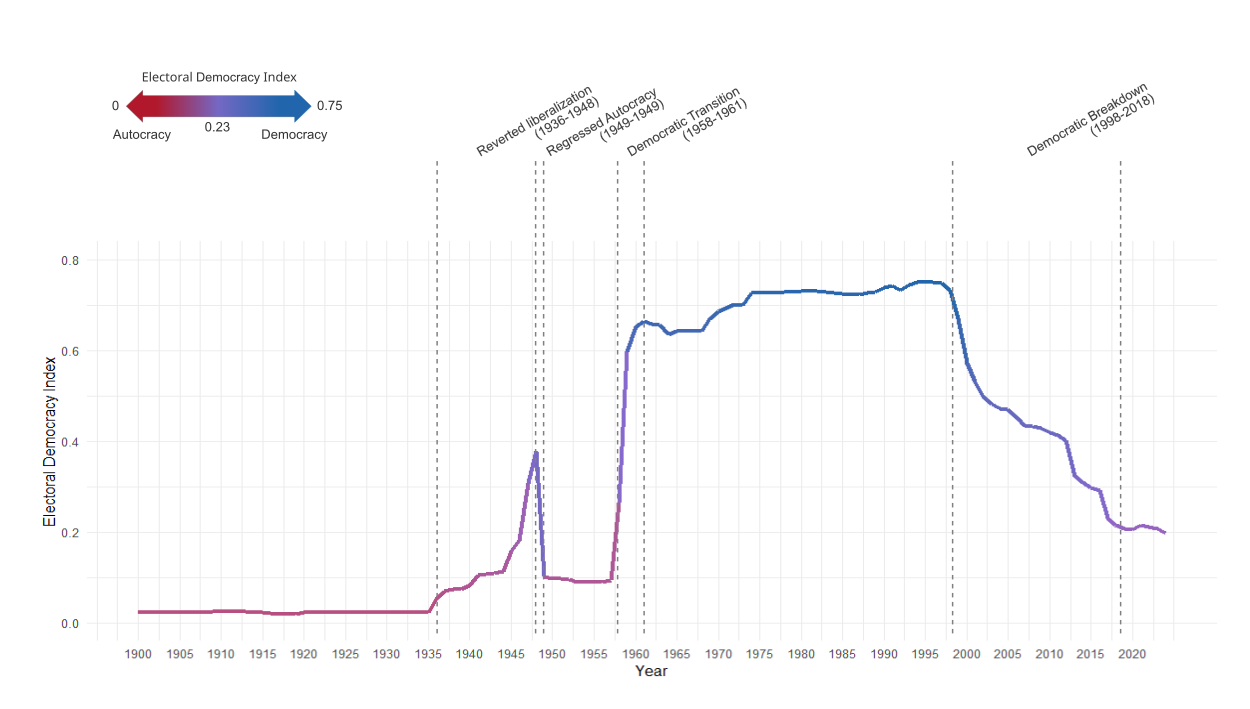
Currently, Venezuela sits at a 0.2 value on the Electoral Democracy Index curated by the V-Dem Institute. This is certainly a low score, and it reflects that the country is an electoral autocracy.
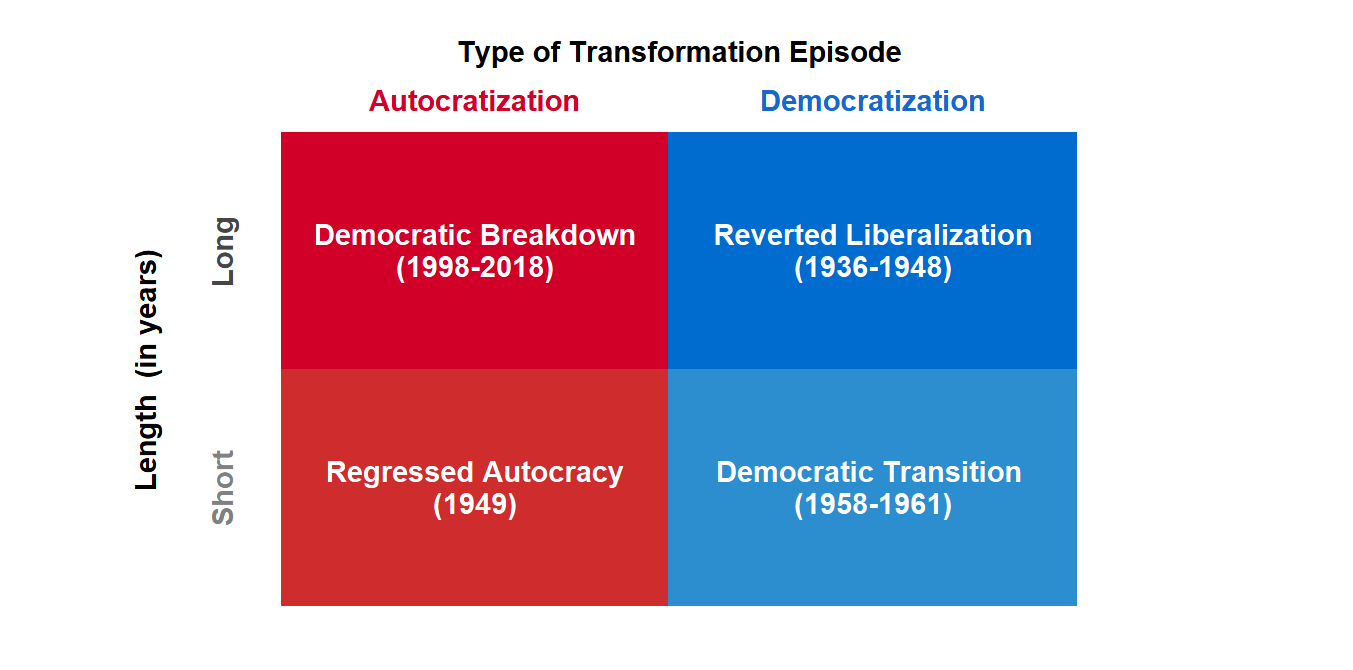
We are trying to examine how regimes historically transform and move from one type to another, while also taking into account Venezuelan history and its past episodes of democratization and autocratization. We are certainly not living our first regime transition. In the past, we have witnessed four dramatic episodes of regime change. But in our country’s dramatic history, what sometimes seems cyclical is not. Understanding Venezuela’s past transitions with the theoretical framework developed by Maerz et al. (2023) on ‘Episodes of regime transformation’ (or ERT), may give us access to what the future could look like given the recent events and the current developments.
This will allow us to think about different scenarios, with different probabilities of actually happening.
The roller coaster of history
Venezuela’s Electoral Democracy Index (EDI) from the 1900s until 2024 has changed over time. Its democratic path can be seen as a roller coaster. In the last 100 years, we have had two episodes of democratization and two episodes of autocratization, with fast and slow regime transitions.
Starting from the very beginning, we had a reverted liberalization episode from 1936 to 1948. After Eleazar López Contreras came to power, and later Isaías Medina Angarita, Venezuela was slowly but surely transitioning into a democracy. However, changes implemented during the Trienio Adeco (1945-1948) were not enough to cross the 0.5 threshold on the EDI to reach an electoral democracy.
In 1948, Marcos Pérez Jiménez imposed a military junta, bringing a regressed autocracy episode. It was not until 1958 that Venezuela embarked again on a transition until 1961, becoming for the first time an electoral democracy. Forty years later, Hugo Chávez’s election started a democratic breakdown episode that Nicolás Maduro carried forward until 2018. Venezuela currently sits at a 0.2 value on the EDI, placing the country as an electoral autocracy, very close to being a closed autocracy, because of the permanence of electoral institutions that disguise the regime’s true nature.
Venezuela’s history shows that democracy is hard to build, transitions can go wrong, and liberalization processes can be reversed. Even after a 40-year democratic period, it took Chávez and Maduro two decades to dismantle the institutions they swore to protect.
Five scenarios: untangling the future
The ERT framework allows us to assess when a country is either democratizing or autocratizing. Since Venezuela currently sits at a very low value on the Electoral Democracy Index, there are five potential scenarios we can consider by relying on a decision tree spread on four questions: whether liberalization is taking place, whether there is an economic stabilization, whether elections are free and fair, and whether democracy is the only game in town.
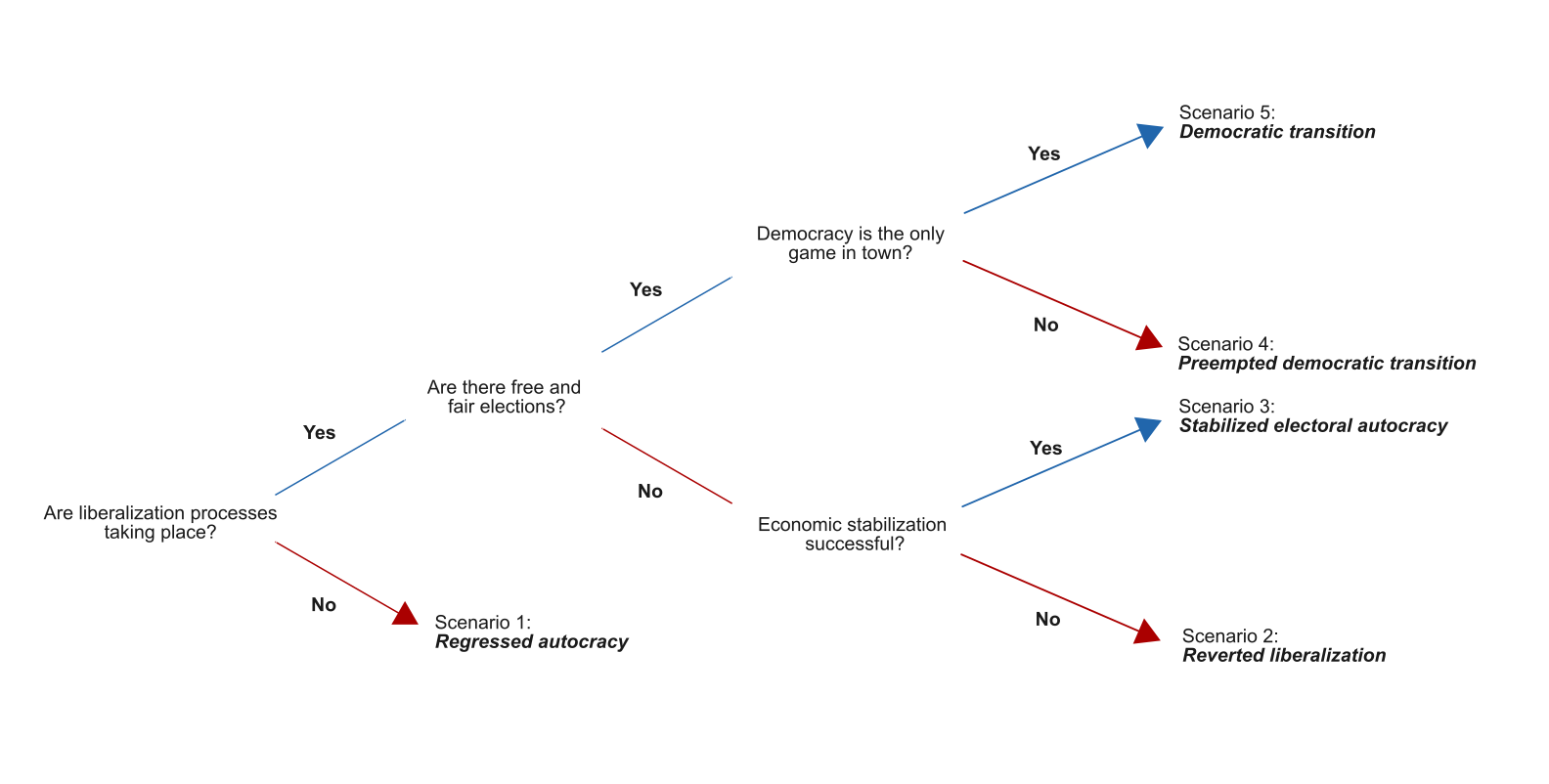
This framework presents five scenarios: two ugly ones (scenarios 1 and 2), two bad ones (scenarios 3 and 4), and only a good one (scenario 5).
Within the regime, we can identify reformers, more open to economic liberalization, and revolutionaries, who rely on repression and seek to maintain the status quo. In the opposition, there are radicals who promote protests and similar tactics to try to overthrow the regime, and moderates who believe in negotiations with the government.
Revolutionaries within the government and radicals within the opposition serve as veto players that can push toward one of the bad or ugly scenarios, depending on how much agency a given group within each faction will have at a given time.
The good outcome, the only genuinely positive scenario, would emerge from negotiations between moderates within the opposition and reformers within the regime.
Scenario 1: Regressed Autocracy (the Closed Door)
Under this outcome, there is no political liberalization and Venezuela moves closer to the most autocratic regimes in its history. One could imagine a hardline military junta or a chavista revolutionary taking control of the government, more likely by overthrowing Delcy Rodríguez and her brother. The regime would abandon the electoral facade entirely and move towards a one-party state like Nicaragua or Cuba. Warning signs would include military infighting, the breakdown of basic state services, and widespread political violence. This is, without a doubt, the ugliest scenario.
Scenario 2: Reverted Liberalization (the Fragile Spring)
Initial openings collapse under economic failure or elite backlash, like what happened in 1948, because reforms become too threatening to military power or economic elites. This may be one of the more likely scenarios, given how powerful these interests are. It might present another electoral fraud like the one on July 28, 2024.
Scenario 3: Stabilized Electoral Autocracy (The Branch on Steroids)
The default outcome under the current context has no clear parallel in Venezuela’s history: a new equilibrium, more economically liberal but politically limited form of competitive authoritarianism. We might see concessions in certain elections, neither free nor fair, but the Rodríguez regime is able to convince the Trump administration that it represents a better option for avoiding chaos and securing oil production and the interests of foreign investors, crossing a narrow window of opportunity to remain in power. It could bring modest economic improvements plus continued repression and emigration. The permanence of what Raúl Stolk branded The Branch.
Scenario 4: Preempted Democratic Transition (the Glass Ceiling)
Similar to 1971-1974 Argentina, when democratic consolidation was interrupted with a coup. In this scenario, Edmundo González or María Corina Machado win a snap election but face a deep state that remains fundamentally chavista, from the Supreme Tribunal to security forces, that sabotage the elected government. The economic crisis also frustrates the population and splits the ruling coalition. Electoral gains would not translate into effective governance, nor into the consolidation of a democratic regime. According to the V-Dem Institute, in low-rated electoral autocracies attempting liberalization, this is a relatively likely outcome.
Scenario 5: Democratic Transition (the 1958 Moment, sort of)
If one answers “yes” to all the questions in the decision tree, then one arrives at this scenario similar to Venezuela’s transition to democracy between 1958 and 1961, Chile’s from 1988 to 1990, or Spain’s between 1975 and 1982. This is where it gets interesting. Unlike the previous examples of a pacted transition, where free and fair elections take place and democracy is consolidated, this will look more like a supervised transition after the regime received enough pressure, mainly from the United States. In this scenario, the opposition finally reaches power and remains united. There’s a favorable international context and a successful institutional rebuilding. Veto players from both the regime and the opposition are unable to spoil the process and economic stabilization offers a glimpse of a better future.
It would be crucial to stabilize politically and recover economically before entering a negotiation that would lead to a democratic transition. Venezuela would have to beat the odds to produce another 1958 moment, requiring the alignment and coordination of multiple conditions simultaneously. The institutions in 2026 are far more degraded than they were back in 1958.
One element left out of this analysis is the criminal dimension of the Venezuelan regime. Current autocratization and democratization models are largely based on the third wave of democratization and earlier periods, and they usually do not address how to overcome this challenge.
If this scenario—the only genuinely good one in this analysis—were to materialize, we would see not only economic recovery but also migration reversal and regional reintegration. This could also open the door to a successful constituent assembly aimed at reforming the state toward a more constrained executive, clear military subordination to civilian authority, and the establishment of a transitional justice framework. This scenario goes more in line to the best scenario previously outlined by Caracas Chronicles editors last November.
A clearer picture of the outcomes
Under the current circumstances, elections themselves are not as decisive as elite commitment and coordination around a reinstitutionalization process. The most likely scenarios are either a preemptive democratic transition or a stabilized electoral autocracy. Beyond that, a reverted liberalization could take place, and even a regressive autocracy scenario remains plausible. The good scenario of a full democratic transition is the least likely outcome.
We must pay attention to the behavior and cohesion of the security and military sectors, opposition unity and effectiveness, economic policy choices and oil revenue management, coordination—or lack thereof—within the international community, and, finally, chavista elite defection versus cohesion. Ultimately, the questions laid out in the decision tree represent concrete choices made by Venezuelans. Outcomes will be shaped by the decisions of elites, but also by society as a whole.
The ERT framework reminds us that episodes are fragile, reversible, and contingent. The future is not written, and developments can unfold in between these episodes. This third figure illustrates how these scenarios might unfold over time.
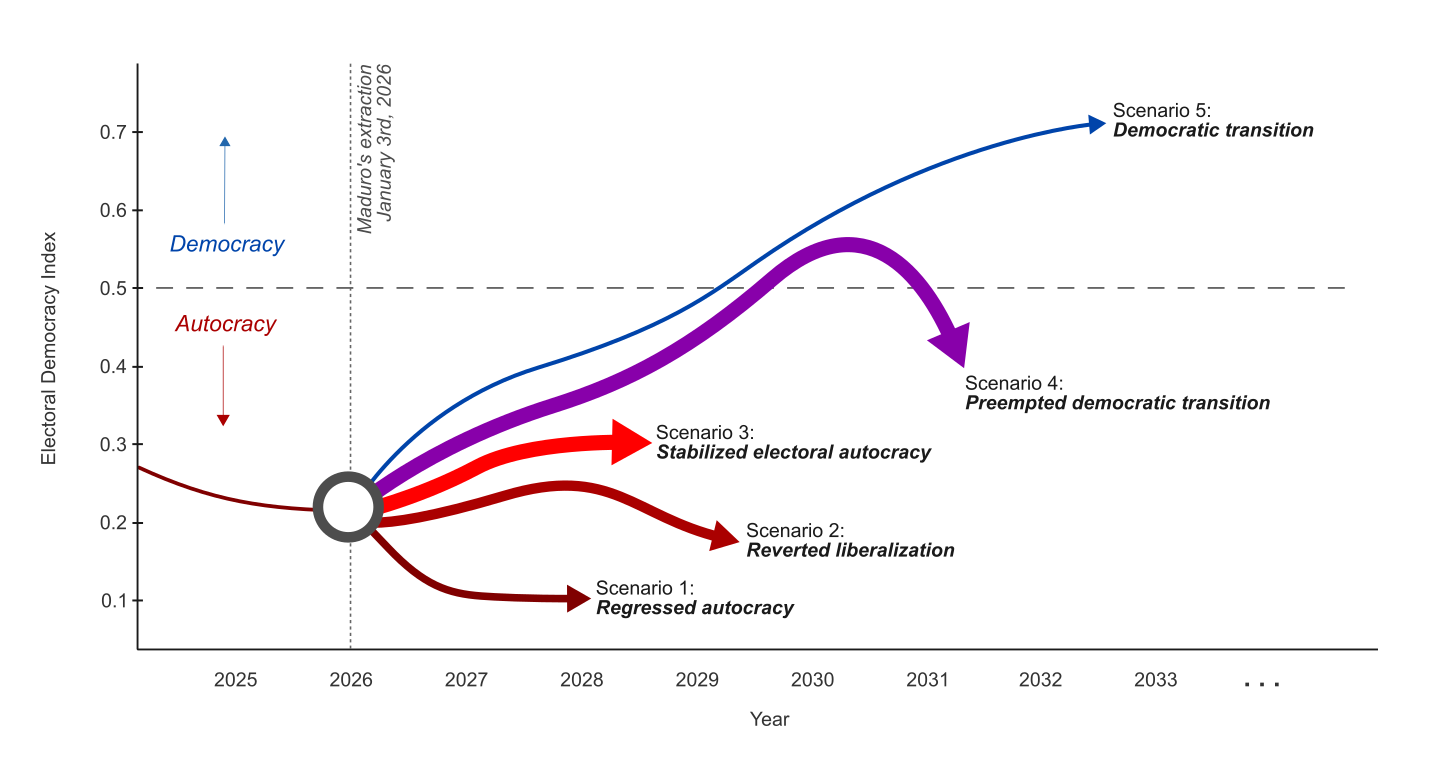
Within this framework, regime transformation processes do not happen quickly; they are measured in years. Democratic transitions tend to be—in average— the longest processes, but also the least likely in Venezuela’s current conditions, reflecting how fragile democracy truly is. By contrast, regression, destabilization, or regime breakdown can occur much more rapidly.
The likelihood of these scenarios may change in the near future as circumstances evolve, but the framework itself still stands. The results from one of these five episodes are more likely to materialize in the medium to long term, that is, within one to five years.
In the end, agency and choices matter enormously and can be influential in shaping a desired outcome. If María Corina Machado aims to lead the country towards democracy, there are actions she must take carefully in order to influence the outcome. While Venezuela is currently trapped in a borderline closed autocracy, any liberalization gate that opens represents an opportunity that must be seized by the democratic forces. One element left out of this analysis is the criminal dimension of the Venezuelan regime. Current autocratization and democratization models are largely based on the third wave of democratization and earlier periods, and they usually do not address how to overcome this challenge. In this context, we can approximate criminal gangs as veto players, insofar as the nomenklatura allows them to operate as such. If the rule of law were to return, this would mean their role as veto players would be significantly diminished.
First Appeared on
Source link