


Italy’s investigation into ‘human safaris’ in Sarajevo calls in first suspect | International
The investigation in Italy into alleged organized trips to the Serbian siege of Sarajevo during the Bosnian War in the 1990s, in which Italian and other European citizens paid to shoot civilians from the city’s hills, has its first suspect. According to several Italian media outlets, the Milan Attorney General’s Office, which opened proceedings last November following a writer’s complaint, has formally registered as a suspect an 80‑year‑old former truck driver who lives in Pordenone, a city in the northeast near the Slovenian border. He has been summoned to testify next Monday.
The Carabinieri have also searched the suspect’s home, and he is under investigation for the alleged crime of repeated voluntary homicide. Seven legally owned weapons were found in his house: two handguns, a rifle, and four shotguns. In the past, he worked for a metalworking company, and during the war — according to testimony gathered by prosecutors — he allegedly boasted of having “hunted men” in Sarajevo.
The prosecutor’s order, according to Italian media, states that the suspected crime is that “in collusion with other individuals still unknown,” and following “a single criminal plan,” he caused the death of “defenseless civilians, including women, the elderly, and children, by firing sniper rifles from the hills surrounding the city of Sarajevo.” Prosecutors are also considering an aggravating circumstance of “abhorrent motives.” According to Italian outlets, the investigation is also being pursued in France, Switzerland, and Belgium, as participants in the sinister trips came from several countries.
The Italian media reports indicate that the prosecution alleges that, “in collusion with other, as yet unknown, individuals” and with “a single criminal plan,” he caused the deaths of “defenseless civilians, including women, the elderly, and children, by firing sniper rifles from the hills surrounding the city of Sarajevo.” The prosecution is also considering the aggravating circumstance of “abject motives.”
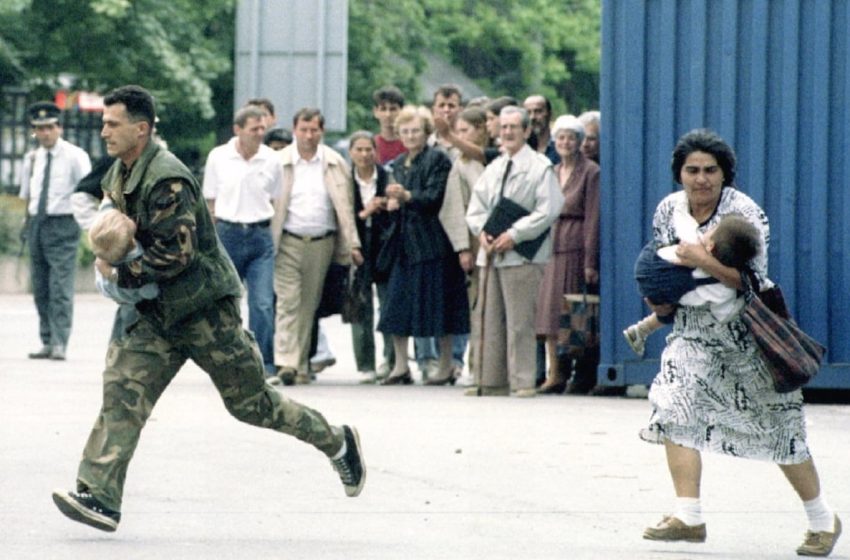
Sarajevo was besieged from 1992 to 1996 by Bosnian Serb militias during the war in Bosnia, which made the so‑called Sniper Alley tragically famous — a street residents had no choice but to cross, where they were shot at from the surrounding hills. It is estimated that more than 11,000 civilians were killed in this way.
The Attorney General’s Office acted after receiving a 17‑page complaint from the Italian writer and journalist Ezio Gavazzeni, who had been gathering information about something that had circulated as a rumor for years. He was supported by the respected former magistrate Guido Salvini — who previously investigated the Red Brigades, Italian neofascist terrorism, and the secret military network Gladio — and by the lawyer Nicola Brigida, who handled judicial cases involving Italian citizens who disappeared under the dictatorships in Argentina and Chile, as well as several major attacks during Italy’s Years of Lead.
Rumors about these so-called “human safaris” crystallized in 2023 in Sarajevo Safari, a documentary by the Slovenian filmmaker Miran Zupanič, which collected testimonies and offered clues about these macabre trips. The premise is that ordinary citizens, passionate about firearms, hired this service and, according to the complaint, traveled to Sarajevo on flights from Trieste to Belgrade operated by the Serbian airline Aviogenex. To act as weekend snipers, they allegedly paid the equivalent of between €80,000 ($94,000) and €100,000 ($118,000), according to the initial hypotheses of the investigation. Shooting at children cost even more. Initial reports mentioned a Milanese businessman who owned a private cosmetic clinic, as well as citizens from Turin and Trieste.
The strongest indication of the existence of these human safaris was the testimony of a former Bosnian intelligence agent during the war, Edin Subasic, who also reiterated his statements to EL PAÍS. He explained that they first obtained reliable information about this activity after interrogating a Bosnian Serb prisoner. They then informed SISMI, the Italian intelligence service, which a few months later — in March 1994 — told them the matter had already been closed. Italian security forces had discovered the route used by these war tourists — flying from Trieste to Belgrade and then traveling overland to Sarajevo — and had shut it down. In other words, there may be official files in Italy containing further information on the matter.
After the investigation in Milan was opened, an official testimony from Italy emerged for the first time confirming these details. Michael Giffoni, who served as the number two at Italy’s diplomatic mission in Sarajevo during the war and later became the country’s first ambassador to Kosovo, said in an interview in November that the human safaris did indeed happen and corroborated the former Bosnian agent’s account: “Subasic isn’t making anything up,” he said.
The Croatian investigative journalist Domagoj Margetic also filed a complaint in Milan, accusing Serbia’s current president, Aleksandar Vucic, of having taken part in shootings against civilians. He claimed that Vucic — who during the Bosnian war was secretary‑general of the Serbian Radical Party (SRS) — volunteered between 1992 and 1993 during the siege of Sarajevo and was present at Bosnian Serb militia positions in the Jewish cemetery. According to Margetic, this was precisely one of the spots where so‑called war tourists were taken to fire at civilians in exchange for money. Vucic, for his part, denied the allegations: “I have never killed or injured anyone, nor done anything of the sort. They have lied about me being a sniper in Sarajevo for 10 or 20 years, and they keep lying.”
Sign up for our weekly newsletter to get more English-language news coverage from EL PAÍS USA Edition
First Appeared on
Source link






