


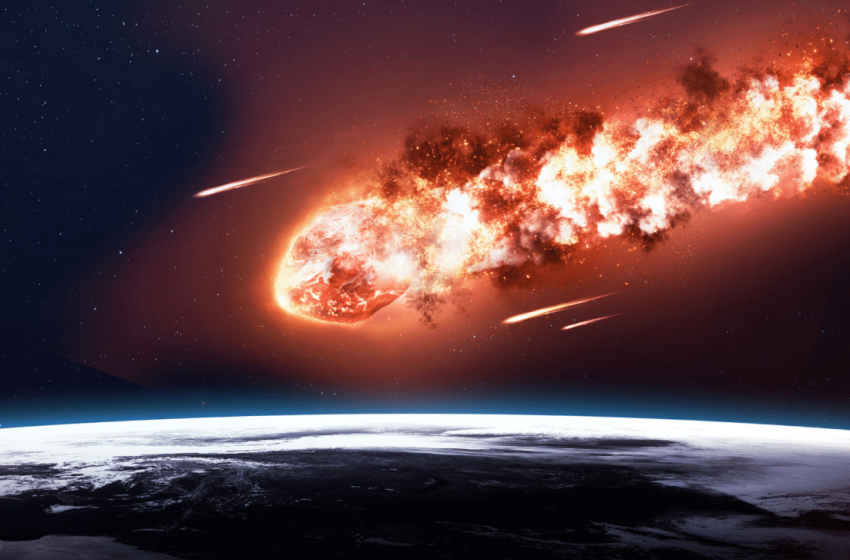
Asteroid Nuking Could Save Earth and It’s No Longer Just Sci-Fi!
In the ever-growing concern about asteroid collisions with Earth, a new study published in Nature Communications offers a breakthrough in understanding how to defend our planet from a potentially catastrophic impact. For years, the idea of using nuclear weapons to deflect an incoming asteroid seemed more like something out of a disaster movie than a realistic solution.
However, recent research by physicists at the University of Oxford and the Outer Solar System Company (OuSoCo) suggests that nuking an asteroid might be more effective than we once thought. The study, which involves the irradiation of meteorite samples to observe their stress responses, could change how we approach planetary defense in the future.
The Strengthening of Asteroids Under Stress
One of the key findings of this groundbreaking research, published in Nature Communications, is that asteroids, when impacted by force, do not necessarily fragment as previously believed. In fact, they may actually grow stronger under stress, which has huge implications for how we plan to defend Earth from an asteroid strike. The study’s focus on understanding how different types of space rocks respond to external pressure is essential for refining deflection methods.
“These analyses are intended to examine changes in the meteorite’s internal structure caused by the irradiation and to confirm, at a microscopic level, the increase in material strength by a factor of 2.5 indicated by the experimental results,” explains Melanie Bochmann, co-founder of OuSoCo and co-leader of the research team.
This insight challenges traditional ideas about asteroid behavior. Previous assumptions suggested that nuclear explosions would likely break apart a threatening asteroid into smaller, more dangerous fragments. However, the latest findings suggest that, under certain conditions, an asteroid may hold its integrity even when subjected to extreme forces, reducing the risk of fragmentation upon nuclear impact.
This discovery is based on a detailed experiment using a sample of the Campo del Cielo iron meteorite, one of the oldest and most studied meteorites. By subjecting this sample to high-energy proton pulses at CERN’s High Radiation to Materials (HiRadMat) facility, the researchers observed a significant shift in the material’s properties. The meteorite softened under stress, but surprisingly, it then re-strengthened, displaying a quality known as strain-rate dependent damping. This characteristic means that the harder the meteorite is struck, the more effectively it dissipates the incoming energy, ultimately making it harder for the material to break apart.
A New Era for Planetary Defense
This research not only provides valuable data about asteroid resilience but also has profound implications for how we might approach planetary defense in the future. Until now, most asteroid deflection strategies, such as the NASA DART mission, focused on kinetic impactors—large spacecraft designed to collide with an asteroid and change its trajectory. However, this method carries significant risk: hitting the asteroid in the wrong spot could do more harm than good, either delaying its path or causing unintended fragmentation.
In light of the new findings, nuclear deflection has become a more viable alternative. Instead of detonating explosives on the asteroid itself, researchers propose the idea of performing a “stand-off” nuclear detonation, where the explosion takes place nearby, vaporizing part of the asteroid’s surface and altering its orbital trajectory. This concept may sound like science fiction, but it’s now supported by experimental data showing that asteroids can withstand far more than we initially thought.
“This is the first time we have been able to observe – non-destructively and in real time – how an actual meteorite sample deforms, strengthens and adapts under extreme conditions,” says Gianluca Gregori, a physicist at the University of Oxford and one of the study’s co-authors.
This ability to observe real-time changes in the meteorite under stress could help fine-tune the strategies for a successful nuclear deflection mission, providing insights that were previously unavailable through destructive testing.
Challenges Ahead: The Need for Confidence in Nuclear Deflection
Despite the promising findings, the study also highlights significant challenges in applying these new insights to planetary defense. According to Karl-Georg Schlesinger, co-founder of OuSoCo, “The world must be able to execute a nuclear deflection mission with high confidence, yet cannot conduct a real-world test in advance. This places extraordinary demands on material and physics data.” In essence, the stakes of conducting a real-world nuclear deflection mission would be enormous. With no way to test these strategies in advance on an actual asteroid, scientists must rely on precise data and simulations to ensure the approach works.
The need for more research and experiments in the field of planetary defense is clear. While nuclear deflection might one day be our best option, there’s still a lot of work to be done to understand all the variables involved. Different types of asteroids, made from various materials, will react differently to stress. Understanding these variations is crucial for developing the best deflection techniques. As the study shows, asteroid deflection isn’t a one-size-fits-all solution, it requires a deep understanding of the materials involved and how they respond to extreme conditions.
First Appeared on
Source link






