


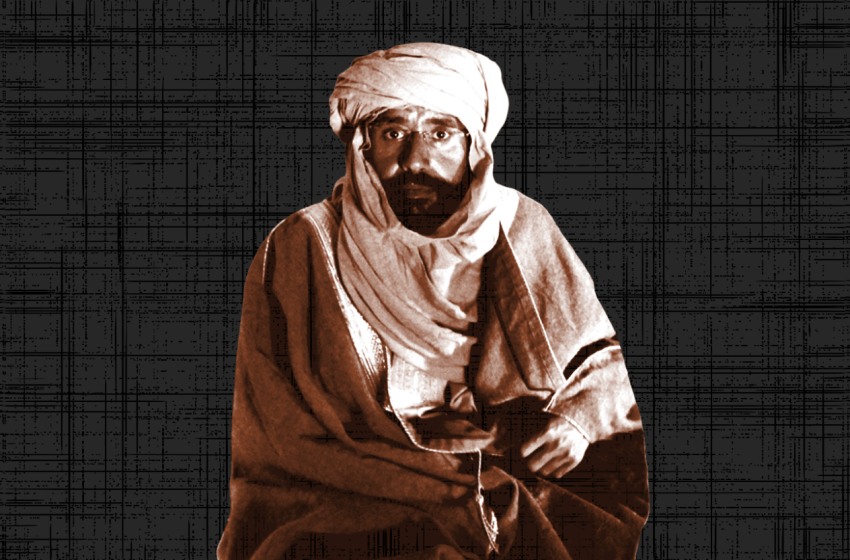
Saif al-Islam: The death of a myth
Saif al-Islam Qadhafi eluded death at least twice.
The first time came in 2011. His brothers, Saif al-Arab and Khamis, were killed in strikes launched by the North Atlantic Treaty Organization (NATO) targeting figures in the regime of Muammar Qadhafi. Saif al-Islam had nearly met the same fate as his convoy fled the Libyan city of Bani Walid, the Qadhafist stronghold that fell to advancing revolutionaries at the time. But he escaped, with a mangled hand that would later need extensive surgery.
The second time came after he was captured by Zintani militias, as he was decked out in Bedouin garb trying to make his way to Niger. Sentenced to death by firing squad for his incitement and direction to kill protesters, Saif sat in a jail in the Zintan mountains for nearly five years, as Libya’s city states fought over jurisdiction, control and access to key state revenues, and Zintan refused to hand him over to authorities in Tripoli. Death was evaded this time by befriending the colonel in charge of keeping him in prison, Ejmi al-Atiri, who saw in him a “savior,” but more realistically, as a way to exploit shifting rivalries in Zintan and with Libyan National Army strongman, Khalifa Haftar, his nominal ally. In 2017, Saif walked free.
But Saif’s luck ran out on Tuesday night. He was killed in Zintan, southwest of Tripoli, where he has moved like a ghost for so many years, and where he had become a cipher for the nostalgia for a unified Libya before the current de-facto divisions and economic erosion of recurrent civil wars plagued the country.
News of his death appeared first on social media.
It was Saif’s political team that first mourned the colonel’s son, writing on Facebook that he was killed “in a treacherous and cowardly assassination carried out by criminal hands at his home in Zintan.”
“Four treacherous masked men” stormed Saif al-Islam’s residence and “desperately switched off the security cameras in a pathetic attempt to conceal their heinous crime,” reads the statement. “The martyr then engaged them in a direct and heroic confrontation, facing them head-on, until God chose him to be with Him as a martyr and a witness to the tragedy of a nation.”
The statement called Saif’s death “an assassination of the chances for peace and stability in Libya,” emphasizing that this crime “will not go unpunished, and all those involved in planning and executing it will be pursued and held accountable.” The political team called on Saif ’s supporters throughout Libya “to exercise restraint, wisdom, and patience,” urging them to adhere to his national project and remain steadfast in their principles to respond to the killers.
And then early on Wednesday morning, Libya’s Attorney General announced that an investigation team, accompanied by forensic doctors, had visited the crime scene and examined the deceased body, confirming he had been killed by gunshot wounds.
“The investigation team is searching for and investigating evidence, identifying the circle of suspects involved in the crime, and initiating the necessary procedures to file a public prosecution against them.”
Aqeela al-Jamal, head of the Social Council of the Warfalla tribes, told Mada Masr that Saif’s body will be transferred to his hometown of Sirte for burial, after members of the Qadhadfa tribe arrive to receive the body from Zintan.
Saif’s story, who he was before the revolution and who he became up until his death on Tuesday, is a microcosm of the unity and disunity that Libya has cycled through in the 15 years since the February revolution broke out. The most public face of the Qadhafists, members of the former regime who have now fragmented off into rival camps, he represented many things. For those too young to remember the violence he and his family unleashed, his ascent to power could have been interpreted as return to a united Libya. For those in the Green Movement, adherents to Muammar Qadhafi’s political ideology, he represented a return to dominance from under the boots of what became the more powerful Libyan camps. And for those looking to use the former regime to prop up some national unity campaign, he was a powerful voice of legitimacy.
But now he is dead, and these hopes — many of them rooted in the myth that Saif himself worked so hard to cultivate — are now gone.
***
Saif emerged into the public eye in Libya leading negotiations to improve his father’s regime’s image. He spearheaded talks with senior regime officials in 2004 that resulted in a reconciliation with major Western powers, including the United States and France. This followed the Qadhafi regime’s admission in 2003 of responsibility for the Pan Am bombing over Lockerbie, Scotland, and the UTA Flight 773 bombing over Niger in the late 1980s, attacks that led to a decade-long embargo on Libya.
Subsequently, Saif spearheaded a reform project for his father’s regime, dubbed “Libya of Tomorrow,” which began in 2006 with reconciliation with Islamists, the establishment of new media outlets and the drafting of a constitution with the participation of experts from the United States, France and Britain. The Gaddafi International Foundation for Charity Associations was also established, managing a network of civil society organizations. The project ended under mysterious circumstances in 2010, months before the start of the February 17th Revolution.
When the revolution broke out, it was some of these same reformists who took to the streets. Mahmoud Jibril, for example, led the revolutionary National Transitional Council’s foreign relations before becoming head of the council’s executive office.
A few years prior, Jibril was head of the parliamentary National Planning Council of Libya and the country’s National Economic and Social Development Board, working closely with Saif.
It was this period that made Saif a divisive figure within Qadhafist currents after the revolution.
“A significant share [of the Qadhafists] never forgave him for the ‘liberalization’ agenda he pushed in the early 2000s, nor for the limited reforms and outreach to Islamists and opposition figures he spearheaded. For many, that approach is seen as a direct precursor to the regime’s collapse in 2011,” Emadeddin Badi, a senior fellow at the Global Initiative against Transnational Organized Crime (GI-TOC), told Mada Masr.
Infamous rivers of blood speech, February 2011.
But whatever reforms Saif had carried out, the revolution was a turning point for him. He was determined, along with his brothers and father, to crack down on the protests.
In the early days of the February revolution, Saif made a highly controversial nationally televised speech threatening protesters with violence.
“We now demand, as a final solution, and before it’s too late, and before we all resort to weapons.. Five million Libyans will take up arms. Libya is neither Tunisia nor Egypt. My brothers, we are made up of tribes and clans, and we will take up arms. Arms are now within everyone’s reach. Instead of mourning for 84 killed, we will mourn hundreds of thousands of deaths. Blood will flow, rivers of blood, across all of Libya’s cities. And you will leave Libya. Oil flows will stop,” Saif said.
“Tomorrow, foreign companies will leave Libya, foreigners will leave Libya, oil companies will leave Libya, oil facilities will stop, and by tomorrow, there will be no more petrol. There will be no more money and we will not be able to find bread. Today, bread in Bayda costs 1.5 dinars. In a week, it will cost 100 dinars. And in a year, bread will be worth the price of gold in Libya. So I appeal to you, and for the last time, before we invoke the rule of weapons, if things spiral out of control and we enter a civil war, secession and rampant chaos, as they want to happen in Libya. So before we resort to this, and every Libyan is forced to take up arms and defend themselves, and blood is shed, I say: Either prepare yourselves, Libyans, to enter into confrontations, for Libya to be divided piece by piece, to enter a civil war. Prepare to forget all about oil or gas. Gas and oil pipelines will be destroyed. There will be chaos. What is happening now in Barga will happen everywhere else in Libya. Forget all about education and healthcare for your children. Because what is happening today in Barga, in Bayda, in Shahat, in Benghazi, is very sad.”
But the protesters did not stop and the regime doubled down.
The Qadhafi family sent death squads of foreign mercenaries to patrol the streets of Tripoli and shoot at groups of people who ventured out.
As early as February 24, the International Federation for Human Rights said that the Qadhafi regime was “implementing a strategy of scorched earth. It is reasonable to fear that [Muammar Qadhafi] has, in fact, decided to largely eliminate, wherever he still can, Libyan citizens who stood up against his regime and furthermore, to systematically and indiscriminately repress civilians. These acts can be characterised as crimes against humanity, as defined in Article 7 of the Rome Statute of the International Criminal Court.”
A few months later, in June, an arrest warrant for Saif was issued.
After the regime’s collapse, Saif attempted to flee to Niger, but he was captured near the city of Ubari in southwestern Libya by an armed group from Zintan.
They detained him in the city and refused to hand him over to the Tripoli Public Prosecutor’s Office for trial. He appeared before the court only three times via video link before being barred from attending the proceedings.
The trial resulted in a death sentence in 2015.
Meanwhile, the country was facing sharp polarization. The Libyan National Army, under the leadership of former Qadhafi military commander Khalifa Haftar, was consolidating more territory in a nominal bid to stomp out Islamist rivals.
After a prolonged three-year battle, Haftar, quickly becoming a dominant force in eastern Libya but locked in a battle for dominance with the UN-backed Government of National Accord in Tripoli, took full control of Benghazi.
Groups across Libya, however, looked at the general’s quest for consolidation with skepticism.
One of those groups happened to be the Abu Bakr al-Siddiq Battalion in Zintan. The battalion was nominally aligned with Haftar’s forces and the wider Zintan military council, but made the strange decision to release Saif in 2017.
The armed group said it released Saif at the request of the eastern-based transitional government, which had offered him amnesty earlier.
The move, however, was met with a fierce rebuke from the Zintan Military Council, which ordered the brigade to dissolve.
The release began a new chapter for Saif. From 2015, prior to his release, until 2021, Saif communicated with the Libyan people primarily through his political team or via recorded speeches and written statements. He rarely appeared in public. He only appeared publicly twice, in photographs and videos taken in the Libyan desert.
His retreat from the limelight served multiple purposes.
On one hand, he still had many local rivals who looked at his release as a travesty of justice for the protesters his family had slain during the revolution, and individual retribution was a real risk. Toward that end, members of the former Abu Bakr al-Siddiq Battalion, the same battalion that held him captive before, took up a security detail to protect him. Reminiscing fondly about his former captive, Atiri told the press in 2022 that Saif had developed a passion for camping and nightly rides in the desert, and that his leisure time was limited to hunting and reading.
Saif also represented a threat to other local actors, even if in a largely symbolic way, given that different corners of the Green Movement still looked to him in one way or another and he enjoyed a semblance of international support.
“A segment [of Qadhafists] either remained ideologically committed to the Qadhafi family or was pragmatic enough to recognize that he was the only figure who could ‘salvage’ Qadhafi-era networks, without forcing them into subservience to the status quo actors,” Badi says.
The failure of the LNA’s war on Tripoli in 2020 opened a new chapter of political transition, led by a newly mandated Government of National Unity which was to steer the country to presidential elections by the end of 2021.
In the leadup to the elections, there was significant speculation that Saif would throw his hat in the ring and was being prepared by Russia.
Bloomberg reported in 2020 that Yevgeny Prigozhin, a confidante of Russian President Vladimir Putin at the time who now heads the Wagner group, dispatched consultants to work alongside Saif, and that some Western diplomats have come around to viewing the former regime leaders as future players.”
“Saif retained value as a fallback option for Moscow, especially given persistent Russian caution toward Haftar due to his US ties, CIA history and American citizenship,” Badi added. “More importantly, he carried a residual popular appeal that many status quo actors lacked — sustained by nostalgia, his long disappearance from the scene and Libya’s youthful population, which made him a convenient projection screen for constituencies fed up with entrenched elites.”
But ultimately, the Russian bet was on the Qadhafist networks, not on Saif himself, especially in the wake of Haftar’s major setback in failing to take the capital.
After 2020, many Qadhafits were co-opted into the two dominant groups ruling the country: Abdul Hamid Dbaiba largely through business and political networks post-2020, and Khalifa Haftar, predominantly through military networks and former intelligence figures, although Haftar had begun incorporating Qadhafists as far back as when he launched Operation Dignity, the 2014 large-scale anti-Islamist campaign.
“In both cases, the underlying logic was incorporating them under their hierarchy, with implicit ambitions to rule over and dominate those networks, rather than to empower them as autonomous political stakeholders,” Badi says. “For Green constituencies, the prospect of Saif one day rising to power remained something to look forward to, as a pathway to becoming the ones dominating, rather than being dominated by the prevailing order.”
When Saif decided to submit his paperwork to run in the 2021 election, many Qadhafists rallied behind him. “That support was then leveraged through his name, and at times through claims of representing him, as a vehicle to secure recognition and seats for Qadhafi-era constituencies in political dialogue and reconciliation forums.”
But Saif himself was also leaning into his own grandeur. In a long sitdown with the New York Times, which included theatrically stylized photographs of the former dictator’s son, Saif is framed as a fortuneteller, his 2011 “rivers of blood” speech presented as a prophecy of the destruction that would come to Libya.
Saif’s candidacy was never really about himself, however, nor was that the reason anyone saw him as a threat.
“He did not possess any political movement or power,” Libyan researcher Hisham al-Shalawi says.
Badi says that Saif’s threat rested more on his ability to pull “segments of the Green constituency out of [Haftar and Dbaiba’s] orbit and reconstitute an alternative hierarchy of patronage outside of their control. The network element mattered in its own right,” even if it was reinforced by Saif’s personal attributes: his opportunism, his selective engagement with the international press, his signalling of autonomy away from a compromised elite, he says.
In the end, however, the intentionally far-fetched elections ultimately never occurred. And Saif continued to roam the mountains, the subject of speculation and fantasy.
***
Before his death, Saif’s role had been significantly marginalized. He “lacked the power or the fangs to count in the Libyan political, security and military equation,” Shalawi says. “This balance of power has narrowed down to two main factions: the Government of National Unity, headed by Dbaiba and supported by the largest military force in the western region, represented by the city of Misrata and the General Command of the Libyan National Army, led by Haftar, which controls eastern and southern Libya and possesses heavily armed forces with substantial external support.”
In the weeks leading up to Saif’s death, the security situation in Zintan was becoming hostile to him. On January 9, the Elders and Notables of Zintan Municipality issued a statement warning “those who represent or support Saif al-Islam Qadhafi against entering the city of Zintan. The supporting parties and tribes will bear full legal responsibility for any consequences resulting from this.”

Zintan elders announcement.
This was followed by statements from Abdullah Allah Naker, the head of the Qimma Party, who hails from Zintan and has an increasingly close relationship with Dbaiba, calling for Saif to be arrested.
This hostility may have caused a change in Saif’s security detail. On Tuesday night, when his house was attacked, he was not with his normal guard, a source in the Attorney General told Mada Masr.
Shalawi reads the ease with which Saif was killed as a sign that Russia had abandoned him, after Wagner forces had protected him for a time and facilitated his travel from Zintan to Sabha.
But as for the implications, both Badi and Shalawi agree that Saif’s death likely means fragmentation for the Green Movement.
“I expect the alliance surrounding Saif al-Islam to unravel, whether those angered by the February revolution or those who saw their political and economic interests served by it,” Shalawi says. “They will scatter in multiple and different directions, because they lack major political blocs or social movements capable of sustaining themselves once the institution or its leader dies or disappears. The entire process is tied to individuals, unless there is massive international investment, as is the case with Haftar in eastern Libya.”
For Ahmed Hamza, the head of the Libyan Foundation for Human Rights, Saif’s death could stymie international efforts to reunify Libya.
“Supporters of the former regime were involved in the political process in Geneva and are currently participating in the structured dialogue within the new UN mission, as well as in the national reconciliation process sponsored by the African Union and the United Nations,” Hamza says. “We needed to leverage Qadhafi’s legacy to influence his supporters, and supporters of the former regime, to support reconciliation and national peace, which would positively impact the overall situation in Libya and allow them to play a constructive role in reaching a settlement.”
One thing is clear, however.
“The legend of Saif al-Islam,” Shalawi says, “has ended, and with it, the movement that rallied around him.”
First Appeared on
Source link







