


The Lost Tomb of Legendary Viking “Ivar the Boneless” May Have Finally Been Found on the English coast
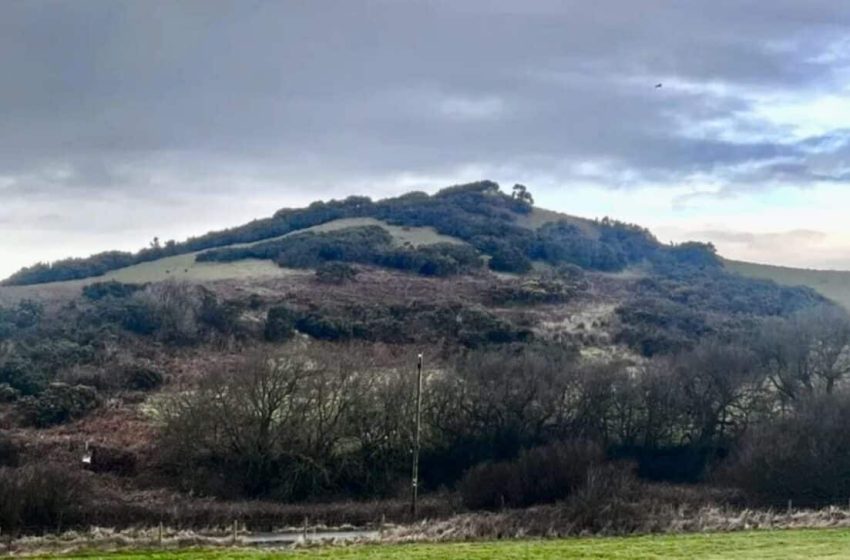
A large earthwork on England’s northwest coast may hold the remains of Ivar the Boneless, a 9th-century Viking commander known for leading devastating military campaigns across Anglo-Saxon England. The unexcavated site, situated in Cumbria near the Irish Sea, has become the focus of growing archaeological interest following research that aligns physical features of the landscape with longstanding historical accounts.
The discovery centers on a prominent mound matching the dimensions and placement of high-status Viking burials. It is surrounded by smaller burial mounds and has yielded early indications of maritime and commercial activity consistent with elite Norse presence in the region.
Researcher Steve Dickinson, who identified the site through a combination of medieval manuscript analysis and non-invasive fieldwork, believes this may be the strongest lead yet in the search for Ivar’s lost grave. Although excavation has not yet begun, the combination of literary references, topographical characteristics, and artifact recovery has drawn attention from scholars of Viking Britain.
Historical Records Align with Topographical Analysis
Dickinson’s work links the mound to a location mentioned repeatedly in Icelandic sagas and Anglo-Saxon sources as Coningeshou, or “The King’s Mound.” Measuring approximately 60 meters in diameter and rising six meters above sea level, the site fits the typical size and form of Norse ship burials, which often involved interring a vessel containing weapons, regalia, and ritual offerings beneath a constructed mound.
The placement near the coastline further supports its potential as a burial for a seafaring figure. Ship burials were typically reserved for high-ranking individuals in Viking society and were intended to reflect their status both in life and in death.

In addition to the main mound, BBC News reported that 39 smaller surrounding mounds may have housed the remains of companions, family members, or honor guards. This layout mirrors elite Norse necropolises identified in Scandinavia, where proximity to the central grave denoted status within a ruler’s inner circle.
Artefacts Signal Elite Viking Maritime Activity
Initial surveys have uncovered iron ship rivets, lead weights used in silver trade, and proximity to a previously discovered hoard, all of which support the theory that this area served as more than a simple burial ground. The presence of large rivets, in particular, points toward a wooden vessel having once occupied the site, in line with other ship burials documented in Viking-era Scandinavia.
While no excavation has been carried out, Dickinson has indicated plans to conduct ground-penetrating radar scans in the coming months. These scans would help determine whether subsurface features match the structural outline of a buried ship or chamber, providing critical evidence before any physical intervention is considered.
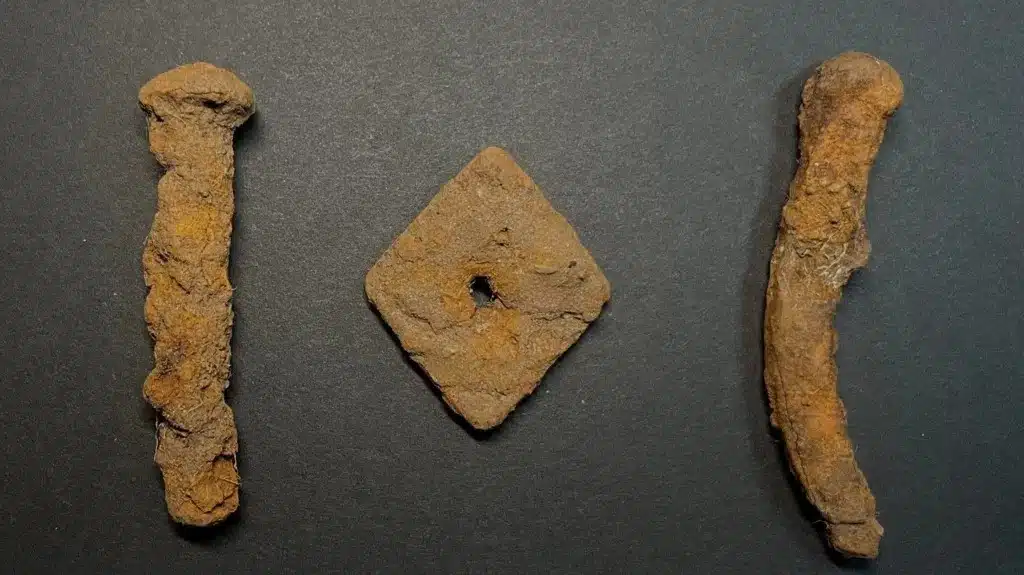
In an interview cited by the BBC, Dickinson emphasized that the discovery is consistent with both literary descriptions and archaeological expectations for a royal Norse burial. He noted that “very large ship rivets” and weights used to measure out a silver hoard had been found nearby, strengthening the case for a site of substantial cultural and material wealth.
Ivar the Boneless: Myth, History, and Unresolved Legacy
Ivar Ragnarsson, known as Ivar the Boneless, was one of the most prominent leaders of the Great Heathen Army, a coalition of Viking forces that invaded England in 865 CE. His campaigns included the capture of York and a significant role in establishing Norse power in Dublin, where his dynasty endured for generations.
The origin of his nickname remains debated. Old Norse texts use the term beinlausi, which has been interpreted as meaning “without bones,” possibly referring to a disease, an unconventional fighting style, or symbolic metaphor. Resolving this question would likely require examination of physical remains, provided they could be reliably identified.
Efforts to locate Ivar’s grave have previously focused on Repton in Derbyshire, where a Viking mass grave was discovered in the 1980s. Although the Repton site contained remains from the correct period, no definitive link to Ivar has been established.
Dickinson’s focus shifted westward after repeated mentions of Coningeshou appeared in multiple sagas. These references, coupled with matching topographical features in Cumbria, led to his current hypothesis.
Strategic Implications for Viking Studies in Britain
If the Cumbria site is confirmed as a Viking ship burial, it would be the first of its kind ever found in the United Kingdom. Elsewhere in Britain, the most famous ship burial remains Sutton Hoo, an Anglo-Saxon site in Suffolk. Researchers have long noted the absence of comparable Viking burials in the UK, despite abundant historical records of Norse activity.
The discovery would add weight to interpretations of the western Irish Sea coast as an operational hub for Norse forces during the 9th century. It also has potential to shift the focus of Viking studies away from the more heavily researched Danelaw regions of eastern England.
In terms of burial typology, the site would join fewer than twenty documented Viking ship burials across northwest Europe. These rare funerary monuments provide essential evidence for understanding the symbolic and material investments made by Norse communities in commemorating their leaders.
First Appeared on
Source link






