


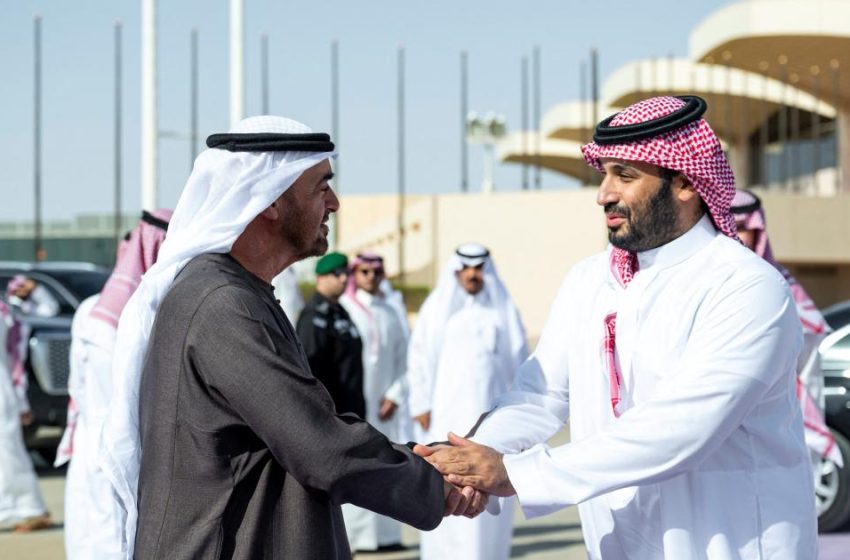
The Real Risks of the Saudi-UAE Feud
A rift between Saudi Arabia and the United Arab Emirates is now plain for the world to see. Tensions were rising last year as the two Gulf monarchies clashed over Yemen, but the underlying animosity spilled out into the open in January, as Saudi media outlets accused the UAE of “investing in chaos” across North Africa and the Horn of Africa and acting as Israel’s stooge in the wider region. The UAE, for its part, has refrained from such public comments, but the latest discord is just the tip of the iceberg.
Riyadh and Abu Dhabi are locked in a broader strategic contest, jockeying over economic, political, and security matters. What was once a friendly competition has devolved into rivalry. The root of their crisis lies in Vision 2030, Saudi Arabia’s grand plan for its future. If the kingdom is to reach the goals set by its de facto leader, Mohammed bin Salman (known as MBS), it must challenge the UAE’s dominance in finance, tourism, and commerce. Neither government has publicly acknowledged this tension, but they are certainly aware of it; such a displacement is, after all, what the UAE accomplished several decades ago when it supplanted Bahrain as the Gulf’s foremost commercial actor.
The Gulf rift probably won’t escalate into a direct war between Saudi Arabia and the UAE or even lesser military actions, such as a blockade. But Riyadh and Abu Dhabi are in an economic conflict at home and in several proxy military battles abroad. Their quarreling will shape the region for the next decade, including how they approach security engagements with Western powers, how they court private-sector investments, and how they choose to engage in several ongoing and brewing regional conflicts.
HEATED RIVALRY
In 2015, when MBS became deputy crown prince and began pulling the levers of the Saudi government, Riyadh and Abu Dhabi were closely aligned on the Middle East’s biggest problems. On a personal level, MBS and Emirati President Mohammed bin Zayed (known as MBZ) got along. The UAE lent support to Saudi Arabia’s military campaign against the Houthis—an Iranian-backed terrorist organization—in Yemen. The two countries championed U.S. President Donald Trump’s “maximum pressure” campaign against Iran. In 2017, they embargoed Qatar together to pressure Doha to distance itself from Iran; to shut down Al Jazeera, a news outlet; and to end its support of the Muslim Brotherhood, a century-old, region-wide movement that promotes a form of political Islam that some Gulf governments find threatening. The brotherhood, for example, supports democracy. (Last month, the United States designated the group a terrorist organization.)
But within a few years, this shared agenda began to show signs of strain. The two countries abandoned their blockade of Qatar, even though Doha’s support for the Muslim Brotherhood and its relationship with Iran had not meaningfully changed. And the Trump administration’s maximum pressure campaign failed to persuade Tehran to moderate its behavior.
In light of these failures, and starting around 2021, Saudi Arabia began diverging from the UAE. It started warming relations with Iran, Qatar, and Turkey. By 2023, it had agreed to a formal rapprochement with Tehran. Senior Saudi officials even started claiming that the UAE had cajoled Saudi Arabia into the blockade of Qatar years earlier.
Saudi Arabia’s shift stemmed from a reassessment of how best to achieve its domestic agenda. MBS originally embraced an adversarial foreign policy that focused on going after countries connected to political Islam. But he eventually realized such an approach was not advancing his paramount objective—achieving Vision 2030, which would see the kingdom wean itself off oil and become a hub for finance, business, and travel. To realize the plan, the kingdom needs billions of dollars in foreign investment, which in turn requires predictability and calm.
Saudi media outlets have accused the UAE of “investing in chaos.”
Saudi Arabia, therefore, is forging warmer ties with its former antagonists not because its view of those countries has changed, but because it now believes accommodating them is a better strategy. Conflict in the Middle East or along the Red Sea risks disrupting trade corridors or spooking foreign investors. In contrast, the UAE remains tethered to the same set of priorities that have driven its foreign policy for much of the last decade. It wants to maintain its regional and global power, which is undergirded by its domestic economic, commercial, and investment prowess, and to prevent the spread of political Islam.
Today, Saudi Arabia and the UAE are at odds over Israel, Sudan, Syria, and Yemen. In most of these arenas, Saudi Arabia prioritizes stability—as long as there is no specific threat to the kingdom—whereas the UAE generally wants to prevent Islamists from gaining ground. In Sudan, home to the world’s worst humanitarian crisis, Riyadh has backed the Sudanese Armed Forces (which the UAE suspects of having Islamist ties), and the UAE has sent money and arms to the rival Rapid Support Forces, although it denies doing so.
Saudi Arabia, meanwhile, has agreed to invest billions in Syria’s reconstruction because it sees its new leader (a former jihadist) as the country’s best shot at stability. But the UAE has offered little money because it is skeptical of the new president’s ability to consolidate power and his willingness to abandon his Islamist roots. And when it comes to Israel, the UAE has quietly increased its commercial and security ties, whereas Saudi Arabia refuses to normalize relations without a pathway to a Palestinian state.
These regional tensions came to a head in late 2025 in Yemen. After years of working together to fight the Houthis there, factions backed by Riyadh and Abu Dhabi descended into infighting. In December, a Yemeni separatist group supported by Abu Dhabi seized territory in Yemen held by Saudi-backed groups. Riyadh retaliated by bombing an Emirati arms shipment, prompting the UAE to withdraw its troops from the country entirely.
TUNNEL VISION (2030)
It is in the interest of both Saudi Arabia and the UAE to publicly downplay their differences to reassure foreign investors that the Gulf is a safe place to put their money. But Emirati-Saudi tensions will probably get worse. The two countries are increasingly competing for investment in the same sectors. Given how much foreign capital Saudi Arabia needs to fulfill Vision 2030, its success is likely to come at the cost of Emirati dominance in finance, technology, tourism, and logistics. Regional and global markets probably can’t support both countries at scale simultaneously.
Emirati leaders are determined not to let the UAE go the way of Bahrain. In 1932, Bahrain became the first country in the region to discover oil. But because of its small reserves, it diversified its economy. By the 1970s, it was the region’s hot spot for finance, tourism, logistics, and aluminum smelting. But in the early 1990s, Dubai, and later Abu Dhabi, set up financial centers with fewer regulatory constraints and more capital. By the first decade of the twenty-first century, megaprojects including the Palm Jumeirah, a manmade island intended for luxury residences and tourism, and the Burj Khalifa, the world’s tallest building, cemented the UAE as a destination for expatriates. The government then spent the 2010s translating its economic power into global influence. In 1971, the year the UAE was formed, its GDP was $940 million and Bahrain’s was $422 million. By 1990, the UAE’s GDP was $308 billion and Bahrain’s was $27 billion.
Today, Saudi Arabia is adopting this strategy. But whereas the UAE took decades to surpass its neighbor in key industries, Saudi Arabia is trying to do so in far less time and is leveraging every advantage is has. The Saudi market is the largest in the region. To outcompete the UAE, Riyadh is using nontariff barriers to squeeze Emirati firms out of its domestic market. The kingdom, for instance, requires foreign trucks to have a special permit to transport crops and livestock within its borders. In 2021, it began applying higher tariffs to goods produced in so-called free zones, which permit foreigners full ownership of companies and exempt them from import and export taxes. The UAE is the biggest exporter in the Gulf and hosts more than 40 such zones. In 2024, Saudi Arabia began awarding government contracts to only those companies with regional headquarters in the kingdom, causing many multinationals to move their offices from the UAE to Saudi Arabia.
By land mass, Saudi Arabia is 27 times bigger than the UAE.
Saudi Arabia also has far greater industry and manufacturing capacity than does the UAE, and it is investing heavily in domestic mining because of its reserves of phosphates, gold, bauxite, and rare-earth elements. By land mass, it is 27 times bigger than the UAE. It is even leveraging its size, capital, and energy resources to build vast production complexes that support the biggest dairy industry in the Middle East. It also benefits from religious tourism and the influence that comes from its stewardship of Islam’s two holiest mosques, in Mecca and in Medina. Riyadh believes that, because of this role, it is the singular leader of the Arab and Muslim world.
Saudi Arabia’s larger population, however, is a double-edged sword. It means the country has much more room to grow in terms of domestic consumption but also has far more people to support. Saudi Arabia has 35 million people, roughly 20 million of whom are Saudi, whereas the UAE has 11 million people, but a much larger share are foreigners: just over one million are Emiratis. Its small size allows it to pivot much quicker than its neighbor, especially in fast-moving industries such as artificial intelligence and biotech.
The UAE has long been attractive to foreign investment and talent. It already has an established edge in financial services, aviation, health care, and tourism. It also has looser social restraints. Unmarried couples, for example, are allowed to cohabitate. And its ability to handle trade and logistics is unparalleled in the region: in 2023, for example, the UAE handled double the number of shipping containers and received twice the amount of foreign direct investment as did Saudi Arabia. With such a diversified economy, only about 25 percent of the UAE’s GDP comes from oil, making it less sensitive to changes in oil prices compared with Saudi Arabia, where almost 50 percent of GDP is dependent on oil.
The problem for Saudi Arabia is that, as it seeks to diversify its economy, the UAE is not giving an inch. Abu Dhabi is spending billions to compete in the same sectors that Vision 2030 calls for Saudi Arabia to dominate by the end of the decade, such as AI, renewable energy, and global logistics.
HUG IT OUT?
Riyadh and Abu Dhabi could still diffuse tensions by cooperating in specific industries, such as by creating joint technology hubs and data centers. The two countries could also, either bilaterally or through mediators such as Bahrain or Oman, try to agree on the outcome they would like to see in various conflict zones, and work backward together to achieve their desired end result.
But it seems increasingly likely that tensions will escalate. Given this reality, the United States and Europe should be careful not to take a side in the Gulf rivalry. The geography of both Saudi Arabia and the UAE affords them outsize influence over oil markets and critical trade routes; it is important to keep both happy. If Washington or European capitals show a preference for one side, they will lose influence and investment opportunities with the other. Worse still, they could undermine regional stability. If one Gulf power feels its status is slipping, it might lean toward China, potentially giving it preferential treatment in shipping, investment, and military basing rights.
The past four American presidents have pledged to do less in the Middle East, only to remain active. Trump would be wise to keep a strong U.S. presence in the region. Together with European leaders, he should hedge between the two Gulf countries. He should also note that mending their division could require a more personal touch. Some observers say that in the early days of MBS’s tenure as crown prince, he was a protégé of MBZ’s. Although that is likely an exaggeration, the two men were on good terms. Today, each leader sees the other as insufficiently respectful, and their jealousies feed into the broader rivalry. A rapprochement between these two men could go a long way toward stabilizing the region.
Loading…
First Appeared on
Source link






