


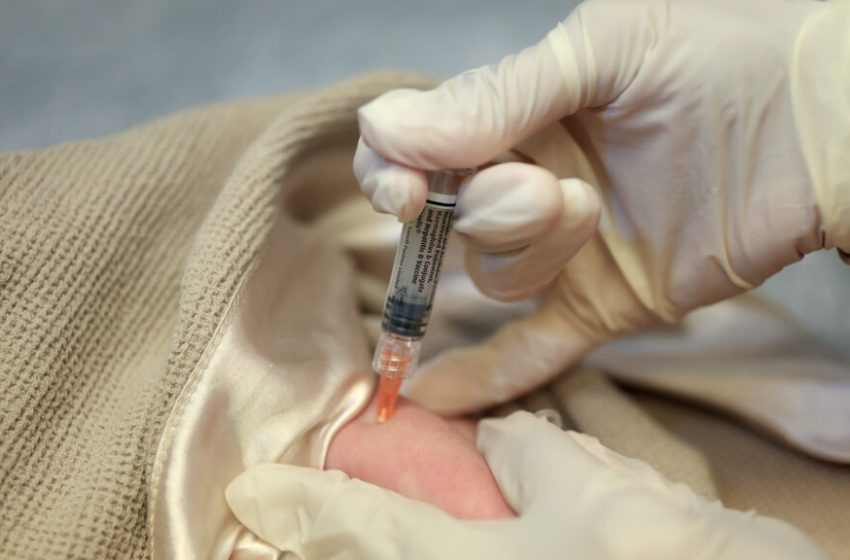
Denmark’s childhood vaccine schedule comes with a heavy price
During my time practicing medicine in Denmark, there was a day in the pediatric ward I will never forget. We had nearly 20 infants admitted simultaneously, all of them dangerously ill and severely dehydrated. The culprit was rotavirus.
As I moved from bed to bed, adjusting IV fluids for babies who were listless and gray, I was struck by a singular, frustrating thought: This was preventable.
Later, my rotations took me into the sterile silence of rooms where I performed lumbar punctures on children with suspected chickenpox encephalitis. I saw the aftermath of meningitis A — a disease that claims the lives of healthy teenagers in Europe with tragic regularity.
At a Senate hearing on Tuesday, National Institutes of Health Director Jay Bhattacharya was questioned about the Centers for Disease Control and Prevention’s new childhood vaccination schedule, which was influenced by Denmark’s. Bhattacharya defended the schedule, claiming that it would increase public trust in vaccination. But several senators, including physician and committee Chair Bill Cassidy (R-La.), pushed back. “I have to admit, I was a little like, ‘What? We’re like Denmark?’ … That’s a crazy idea,” Cassidy said.
I have to agree.
Four years ago, I moved from Denmark to join Pediatric Partners of the Southwest in Durango, Colo. Having served as a hospitalist in a large Danish facility and now as a pediatrician in the United States, I have a unique vantage point on two very different systems. While there are many “shining lights” in Danish health care, the country’s approach to immunization is not one of them. In fact, the one area where the United States has historically stood head and shoulders above the Danish system is in our commitment to a comprehensive vaccine schedule.
Recently, the Centers for Disease Control and Prevention issued new guidelines that move the U.S. toward a model based on the Danish immunization schedule. In my opinion, this shift is a mistake. The new CDC schedule removes vaccines for hepatitis B, rotavirus, meningitis, and varicella (chickenpox) from the routine. I’ve treated the very diseases these vaccines prevent, and I believe these changes are not in the best interest of American children.
The danger of false equivalence
It is tempting for policymakers to look at a country like Denmark — with its high life expectancy and centralized care — and assume its medical protocols are a universal gold standard. But you cannot simply mirror a Danish public health policy onto the American landscape.
Denmark is a small, homogeneous country with a centralized, government-run health care system. Its infrastructure allows for a level of universal monitoring and rapid intervention that the United States, with its vast geography and fragmented private-public insurance models, simply cannot match. In Denmark, if an infant is sick, the path to care is singular and direct. In the United States, gaps in access mean that prevention is our most powerful — and often only — line of defense.
Seeing what we’ve forgotten
In my current practice in the United States, I do not see the rotavirus complications I saw in Denmark. I do not see the devastating neurological fallout from chickenpox or meningitis. This is not because these viruses have disappeared; it is because our comprehensive vaccine schedule has been working.
When we remove a vaccine like the meningococcal shot from the routine schedule, we aren’t just changing a line on a chart. We are inviting previously well-controlled diseases back into our high schools and colleges. Meningitis moves with terrifying speed; a healthy teenager can go from a slight fever to organ failure or death within 24 hours.
In Denmark, these deaths are accepted as occasional, tragic outliers. In the United States, they should be considered unacceptable.
My practice follows the American Academy of Pediatrics schedule because it is designed to protect children from the moment they are most vulnerable.
While the federal guidelines have shifted, our clinical recommendation has not. My colleagues and I believe that hepatitis B, rotavirus, meningitis, and varicella vaccines are essential components of pediatric health. We also remain a “big tent” practice: we are open to all patients regardless of their vaccine choices, and we prioritize open, honest dialogue with parents and accept a patient’s autonomy for their own medical decision-making.
However, my time in the Danish wards taught me that “waiting and seeing” comes with a heavy price. We should not have to witness a resurgence of preventable dehydration, encephalitis, or meningitis to remember why we started vaccinating to prevent them in the first place.
The Danish system has much to admire, but when it comes to protecting our children from infectious disease, the United States should lead, not follow.
Michael Thwing, M.D., is a pediatrician at Pediatric Partners of the Southwest and part of the Colorado Chooses Vaccines coalition. He previously served as a pediatric hospitalist in Denmark. He used AI to help organize his thoughts in this column; it was then edited by STAT staff.
First Appeared on
Source link






