


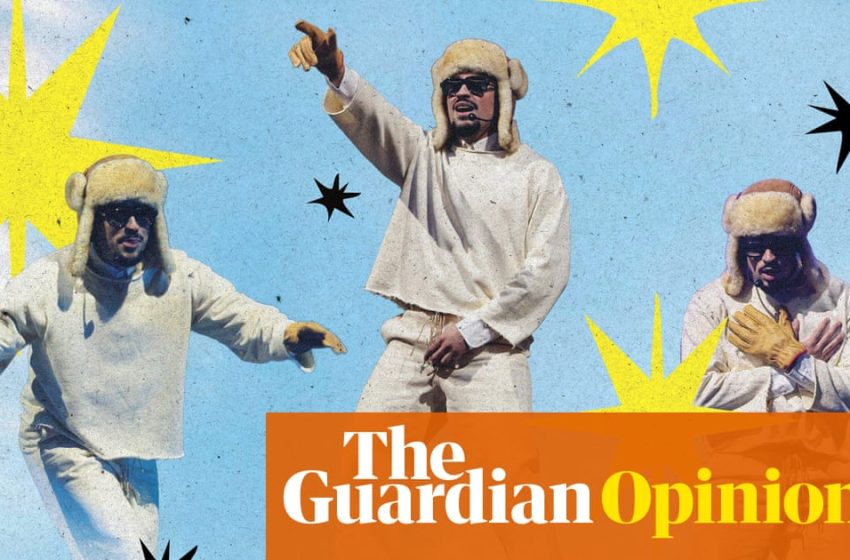
Bad Bunny gives Super Bowl viewers two choices: crash out or tap in | Bad Bunny
The morning after the 3 January US military action in Venezuela, in which Nicolás Maduro was captured, the Federal Aviation Administration temporarily closed airspace in parts of the eastern Caribbean, and my stay in St Kitts stretched into an unexpected extra week. At the mercy of the systems that determine which corridors open and when, and who gets routed where, an overwhelmed customer service agent suggested I charter a boat to nearby St Maarten, fly to Amsterdam, and then stitch together a series of flights to avoid the affected airspace. I understood the Caribbean, then, less as a string of proximate islands and, instead, as a set of routes connected by powers elsewhere.
Power doesn’t just regulate airspace, it also governs cultural transmission – who gets broadcast, who gets heard, and on what terms. That’s why the handwringing over the Puerto Rican artist Bad Bunny headlining the Super Bowl halftime show, and the characterization of his almost exclusive use of Spanish in his music as an intrusion, feel so disingenuous. The drama isn’t about understanding the lyrics. Rather it’s a claim about Bad Bunny and his music as fundamentally un-American, stemming from a fear of feeling left out, or the more colloquially known fear of missing out (Fomo).
Feelings of Fomo usually go in one of two directions: they either sour into resentment or they’re leavened by productive curiosity. While some are promoting bespoke counter-events to watch during halftime, such as Turning Point USA’s so-called All-American Halftime Show, my neighbor Susie has been spending a few minutes every night at the dinner table with her kids, going over the appropriately slack pronunciation of más beso’ y abrazo. Some folks crash out, others tap in. Both reactions are shaped by the same routes of power that decide what it sounds like to be American, and what gets stiff-armed as foreign.
The US has long relied on the Caribbean while insisting the region remains culturally elsewhere. Puerto Rico’s status as an unincorporated territory was engineered to keep it close enough to claim (to own, that is), while still withholding full belonging from its inhabitants. There’s nuance to this arrangement, of course. Empire relies on these hidden infrastructures, ones that create invisible borders between places and people.
Caribbean artists, for their part, make these invisible borders graspable – often dance- and sing-along-worthy, too. Much of what I know about the shape of imperialism comes through Caribbean sounds: Peter Tosh, The Mighty Sparrow, Singing Sandra and Ruben Blades, to name a few. Before I could understand exactly what they meant when they sang about freedom, liberation and colonization, the sticky melodies and body-rocking rhythms kept me close long enough to learn more and learn better.
That’s why I’m not moved by the claim that music sung in Spanish will alienate viewers. Bunny’s 2022 song El Apagón, for example, references the frequent blackouts in Puerto Rico’s long run of infrastructural failures – an electrical grid left to rot and wider colonial abandonment. Over a heavy percussive beat, stripped of its digital sheen, the song sounds out the lo-tech conditions named in its title, The Blackout. It’s still a party song; it makes you move, but the political center is unavoidable. Caribbean music like Bad Bunny’s – inflected with reggaeton and its dembow backbone, alongside salsa and bomba, fortified by trap and their diasporic cousins – performed on a stage like the Super Bowl halftime show is an invitation into a shared situation, and people want in.
My point isn’t that music is universal or that Bad Bunny’s is a transcendentally global sound. It is not. It is very specifically rooted in and routed through his island home. His music doesn’t transcend language so much as it holds our attention long enough to do the actual labor of getting beyond surface lyrics. It invites us to do the work of figuring it out, and that feels especially poignant (crucial, even) in a political landscape where nativism is dressed up as logic and fear is marketed as patriotism.
In a time of waning attention spans, what conservative critics of Bad Bunny are forgetting – willfully or not – is that contemporary audiences consume music with unlimited study guides. Throughout his career, Bad Bunny’s music videos have done the heavy lifting for those of us who don’t immediately understand his colloquial Puerto Rican Spanish. On his most recent project, Debí Tirar Más Fotos (DtMF), the music videos (short films, really) tell moving stories of change, loss, family, immigration and a desire to have a good time. What people may lack in comprehension of a foreign language is made up for by myriad translations, tutorials, and real people who are happy to spell out stakes and clarify meanings.
One captivating moment during this year’s Grammys came when the South African–born Trevor Noah sang the lyrics to the single DtMF back to El Conejo Malo himself. Noah was modeling a contemporary ethic of listening: an ordinary willingness to cross a small distance for the payoff of mutual recognition. So many people are waiting for a similar moment while watching the halftime show.
When fear is being peddled as nationalism, the productive curiosity that Fomo can inspire becomes a counterforce – an imperfect one, surely, but catalyzing nonetheless. And in a moment defined by so many fears – fear of the future, or the felt absence of one – many of us are choosing the work of joining in over fearing each other.
Jessica Swanston Baker is an associate professor of music at the University of Chicago who specializes in contemporary Caribbean popular music.
First Appeared on
Source link






