


From New York to New Mexico: new Epstein files shed light on his sprawling ranch outside Santa Fe | Jeffrey Epstein
For years, Jeffrey Epstein took respite at a sprawling ranch in the desert scrub outside Santa Fe, New Mexico. Epstein’s nearly 10,000-acre (4,000-hectare) property – known as Zorro ranch – was dotted with cholla cactus and Angus cattle, and came to include a 26,700 sq ft mansion, as well as a private runway and hangar.
For years, Epstein abused teenage girls and young women on this ranch with impunity, according to testimony from several women. In court proceedings, survivors detailed horror after horror they say unfolded on this isolated expanse of land.
Authorities searched many of Epstein’s other properties over the years – his New York townhouse, private Caribbean island, Palm Beach estate and Paris apartment – but state and local officials said they were not aware of any federal search of the ranch.
Hector Balderas, New Mexico’s attorney general at the time of Epstein’s 2019 arrest, said that in 2019 his office “investigated activity that occurred in New Mexico that was still viable for prosecution, including contact with multiple victims”. But, he said, the US attorneys in New York handling the federal investigation “asked that we hold any further state investigation or prosecution of activity related to Epstein, as they communicated to us that they were already leading an active multi-jurisdictional prosecution”.
Emails released by the justice department last week as part of a large set of documents related to Epstein also suggest that a search did not occur around the time of Epstein’s arrest. In September 2019, Manhattan federal prosecutors said that they spoke with the New Mexico attorney general’s office, who they said had “agreed to cease any investigation into sex trafficking and share whatever they had gathered regarding sex trafficking activity with our office”.
In a December 2019 email, a prosecutor told a lawyer for one of Epstein’s estate co-executors that they had “not searched the New Mexico property”.
The Department of Justice deferred inquiries from the Guardian to the FBI. The FBI’s main office, when asked whether they searched the property, said: “Unfortunately, we don’t have a comment.” The FBI office governing Santa Fe similarly said: “We have no comment at this time.”
The Zorro ranch was a place where powerful men allegedly visited including a former governor of the state. It was also the proposed setting for Epstein’s previously reported plans to spread his DNA across the human race by impregnating as many women as possible.
A Guardian review of the recently released documents has uncovered more details about the ranch, including never-before-seen photos, and about past law enforcement inquiries related to the property.
Multiple women have said that Epstein abused them as teen girls or young adults on his New Mexico ranch.
Among them is Jane, the first accuser to testify at Epstein accomplice Ghislaine Maxwell’s sex-trafficking trial. Jane said that she met Epstein in 1994 while attending the Interlochen Center for the Arts, an esteemed youth arts camp in Michigan. When Maxwell and Epstein learned that Jane was from Palm Beach, they requested her mother’s phone number, she testified.
Jane provided them with her mom’s contact information. When Jane returned from Interlochen, she and her mother were invited to tea.
She started spending time with Epstein and Maxwell. Epstein started to sexually abuse Jane when she was 14.
Jane said that she traveled with Epstein and Maxwell to New York City and New Mexico. “I just remember someone, at one point, just came into [my] room and said: ‘Jeffrey wants to see you,’ and then escorted me to see him,” she said. “I just, as usual, felt, like, my heart sink into my stomach, you know.”
“I did not want to go see him,” said Jane, who recalled being 15 or 16 at the time. “I just remember being led to his bedroom and, you know, the same thing would happen.”
Annie Farmer, the fourth accuser to testify at Maxwell’s sex-trafficking trial, said that the British socialite gave her a nude massage at the ranch when she was 16.
During Maxwell’s trial, Farmer testified that the morning after this encounter with Maxwell, Epstein lumbered into bed with her and said he “wanted to cuddle” and she “felt kind of frozen”.
“He pressed his body into me,” she said. Farmer testified that she told Epstein she needed the restroom, as to escape.
Another woman identified as Jane Doe said she met Epstein during a school trip to New York City. At Epstein’s townhouse, his secretary allegedly took photos of her and told her that Epstein “really wanted to meet her”. A few weeks later, Jane Doe alleged that the secretary emailed that “Epstein was excited by the photos and that he was very interested in [her] … ”.
Jane Doe and her sister were invited to a magic show in Las Vegas and then Epstein’s ranch. After the magic show, they flew on Epstein’s plane to New Mexico. He was there “along with several young girls”, Jane Doe claimed.
At the ranch, Jane Doe said she was summoned to the main house and brought to Epstein’s bedroom. There, she alleged, Epstein was wearing a bathrobe and demanded a massage. She felt that Epstein wanted her to participate in sexual activity “but she did not know what it was. Epstein seemed to get frustrated as a result.” Epstein assaulted her with a device, she said in court papers.
Virginia Giuffre, one of the most vocal Epstein accusers, was among those who said they were victimized at the ranch. Giuffre, who sued Maxwell for defamation after the British socialite accused her of lying, provided photos of herself at the ranch in a 2015 court document.
Giuffre said that Epstein trafficked her to powerful men at the ranch, including the late Bill Richardson, who served as New Mexico governor from 2003 to 2011.
A spokesperson for Richardson, who died in 2023, previously said that the former governor never met Giuffre and that “these allegations and inferences are completely false” and that in his “limited interactions with Mr Epstein, he never saw him in the presence of young or underage girls”.
Epstein bought the secluded New Mexico property in 1993 from the family of Bruce King, the state’s former three-time Democratic governor. Records show that Epstein acquired the property through an entity named the Zorro Trust, which later became Cypress Inc, and that the purchase included about 1,200 acres (485 hectares) of state land, leased for agricultural purposes.
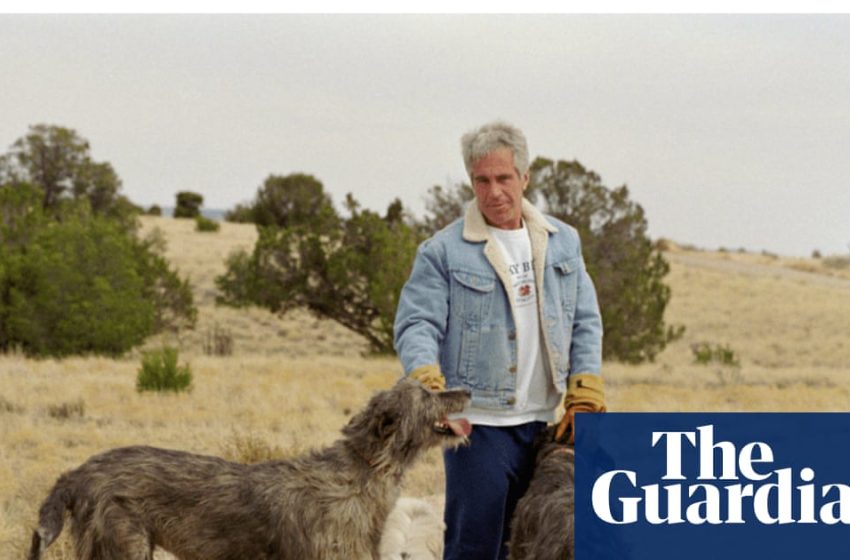
Undated photos in the batch of Epstein files released last week offer rare glimpses of life on the ranch: Epstein’s giant mansion, the stables, a vintage caboose and livestock, as well as Epstein himself on the land with dogs. Other images show young women, whose faces are redacted, riding horses, practicing archery and shooting.
Several men also appear in the photos, including the late French modeling agent Jean-Luc Brunel, linguist Noam Chomsky and film-maker Woody Allen. A representative for Allen did not respond to a request for comment about the image. Neither Chomsky nor Allen have been accused of criminal wrongdoing related to Epstein.
In a lengthy statement, Valeria Chomsky, the second wife and spokesperson for Chomsky, said that they had lunch at Epstein’s ranch once, “in connection with a professional event”.
“We attended social meetings, lunches, and dinners where Epstein was present and academic matters were discussed,” she said. “We never witnessed any inappropriate, criminal, or reproachable behavior from Epstein or others. At no time did we see children or underage individuals present.”
After Epstein pleaded guilty to state prostitution-related charges in Florida in 2008, including soliciting a minor in a controversial deal that let him avoid federal charges, the ranch provided a quiet retreat. That was until July 2019, when Epstein was charged with sex trafficking crimes in New York, and state officials quickly began taking a look at his desert ranch.
Balderas, New Mexico’s then-attorney general, opened an investigation that month, and Stephanie Garcia Richard, who was newly elected as the state’s commissioner of public land, provided some 400 pages of lease documents to Balderas and began reviewing Epstein’s two state grazing leases.
That same month, the New York Times reported that Epstein had privately told scientists and business associates that he had hoped to use the ranch as a base where women would be inseminated with his sperm, and would give birth to his babies.
In September 2019, Garcia Richard cancelled Epstein’s state grazing leases, citing obstructed inspections, misrepresentation in filings and that the attorney general had concluded that the entity may have obtained “the leases through illegitimate means for purposes other than ranching or agriculture”.
“This land was no doubt used to protect the privacy of Epstein and his co-conspirators, and today we took steps to take back this public land,” Garcia Richard said at the time.
Garcia Richard told the Guardian that the 1,200 acres have since been divided into two parcels. One, she said, has been considered for a number of uses, including a wildlife refuge area or as a “potential memorial site for girls and women who were harmed at the ranch”, while the other remains leasable.
In 2021, Epstein’s estate listed the remaining roughly 8,000 acres for sale, including the residences and structures. The Wall Street Journal reported that the proceeds were set to go to his estate “including as necessary to compensate claimants, tax authorities, and creditors”.
The property was sold in 2023 to an LLC listed as San Rafael Ranch LLC. Later that year, the New Mexico attorney general Raúl Torrez announced a $4.95m pledge by Deutsche Bank – which, earlier that year, had agreed to pay $75m to settle a lawsuit brought by a group of women who accused the German lender of helping facilitate Epstein’s sex-trafficking operations – to “fund additional resources to prevent, investigate, and prosecute human trafficking in the state of New Mexico”.
The funding, officials said, stemmed from an investigation Torrez conducted into “various financial services companies and the role they played in failing to identify the sexual abuse and trafficking of underage girls” at Zorro ranch.
While Epstein’s activities at Zorro ranch remained hidden from public view, records recently released by the Department of Justice indicate that federal authorities briefly took an interest in the property almost 20 years ago.
In February 2007, as part of an investigation of child sex abuse in Florida, records show that the FBI interviewed Epstein’s ranch manager at the New Mexico property.
Per the document, the ranch manager told the FBI that he and his wife had overseen the property for about four years, and that Epstein typically spent several weeks there in the summer, often accompanied by “his personal assistant, his bodyguard, friends, personal trainer, and sometimes his masseuses”.
The interview ended abruptly, according to the agent. The investigator wrote that someone called the staff and instructed them that “they were no longer allowed to speak with us”.
“The interview was immediately ended,” the report notes.
Other than that, Epstein and his ranch appeared to have drawn little law enforcement scrutiny prior to his death. The Santa Fe county sheriff’s office, which has jurisdiction over the ranch, had records of several incidents on or around the property; none were related to alleged sex abuse.
Records do show that Epstein registered with the Santa Fe county sheriff’s office as a sex offender on 17 August 2010, after being notified by the New Mexico department of public safety that they had received notification from Florida authorities about his conviction, and that he had to register with the state. But, records also show that the department of public safety informed him later that month that they had determined that, per state law, he was not required to register as a sex offender in New Mexico.
Newly released files also include a 2019 FBI tip report stating that a “retired new mexico state police officer” – whose name is redacted – reported hearing “rumors” that the ranch was “used for recruited girls to visit with Epstein” but the FBI stated that he had “no factual evidence to support this claim”. The retired police officer also said that there had been a lot of “high profile people seen frequenting the property” and raised concerns about a newly constructed barn on the land.
Aside from the 2019 investigation opened by the New Mexico attorney general’s office, but later put on hold at the behest of federal authorities, there appears to be no active state or local criminal investigations into what occurred at Zorro ranch, according to local prosecutors at the Santa Fe county sheriff’s office, and the state department of justice.
But state officials are pushing for answers about what occurred there.
Late last year, state lawmakers proposed a bipartisan “truth commission” to investigate what happened at the ranch. The state department of justice said it is working with the lawmakers.
“This commission will specifically seek the truth about what officials knew, how crimes were unreported or reported, and how the state can ensure that this essentially never happens again,” Democratic state representative Andrea Romero of Santa Fe, who is leading the efforts, told a panel of legislators in November. “There’s no complete record of what occurred.”
Romero told the Guardian that, based on conversations with law enforcement and the attorney general’s office, it is her understanding that federal agents never searched the ranch.
Epstein, she noted, “was here for 26-plus years, back and forth, in and out, and yet we have no actual story as to what went on”.
The commission could be greenlighted by the state house as early as next week, she said.
For now, the story of Epstein’s New Mexico ranch remains told in fragments: survivors’ accounts, property listings and land records, as well as a growing archive of documents released by the Department of Justice.
Among them are emails from 2011 showing that Epstein commissioned a $2,000 reproduction of The Massacre of the Innocents, by Dutch painter Cornelis Cornelisz van Haarlem. The tableau depicts a biblical massacre of all male children in Bethlehem under age two.
“It’s the large 9’x9’ canvas that we had rolled out for him to see in the entry way where they are killing babies,” one of Epstein’s assistants writes to another one of his employees, to arrange shipping. Epstein, she said, “wants to use it on the ranch”.
First Appeared on
Source link






