


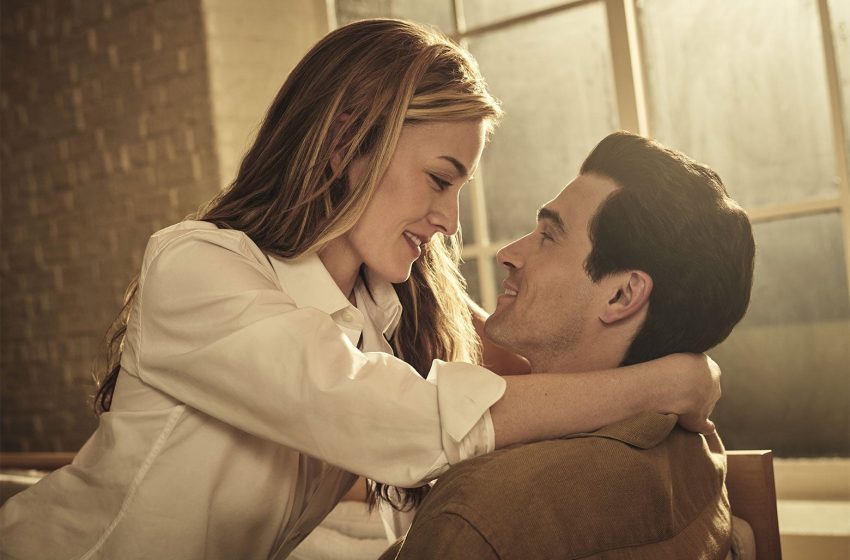
Love Story nails America’s obsession with the Kennedy family.
If the United States has an American equivalent of the British royal family, it has to be the Kennedys. This country has been acquainted with the Kennedy family for the past century and a half, and has been obsessed with them since around the midcentury, when John F. Kennedy’s so-called Camelot presidency and its tragic ending captured the public imagination. In the intervening decades, the American fascination with this political dynasty has shown no signs of stopping, given that Robert “Bobby” F. Kennedy, Edward “Ted” Kennedy, Joseph P. Kennedy II, Joe P. Kennedy III, Patrick J. Kennedy, Caroline Kennedy, and Robert F. Kennedy Jr. have all either been elected or appointed to federal office in the intervening years. (And that extensive list does not include members of the family who married in or don’t carry that famous last name.) Today the Kennedys are once again across our politics, if they ever truly left. There’s our dairy-obsessed health secretary, of course, whose anti-science views prompted five of his own siblings to speak out against him during the 2024 election. Then there’s Jack Schlossberg, the 33-year-old son of Caroline Kennedy and near-clone of his late uncle, who has entered the race for a vacant congressional seat in Manhattan. Oh, and don’t forget that the president now has his eyes—and his name—on the Kennedy Center, named in honor of the late commander in chief.
It’s in this cultural morass that FX’s Love Story, a Ryan Murphy–produced anthology series that builds its first season around John F. Kennedy Jr. and Carolyn Bessette Kennedy, debuts on Thursday. It’s one of at least two splashy Kennedy-centric series in the pipeline; the other is Netflix’s Kennedy, a look at the origins of the family that is centered around patriarch Joe Kennedy Sr., who will be played by Michael Fassbender.
Love Story, which is based on Elizabeth Beller’s 2024 biography Once Upon a Time: The Captivating Life of Carolyn Bessette-Kennedy, charts the romance between JFK Jr. and his fashion-industry bride. The late Kennedy scion is now widely remembered as the little boy who once saluted his father’s coffin but later struggled to find his place in public life as an adult. He tried his hand at law and flirted with acting before settling in media, founding the magazine George, which ran from 1995 to 2001. But for a time he was best known as the country’s most eligible bachelor, with a string of high-profile romances, from Daryl Hannah to Sarah Jessica Parker. In 1992 Kennedy met fashion publicist Bessette and soon began a sometimes stormy romance with her that culminated in their 1996 wedding. As a glamorous young couple, the pair seemed—in the public imagination, at least—the heirs to JFK’s and Jackie O’s political lives. But these plans, like those of JFK Jr.’s parents, also ended in tragedy when the pair, still in their 30s, were killed in a plane crash in 1999.
This new series is reminiscent of The Crown, from which Love Story showrunner Connor Hines drew inspiration when coming up with this show. You can see signs of this shared DNA throughout the nine episodes. “You’re gonna be the American people’s princess,” one of Bessette’s (Sarah Pidgeon) friends tells her as her relationship with JFK Jr. (Paul Anthony Kelly) picks up steam. Later, as Bessette struggles with the paparazzi infestation that has overtaken her life, she watches, horrified, as news reports announce Princess Diana’s death, fearing that she too will be killed at the hands of the press. Both series question the fairy tale behind these famous families, while simultaneously serving it up to lavish effect. They each understand that, as much as many of us may roll our eyes at the notion of hereditary monarchies or political dynasties, we still can’t help but return to them. It’s a cultural obsession. A soap opera. A romance.
The Kennedys serve as avatars for our national successes and failures, as subjects of easy adoration and derision.
In the U.K., at least, there are constitutional and historical reasons for the monarchy’s continued existence. In the U.S., all we can point to is our continued preoccupation with celebrity—a well-established phenomenon in politics long before Donald Trump rode it all the way to the White House. Here, famous leaders have famous spouses and children, who themselves become subjects for will-they-or-won’t-they speculation. (See, for example, the constant discussion of Michelle Obama’s electoral prospects or the political ambitions of the Trump children.) Many politicians feel they are destined for higher office, but for the Kennedys and other dynasties, there is an expectation placed upon their members, both internally and externally. We hold them up as evidence that under the American dream, we too can create a legacy. They serve as avatars for our national successes and failures, as subjects of easy adoration and derision. They are characters for our consumption—real people and not, flawed humans and fictional versions of them. “In [people’s] minds, we don’t exist without them,” we see Jackie Kennedy Onassis (Naomi Watts) tell her son in Love Story.
This series, then, serves to both question and propagate this arrangement. It’s a sexy, swoon-worthy fairy tale that also wants us to know that none of this fantasy, this toxic codependency, is good for the country or the families caught up in it. A dramatized, ripped-from-the-headlines (or history books, depending on your age) miniseries is bound to agitate those for whom this is all very real (and, indeed, the show has upset at least one Kennedy descendant), but it’s also the perfect vehicle to perpetuate the illusion at the core of their identities. As the couple at the center of Love Story learn during their ill-fated relationship, outsiders, insiders, and even love itself can all be chewed up and spit out in the service of a mythmaking so strong it makes it hard to keep track of what’s true. “My experience is generally not trustworthy. I’m always trying to understand what parts are real and what parts aren’t,” JFK Jr. tells Bessette during one of their many fights. “But us? That felt so, so real.”
Somehow, despite a degree of current-day Kennedy fatigue, this FX series feels fresh and compelling. Watts is memorable in a short turn as the late first lady, hitting those unique vowel sounds just as Natalie Portman did in 2016’s Jackie, while Grace Gummer is suitably no-nonsense as Caroline Kennedy, the under-the-radar antithesis of her brother. Particularly charming is the melodic theme composer Bryce Dessner has devised to serve as the lovers’ delicate motif across the series. Fashion fans will also be pleased to learn that the creative team took to heart criticism of the early costuming, working to source designer pieces that accurately reflect the era and its players. I struggle to think of a period show that has ever made the 1990s look more chic.
For many viewers, though, this will be their first in-depth study of Bessette. The former Calvin Klein executive is now remembered mostly as a style icon for trendy, minimalist ’90s fashion, but she was once a daily character in the tabloids, positioned as victim and villain alike. Deftly played here by Pidgeon, who scored a 2024 Tony nomination for her amazing turn in the play Stereophonic, this iteration of Bessette makes it easy to see why the world’s most eligible bachelor felt as if he had met his match, romantically and competitively. She is impossibly lithe and cool, endlessly puffing on cigarettes (an activity that, as the show takes great joy in reminding us, you could still do inside bars in the ’90s) or strutting through Tribeca with a model’s ease. At times, Pidgeon’s wide eyes and high cheeks reminded me of Natascha McElhone, who played the protagonist’s beguiling but forbidden love interest in 1998’s The Truman Show; at other points, she seemed to slightly resemble Olivia Nuzzi, the journalist whose recent love affair with RFK Jr. became its own tabloid sensation. But Pidgeon’s performance succeeds beyond her physical likeness; the actor summons a charisma that is both mysterious and charming, elusive yet approachable. It’s no wonder that Klein himself (here played by Alessandro Nivola) is so impressed with her, or that Bessette is so loath to give herself over to the Kennedy machine.
The show’s creative team struggled for some time to find its Kennedy Jr., eventually settling on Kelly, a former model, just weeks before filming in part because, incredibly, he had the build and chest hair that the role required. If anything, Kelly is in the somewhat enviable position of being too beautiful to play JFK Jr.; his features are sharper, his eyes darker, his hair slicker. But Kelly is terrific as the tortured boy king, at once magnetic and pathetic. When he walks into a room, all eyes turn toward him and voices lower, but this position comes with dangers too. As Klein’s wife, Kelly (Leila George), warns Bessette, there’s a rush to being with someone like that, feeling like a source of envy and perhaps even mutual fascination. “But at the end of the day, they never really choose you, not in the way that you wish they would,” Kelly says. “Shiny people like that—they belong to everyone.”
It’s this imbalance that eventually becomes the fatal flaw in the Kennedy–Bessette romance. Having worked in public relations, Bessette understands the press, but not in the same way that Kennedy does. She knows she’ll be giving her life over to the public; he grew up with that spotlight and can’t envision life without it. She fears losing control of her own image; he takes power and pride in manipulating the media as best he can. Every story needs a protagonist and antagonist, Bessette’s sister Lauren (Sydney Lemmon) warns her, and JFK Jr. is the living embodiment of a protagonist. So where will that leave her? An eternal tabloid villain? The envy of every woman—and gay man, as Kennedy jokes to her—in America? The ultimate answer may, in the public’s eye, simply be as Mrs. John F. Kennedy Jr. “She knows if she marries him, that will be her defining characteristic,” Kelly Klein astutely observes at one point of Bessette—and of herself. “It will be like she never existed before she met him.”
There is a certain gruesomeness to bearing witness to the tragedy of the Kennedys; in the show’s opening, the couple and Lauren board the small plane on which they will ultimately lose their lives in a crash off the coast of Martha’s Vineyard. It feels especially morbid in light of the family’s recent loss, with the untimely death in December of Tatiana Schlossberg (Caroline’s daughter and Jack’s sister) from leukemia at just 35. Young child actors pop up occasionally as Tatiana and her siblings in Love Story, lending an uneasiness to the whole thing. You can sympathize, then, with Schlossberg’s anger at Murphy for “making a public spectacle” of his family.
But the Kennedy name—on which Schlossberg’s political push arguably relies, at least in part—is likely to endure precisely because of works like Love Story, not in spite of them. Such works of romance (in the sense of both love and myth) only add to the family’s mystique, helping to further embed their name in the public consciousness. As a nation, we want to believe in a family like the Kennedys because we want to believe in the fantastical promise of America, especially in such dark and lost times. “All he knows is who he’s supposed to become: the heir to Camelot. That’s the only thing the world has ever told him,” Bessette’s mother, Ann Messina Freeman (Constance Zimmer), tells her daughter of the rudderless JFK Jr. “If there’s no Camelot, then what was the point of all this loss?”
First Appeared on
Source link






