


See how your county, school ranks :: WRAL.com
The measles vaccine is recommended for everyone 12 months of age and older, and it’s required for kindergarteners in North Carolina’s public schools. Still, not everyone is vaccinated.
North Carolina has a kindergarten immunization data dashboard and map showing county-by-county vaccination rates for all vaccines required for kindergarten students across the state. You can even search by school. There is also a measles-specific dashboard estimating measles vaccination rates by county and school.
Estimated measles vaccine rates: A county-by-county look
The State Department of Health and Human Services has published a map and searchable measles vaccine database showing the percent of elementary school-age children in a county that are up to date on their MMR vaccine. A high percent indicates a lower risk of a measles outbreak.
In the map above, counties shaded in red are considered low coverage (under 90%), counties in yellow are considered medium coverage (90%-95%) and counties in blue are considered high coverage (over 95%). In our area, Durham has the lowest estimated measles vaccination rate — just 88%.
| County | Estimated elementary students with MMR |
| Chatham | 95% |
| Cumberland | 90% |
| Durham | 88% |
| Edgecombe | 92% |
| Franklin | 93% |
| Granville | 96% |
| Halifax | 95% |
| Harnett | 92% |
| Hoke | 91% |
| Johnston | 95% |
| Lee | 95% |
| Moore | 95% |
| Nash | 95% |
| Orange | 96% |
| Person | 97% |
| Robeson | 93% |
| Sampson | 95% |
| Vance | 94% |
| Wake | 94% |
| Warren | 96% |
| Wayne | 95% |
| Wilson | 93% |
Find your school
You can also search by school to see how your school’s measles vaccination rate compares with other schools in your county using this link.
Who should get the measles vaccine?
The Centers for Disease Control and Prevention (CDC) recommends children get two doses of the MMR (measles, mumps, rubella) vaccine:
- First dose at age 12 through 15 months
- Second dose at age 4 through 6 years (before school entry)
While MMR vaccination is not routinely recommended for children younger than the age of 12 months, MMR vaccination can be safely given to children as young as 6 months if they are at higher risk.
Adults who did not get the vaccine should receive it. One dose of MMR vaccine is sufficient for most adults, according to the CDC.
How effective is the vaccine?
According to the CDC, two doses of measles vaccine are 97% (range: 67% to 100%) effective at preventing measles. One dose is 93% (range: 39% to 100%) effective at preventing measles.
Signs and symptoms
The virus can live for up to two hours in the air where the infected person was present. Symptoms of measles usually begin seven to 14 days after exposure, but can appear up to 21 days after exposure and may include:
- High fever (may spike to more than 104 degrees)
- Red, watery eyes (conjunctivitis)
- Tiny white spots on the inner cheeks, gums and roof of the mouth (Koplik Spots) two to three days after symptoms begin
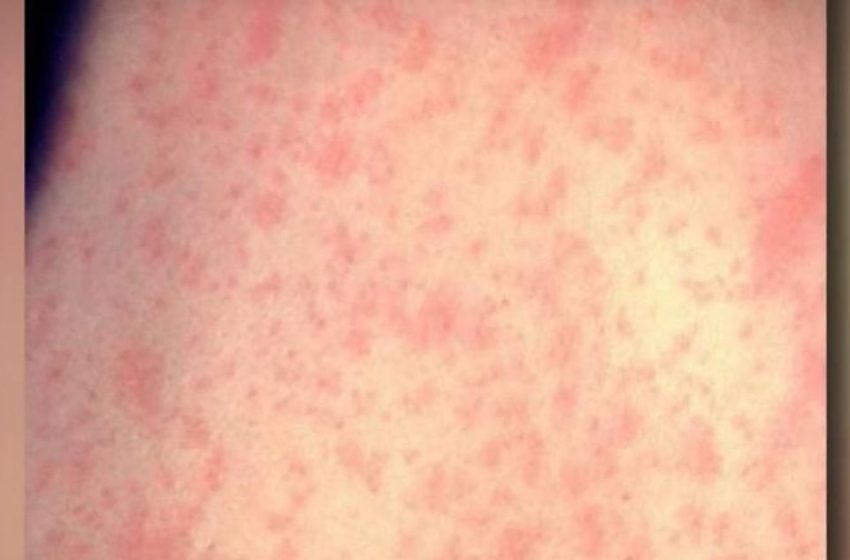
- A rash that is red, raised, blotchy; usually starts on face, spreads to trunk, arms and legs three to five days after symptoms begin
- Measles can also cause complications, including diarrhea, pneumonia, encephalitis (swelling of the brain), and suppression of the immune system.
Anyone who develops symptoms should call ahead before visiting a doctor’s office, urgent care or emergency department to prevent possible spread to others.
People who are not vaccinated or are unsure of their vaccination status should review their records, monitor for symptoms and contact their county health department.
First Appeared on
Source link






