


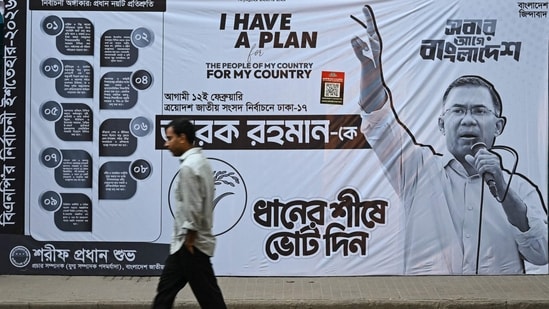
Tarique Rahman goes from ‘symbol of kleptocracy’ to ‘historic victor’: How US sees and saw Bangladesh’s next PM
The United States led the pack as the international community moved swiftly to recognise a new political reality in Bangladesh on Friday. Its congratulatory note for Tarique Rahman, however, marked a whiplash-inducing reversal from the way Washington once defined the man poised to be Bangladesh’s next prime minister.
Rahman was a “symbol of kleptocratic government and violent politics”, as per US diplomatic cables two decades ago. The most damning adjectives for Rahman by US diplomats came during the late 2000s.
In that period when his mother Khaleda Zia served her third term as PM, Tarique Rahman, also called Tarique Zia, was seen by US diplomats as the architect of a “parallel administration” operating out of Hawa Bhaban, the headquarters of the Bangladesh Nationalist Party (BNP) in Dhaka.
Now chairperson of the BNP at 60, Rahman received congratulations from Donald Trump-led US on his “historic” win.
‘Dark Prince’ of Hawa Bhaban
A leaked 2008-09 set of cables (diplomatic communications) from the US embassy in Dhaka, authored by then-ambassador James F Moriarty and later released by WikiLeaks, did not mince words. It described Rahman as “phenomenally corrupt” and noted that he “inspires few but unnerves many”.
The assessment was even more brutal regarding Rahman’s standing in the country, labelling him a “symbol of kleptocratic government” who was notorious for “flagrantly and frequently demanding bribes”.
Central to these US concerns was the “khamba” (electric pole) controversy. The cables tracked allegations that Rahman and his associates used Hawa Bhaban to influence government contracts, specifically the procurement of thousands of electric poles, at inflated prices. These poles were reportedly installed in rural areas but never connected to any power grid.
For the US State Department of the era, Rahman represented the very “hereditary privilege” and systemic graft that the 2024 July protest against Sheikh Hasina — his mother’s longtime rival now self-exiled in India — would eventually rail against.
Why US was wary of Tarique Rahman/Zia
The US wariness was not merely about money; it was about regional stability too at the time. In a confidential 2008 cable titled ‘Khaleda Zia Consolidates Leadership and BNP Adjusts to Life After Tarique Rahman’, the US ambassador explicitly stated: “It is in our interest that the latter [Tarique’s return to power] not happen.”
It argued that the best chance for Bangladesh lay in seeing “alternatives develop within the BNP” and internal party reform, citing the “huge” stakes in a Muslim-majority country with a history of “internal and transnational terrorism”.
Washington’s distrust was further solidified by Tarique Rahman’s conviction in the 2004 Dhaka grenade attack case, an alleged assassination attempt on then-opposition leader Sheikh Hasina that killed 24 people. While Rahman always maintained these charges were “politically motivated”, the US view at the time considered these charges too while sketching his personality.
“His theft of millions of dollars in public money has undermined political stability in this moderate, Muslim-majority nation and subverted US attempts to foster a stable democratic government, a key objective in this strategically important region,” read a cable from 2008.
Exile of ‘notoriously corrupt and violent’ Tarique Rahman
Khaleda Zia’s second premiership concluded with a political crisis and a military takeover in 2007. In an anti-corruption crackdown in which Tarique Rahman alleged he was tortured in custody — leading to spinal problems that he says left him with a near-permanent limp — he fled to London in 2008.
Local outlets saw that as a “deal” among the power brokers as Bangladesh continued with its ‘Battle of Begums’, Sheikh Hasina vs Khaleda Zia, on the surface. The military remained a major player as elections took place under a caretaker government, and Hasina started her latest reign that ended with a popular revolt in 2024.
On Tarique Rahman’s release on bail in 2008, a US cable said, “Tarique Rahman, the notoriously corrupt and violent son of former Prime Minister Khaleda Zia, was released from prison on September 3 after the Supreme Court rejected the Government’s last minute legal efforts to block his bail. Tarique will remain in the hospital under police protection until plans for him to travel abroad for medical treatment are finalized. Begum Zia’s release is expected to follow within days. While Tarique’s release had been expected, the manner in which it took place highlights the Caretaker Government’s inability to stage manage events.”
The US cable added, “It also may leave open the door for a future role for Tarique.”
For 17 years, Tarique Rahman managed the BNP via video link from the leafy suburbs of Richmond in London, leading what he described as a “quiet life” as a public relations consultant, as per his recent profile by Time magazine.
During this period, the US relationship with Bangladesh moved towards the regime of Sheikh Hasina, as did the rest of the world. Her Awami League was often seen as a more stable, secular bulwark against Islamist fundamentalism, but ended up becoming “iron-fisted”, as described by analysts.
However, as Hasina’s rule became repressive with thousands of reported extrajudicial disappearances and alleged politicisation of the judiciary, the calculus began to shift.
The turning point came in 2024, when the GenZ-led protests, fuelled by grievances over joblessness, toppled Hasina and forced her to flee to India. This created a vacuum that neither the US nor regional powers like India could ignore. Indian PM Narendra Modi has also congratulated Tarique and called for an “inclusive” Bangladesh.
The more things change…
A rehabilitation of Tarique Rahman’s image was accelerated by the Bangladeshi legal system’s post-Hasina pivot under an interim regime led by Nobel laureate economist Muhammad Yunus.
In late 2024 and early 2025, courts began overturning his convictions, including the life sentence for the 2004 grenade attack, citing “procedural irregularities”. He was also acquitted in several money-laundering and bribery cases.
A meeting with Yunus, respected in Washington circles, provided a bridge in London in June 2025. BNP supporters called it as “turning point” signalling that the international community was ready to deal with Rahman as a legitimate political leader.
Tarique Rahman returned to Dhaka on December 25, 2025, when his mother was ailing. She died a week later.
Election were held on February 12, with the BNP and its once-ally Jamaat-e-Islami going head to head while Hasina’s party is banned.
After Tarique Rahman-led BNP’s victory in the February 13 cote count, A man once described as a flawed heir is now being embraced as the face of a democratic transition.
Rahman has been keen to acknowledge his past, and promised a “technocratic approach” to governance.
In a recent interview, he struck a humble tone regarding his reputation of the past in particular: “If there are any mistakes which were unwanted, we are sorry for that.”
He said he aims to do better than his late parents, ex-PM Khaleda Zia and former military boss and president Ziaur Rahman.
He also sought to appeal to American pragmatism: “Donald Trump will look after the interests of his country. I will look after the interests of my country. But we can also help each other.”
He suggested a future where Bangladesh might purchase Boeing aircraft and US energy infrastructure to balance the trade deficit largely driven by Dhaka’s textile exports.
A US-Bangladesh trade agreement has made progress on that count under Yunus already.
“The United States looks forward to working with you to realise shared goals of prosperity and security,” the US message to Tarique Ahmad said on Friday, February 13, after his big win.
First Appeared on
Source link






