


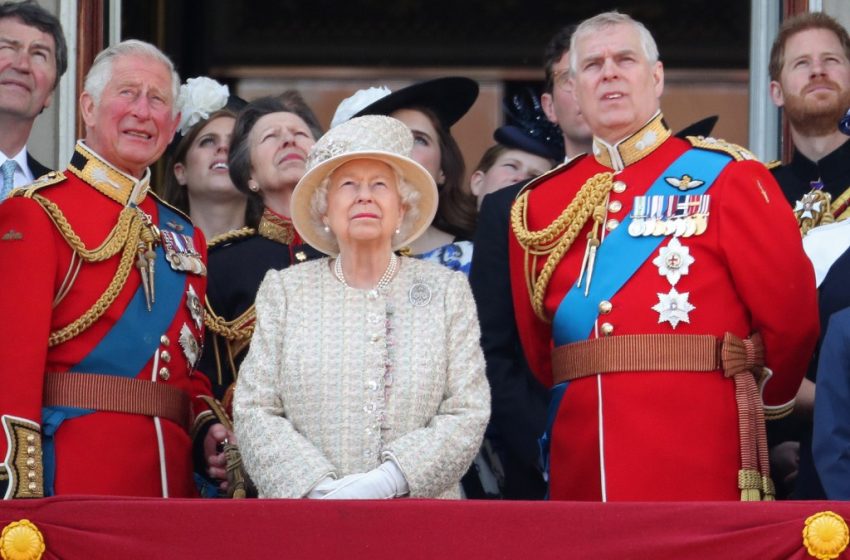
King Charles helped Andrew buy Virginia Giuffre’s ‘silence’: report
King Charles III can no longer claim “plausible deniability” when it comes to the former Prince Andrew’s efforts to escape legal accountability for his alleged sexual abuse of Virginia Giuffre, the most well-known of Jeffrey Epstein’s alleged teen trafficking victims, according to reports.
The Sun reported Wednesday that Charles, as Prince of Wales, personally contributed around $2 million of a $16 million loan to Andrew Mountbatten-Windsor, which his younger brother “used to silence” Giuffre in 2022 by enticing her to drop her U.S. lawsuit against him.
It’s believed that the bulk of this loan to Andrew, which funded his out-of-court settlement with Giuffre, was paid by the late Queen Elizabeth II, according to The Sun. By reaching a settlement, Andrew also was spared having to testify in court, after he had already set off three years of damaging publicity for the British royal family because of emerging revelations about his friendship with Epstein.
But if Charles had a role in paying for Giuffre’s settlement, that “makes it clear that he and his office were fully involved in covering up Andrew’s behavior,” wrote Daily Beast editor Tom Sykes on his Royalist Substack.
“Charles’ money was deployed to buy Andrew out of a full public reckoning, to shut down a civil case that could have put a senior royal’s alleged sexual abuse of a trafficked teenager under the spotlight in a New York courtroom,” Sykes added, saying that the then-future king was “making a hard political calculation about what is in the interests of the Crown.”
But it looks like Charles’ political calculation has backfired.
Since 2022, the scandal over Andrew’s association with Epstein has only grown, especially with the recent release of emails and photos from the U.S. Justice Department’s Epstein files. Andrew has long denied any wrongdoing with regard to Epstein. He also said in his infamous 2019 BBC interview that he didn’t remember meeting Giuffre in 2021, while she said she had three sexual encounters with him at the direction of Epstein. Giuffre died last year by suicide, while Epstein also died in a reported suicide in 2019 after being arrested on federal sex trafficking charges.
The documents in the Epstein files show that Andrew maintained a friendship with the convicted sex offender long after he publicly claimed he had cut off contact with him. They also raise further questions about whether Andrew enjoyed the benefits of Epstein’s sex trafficking operation and whether he passed off confidential reports to the late financier about his visits to Asian countries when he served as a British trade envoy in 2010.
These new documents have prompted a police investigation, it was reported last week and this week. It also has forced the king into the long-unimaginable position of having to endorse a police investigation against a member of his own family. Buckingham Palace released a statement this week saying that the king “has made clear, in words and through unprecedented actions, his profound concern at allegations which continue to come to light in respect of Mr. Mountbatten-Windsor’s conduct.”
“While the specific claims in question are for Mr. Mountbatten-Windsor to address, if we are approached by Thames Valley Police we stand ready to support them as you would expect,” the statement said.
With regards to the king’s “profound concern” and “unprecedented actions,” he has followed the lead of the late queen in taking various steps since 2019 to downgrade Andrew’s public role in the royal family, but critics continue to say that he’s also tried to be conciliatory towards his disgraced brother and that his actions have been too little, too late.
Last year, Charles stripped Andrew of his prince and Duke of York title and formally evicted him from his 30-room Royal Lodge mansion near Windsor Castle. But Andrew continued to live at the home and was often seen riding his horse around Windsor Great Park and photographed waving to crowds. Charles finally ordered Andrew to leave Royal Lodge last week, and the former duke was transported in the dark of night to the royal family’s private country estate, Sandringham.
Rather than take decisive action against his brother, the king has instead pushed the narrative that the queen was responsible for the “Andrew mess,” according to Sykes. Over the past several months, stories have emerged that blame her for indulging her “favorite son,” Sykes added.
For example, Andrew Lownie, a royal historian and Andrew’s biographer, reported that the queen was aware of how her son was using taxpayer-funded trips as a U.K. trade envoy to “line his pockets,” play golf and “chase women,” including when he allegedly had 40 prostitutes brought to his five-star hotel room while on a four-day official trip to Thailand in 2006.
“She knew exactly what was going on,” Lownie said in an interview in October. “I know people went and complained to the queen. I had talked to two permanent undersecretaries who complained to the queen’s private secretary, and they were basically sent away with a flea in their ear.”
But to Sykes, it’s still unseemly the way Charles’ camp is blaming the queen for the scandal that continues to engulf the House of Windsor. He said this blame game “is a disgraceful slur on her legacy.”
“Despite her adoration of her favorite son, she otherwise excised him completely from public life,” Sykes said. “Charles, by contrast, from the moment he became king, starting with his mother’s funeral, consistently went to great lengths to ostentatiously include Andrew in the tableau.”
If you or someone you know is struggling with feelings of depression or suicidal thoughts, the 988 Suicide & Crisis Lifeline offers free, round-the-clock support, information and resources for help. Call or text the lifeline at 988, or see the 988lifeline.org website, where chat is available.
First Appeared on
Source link






