


Should We Help Them or Not When They Look Trapped?
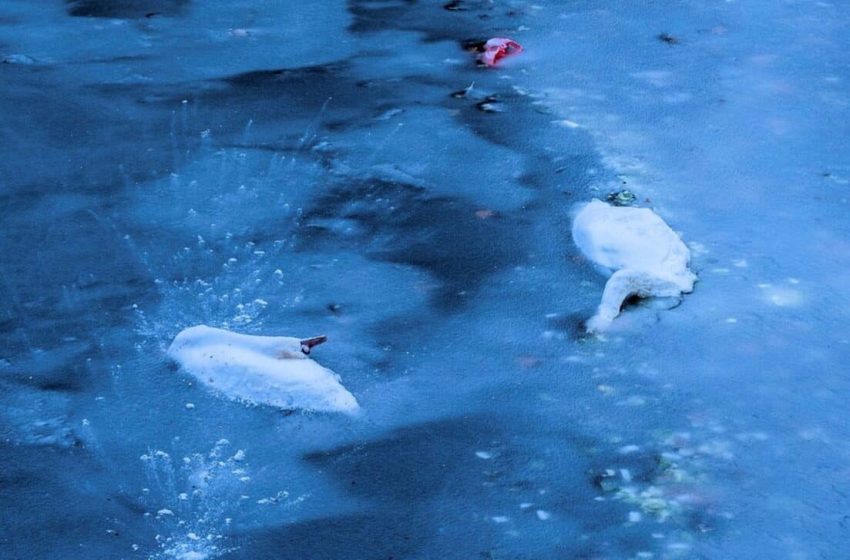
The swan sat motionless on the frozen lake for hours. To the couple walking their dog near Berlin’s Schlachtensee last week, the bird appeared trapped, a victim of the sudden cold snap that seized central Europe in early February. They considered walking onto the ice. They did not know the swan was likely already dying. And they could not have known that approaching it might have made a bad situation worse not just for that bird, but for dozens of others.
This winter, a brutal confluence of natural selection and virology is playing out on frozen water bodies across the northern hemisphere. The spectacle of apparently ice bound birds is triggering public alarm, but the underlying reality is both more complex and more consequential than any single animal’s fate. The decision to intervene or walk away now carries implications that extend from local ponds to international poultry markets and the evolving trajectory of a virus that has fundamentally changed how wild birds live and die.
When Cold Becomes Viral Amplifier
The scene unfolding on European and North American lakes is the visible surface of a deeper ecological shift. Highly pathogenic avian influenza H5N1, first detected as a global threat nearly three decades ago, is no longer an episodic visitor to wild bird populations. Based on surveillance data from multiple states and European veterinary authorities, the virus is now considered endemic in waterfowl, circulating continuously through migration flyways and wintering grounds.
The cold weather that seized the continent in early February did not create this problem, but has intensified it. Freezing temperatures stabilize the virus in the environment, extending its survival on ice and in frozen carcasses. And cold stress, like any physiological pressure, selectively removes the weakest animals a process ornithologists term winter selection, but which virologists now recognize as a sampling mechanism that concentrates infections in vulnerable populations.
Data from Berlin’s urban water bodies illustrates the pattern. As reported on MDR , among numerous wild birds found dead this winter, officials confirmed avian influenza in a significant proportion, with swans disproportionately represented. The finding aligns with broader surveillance: waterfowl serve as natural reservoirs, shedding virus while migrating, and congregating on remaining open water creates ideal transmission conditions.
The Physiology of Apparent Helplessness
The public’s instinct to rescue stems from a misunderstanding of how birds experience cold. What appears as distress a bird seemingly frozen in place is often a deliberate energy conservation strategy.
Birds wintering in temperate zones deploy physiological adaptations that render them far more resilient than their immobile posture suggests. Counter current heat exchange systems in their legs recapture warmth before blood returns to the body, meaning a duck standing on ice may have feet just above freezing while its core remains warm.
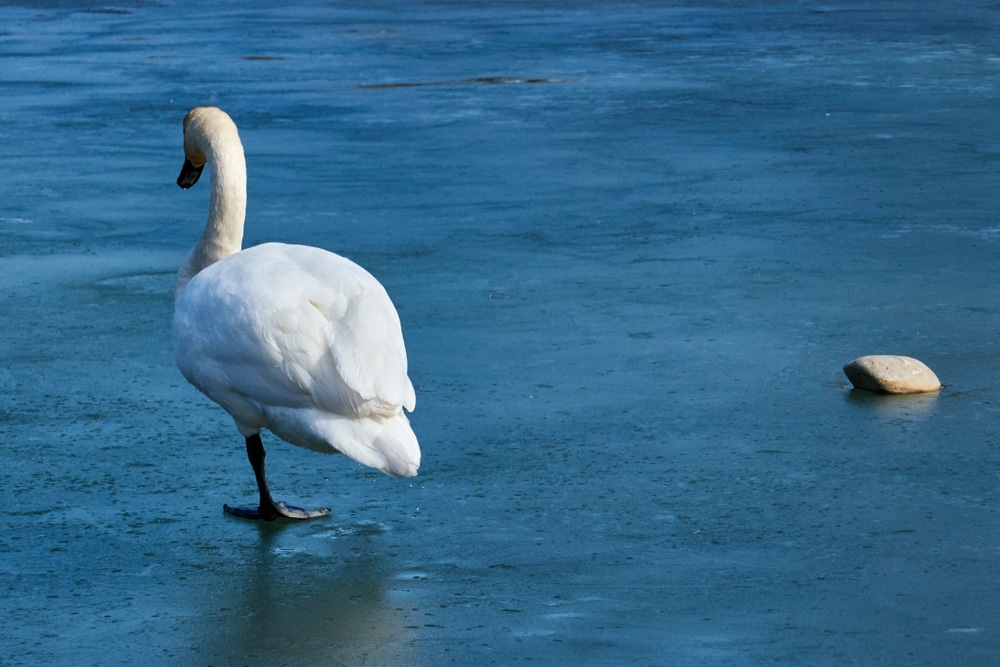
The uropygial gland secretion that waterproofs feathers also prevents ice from bonding to the plumage, a finding documented by the Leibniz Institute for Zoo and Wildlife Research, which notes this oil “protects them from the cold and from freezing.”
When birds genuinely freeze into ice, veterinary pathologists treat this as a post mortem finding, not a primary event. The animal was almost certainly already moribund weakened by disease, starvation, or injury to the point where it could no longer maintain position or circulation. Freezing becomes the final notation in a case file opened days earlier by infection.
Feeding as Transmission Mechanism
The most counterintuitive aspect of current guidance concerns feeding. For generations, park visitors have scattered bread for ducks, an act associated with kindness and childhood memory. Based on current epidemiological understanding, that practice now constitutes a public health risk.
When citizens feed waterfowl, they inadvertently create congregation points. Ducks and swans that would otherwise disperse across a water body cluster tightly around food sources, sharing respiratory droplets and contaminating the immediate environment with feces.
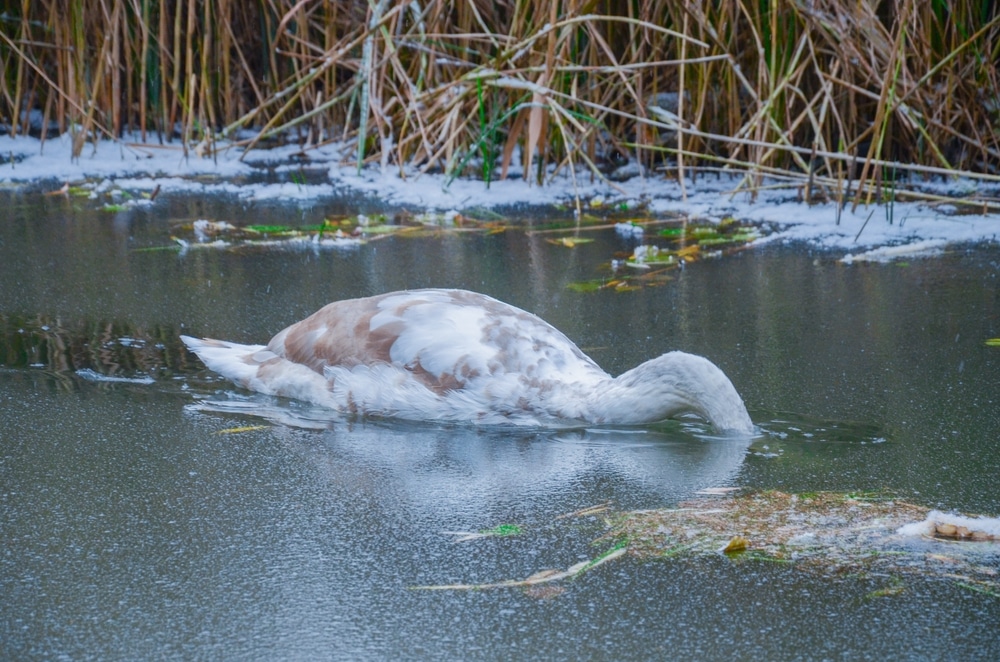
In a population where viral prevalence is elevated, this transforms a natural winter gathering into conditions where, as the Leibniz Institute researchers describe, “the risk of infection for each animal can increase massively.”
Berlin’s Landesjagdgesetz, or State Hunting Law, already prohibits such feeding, a restriction now reinforced by veterinary authorities across multiple jurisdictions. The prohibition is not about the nutritional quality of bread, though that is poor, but about the mechanics of viral transmission in concentrated populations.
Reporting Versus Rescuing
For the public encountering an apparently stranded bird, the recommended response contradicts immediate empathy. Officials advise maintaining distance and refraining from touching any sick or dead animal. The reasoning is twofold: personal safety, as avian influenza carries a zoonotic transmission risk, and epidemiological surveillance, as cadaver testing provides early warning of viral circulation.
Dead waterfowl, raptors, or corvids should be reported to local veterinary authorities, who determine whether testing is warranted and arrange removal when conditions permit. In Massachusetts, residents are directed to an online reporting form for wild bird mortality. In Pennsylvania, where autumn migration continues to seed virus, officials advise domestic flock owners to eliminate standing water that might attract wild waterfowl.
Dogs should be leashed near water bodies. Canines are susceptible to infection and can mechanically transfer virus on fur and feet, a transmission pathway documented in previous outbreaks.
The Shifting Epidemiology of H5N1
The current winter’s mortality must be understood against a backdrop of fundamental change in how the virus behaves. STAT News analysis of Department of Agriculture data indicates that January 2025 was the worst month on record for poultry losses, and 2025 collectively exceeded 2024, which exceeded 2023. Commercial layers absorbed 75 percent of those losses, with turkeys accounting for approximately 11 percent.
These figures reflect only confirmed commercial operations. Wild bird mortality is systematically undercounted, but surveillance programs confirm elevated carcass numbers, particularly among swans and raptors. The virus is not static. Scientists tracking genetic sequences note that while the circulating strain has not acquired mutations for efficient human transmission, the sheer volume of viral replication in bird populations increases stochastic probability.
First Appeared on
Source link






