


NASA Spotted This Comet as It Exploded, and It’s Full of Organic Chemicals
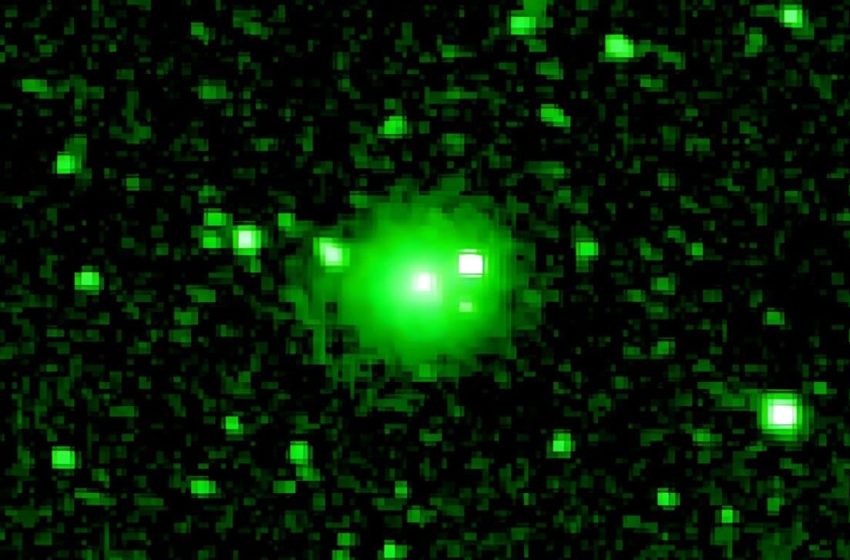
NASA’s SPHEREx space telescope has observed interstellar comet 3I/ATLAS flaring dramatically months after its closest pass by the Sun. Only the third confirmed interstellar object ever detected in our solar system, 3I/ATLAS is offering scientists a rare chemical snapshot of material formed around another star. The new findings expand the growing dataset gathered since its discovery in July 2025.
The mission, formally known as the Spectro-Photometer for the History of the Universe, Epoch of Reionization and Ices Explorer, was launched on March 11, 2025. Managed by NASA’s Jet Propulsion Laboratory, SPHEREx was designed to map the entire sky in 102 infrared wavelengths, primarily to study galaxy evolution and search for the ingredients of life.
A Delayed but Powerful Outburst
Comets heat up as they approach the Sun, causing surface ice to sublimate, shifting directly from solid to gas, and forming a surrounding coma. Peak heating occurs near closest approach, though peak activity can lag behind.
That delay appears to define 3I/ATLAS. According to a new research note cited by NASA, the comet’s December 2025 observations showed it “full-on erupting into space,” in the words of study lead Carey Lisse of the Johns Hopkins Applied Physics Laboratory. She added that:
“Even water ice was quickly sublimating into gas in interplanetary space. And since comets consist of about one-third bulk water ice, it was releasing an abundance of new, carbon-rich material that had remained locked in ice deep below the surface.”
The brightness increase recorded two months after perihelion aligns with the time needed for solar heat to penetrate deeper subsurface layers.
Organic Molecules Discovered in Deep Space
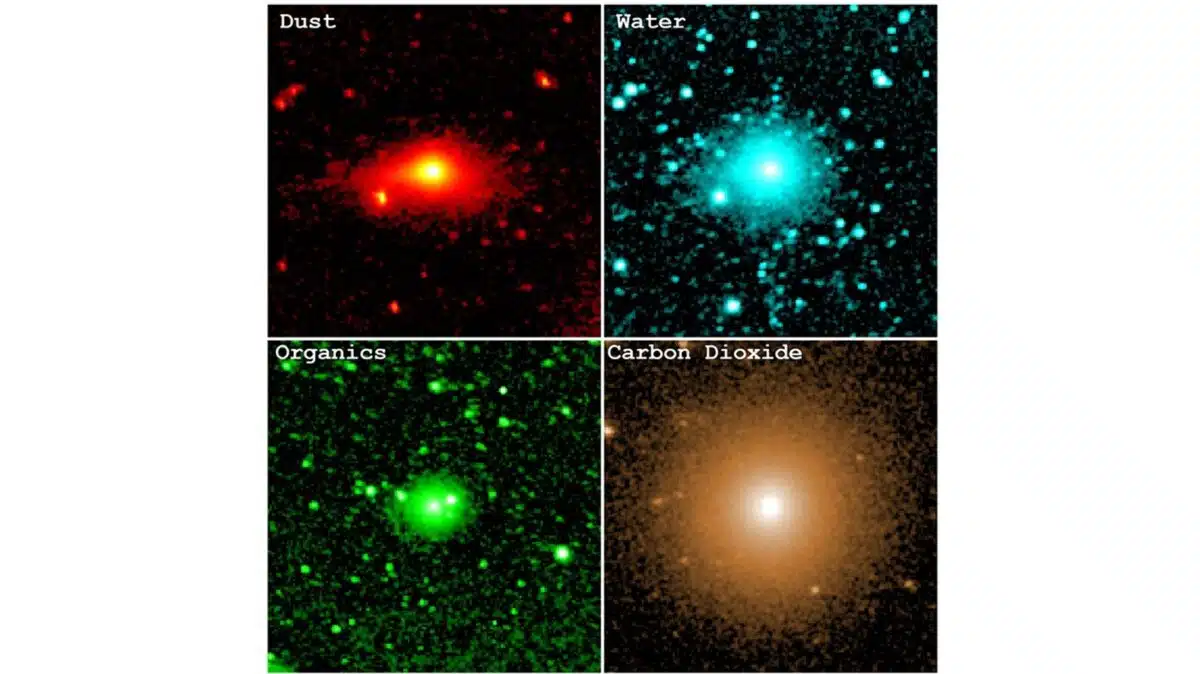
SPHEREx first observed the comet’s coma in August 2025, detecting large quantities of carbon dioxide, smaller amounts of carbon monoxide, and some water. The December data showed a more chemically diverse and active environment.
Based on data released by NASA, organic molecules such as methanol, cyanide, and methane were clearly identified in the coma. On Earth, such molecules underpin biological processes, though they can also arise through non-biological chemistry.
Instrument scientist Phil Korngut of Caltech explained that the comet likely developed a radiation-processed crust during its long passage through interstellar space. Highly energetic cosmic rays may have altered its surface layers over time. Once solar energy penetrated that crust, previously shielded ices began releasing what Korngut described as a “cocktail of chemicals” that had not been exposed to space for billions of years.
Dust, Debris, and a Perfect Cosmic Alignment
The observations also suggest that 3I/ATLAS is ejecting relatively large fragments. The comet displays only a small pear-shaped dust tail. As explained by the SPHEREx team, this indicates that large grains and BB-sized chunks, rather than fine dust, dominate the ejected material, as heavier particles are less easily swept away by solar radiation pressure.
Discovered on July 1, 2025, by the NASA-funded ATLAS (Asteroid Terrestrial-impact Last Alert System) telescope in Chile and reported to the Minor Planet Center, 3I/ATLAS was quickly identified as interstellar due to its high velocity and trajectory.
SPHEREx completed its first all-sky infrared map in late 2025, one of four planned surveys. As deputy study lead Yoonsoo Bach of the Korea Astronomy and Space Science Institute explained, the telescope was uniquely positioned when the visitor entered the inner solar system. “Science is sometimes like that,” he noted.
First Appeared on
Source link






