



What Happens When You Capture Light Speed in a Photo? Scientists Have the Answer!
For the first time in history, scientists have succeeded in visually capturing the speed of light. Through an innovative use of high-speed photography and lasers, researchers have managed to photograph light as it moves, revealing its behavior at speeds near the cosmic limit. The groundbreaking achievement brings light-speed motion into clear view, offering both a glimpse into the nature of light and new possibilities for the future of physics.
The research, published in Communications Physics, marks a historic moment in physics, allowing scientists to witness an effect described in Einstein’s special relativity theory. The team, based in Vienna, demonstrated how objects look when traveling at light speed.
A Century-Old Hypothesis Made Real
The cornerstone of this achievement is the Terrell-Penrose effect, a phenomenon first theorized nearly a century ago. According to this effect, an object moving at the speed of light would appear slightly rotated in photographs rather than simply distorted or compressed.
In 1924, physicist Anton Lampa first posited that a moving object would seem to change shape as it approached the speed of light. Later, Roger Penrose and Nelson James Terrell independently expanded on Lampa’s work, concluding that light-speed objects would appear in a rotated form, not as the compressed or distorted shapes that one might expect.
As stated in the study, the team from the University of Vienna and the Vienna Center for Quantum Science and Technology (TU Wien) recreated this effect using a combination of lasers and high-speed cameras. In a paper, Peter Schattschneider, a researcher specializing in quantum physics and relativity:
“If you wanted to take a picture of the rocket as it flew past, you would have to take into account that the light from different points took different lengths of time to reach the camera,” he explained, “This makes it look to us as if the cube had been rotated.”
High-Speed Photography and Laser Technology: Capturing the Impossible
One of the primary challenges of photographing light at its true speed is the sheer rapidity of its movement. At 299,792 kilometers per second, light moves far too fast to capture using traditional photography.
“We illuminate the object with a pulsed laser and take a photo after a certain delay time. Light reflected from parts of the object that correspond to the respective optical path length will appear bright in this photo,” the authors said.
Each photograph captured a “slice” of light reflected from the object, and by combining these slices, the team was able to create a continuous image of the object in motion.
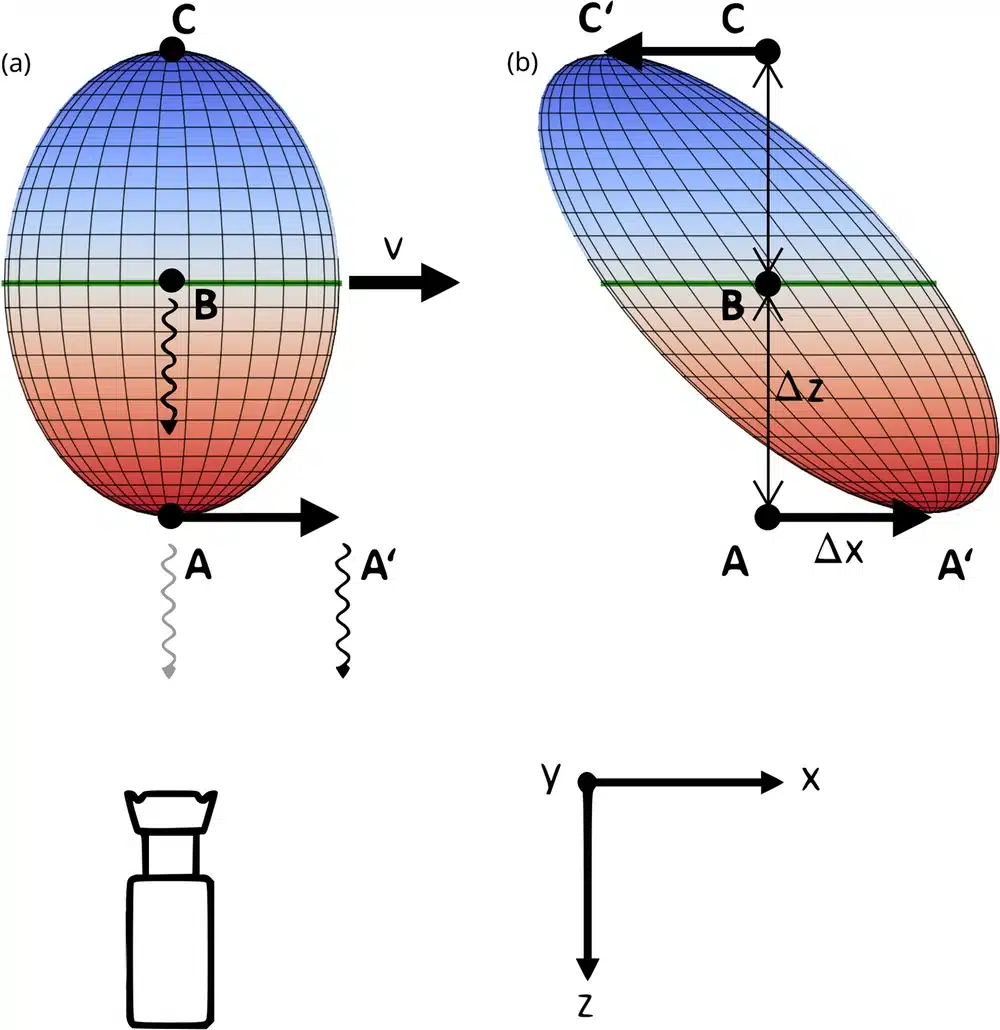
This process allowed scientists to slow the speed to just two meters per second. They observed a twisted cube, a spherical object maintaining its shape, and the shifting North Pole. These phenomena, visible only at light-speed, revealed unexpected changes in appearance.
A New Era for Relativity Research
This breakthrough in light-speed photography could revolutionize the study of special relativity and particle physics. As noted by the researchers, the same technology could be applied to study other relativistic phenomena, such as the behavior of subatomic particles in accelerators like those at CERN.
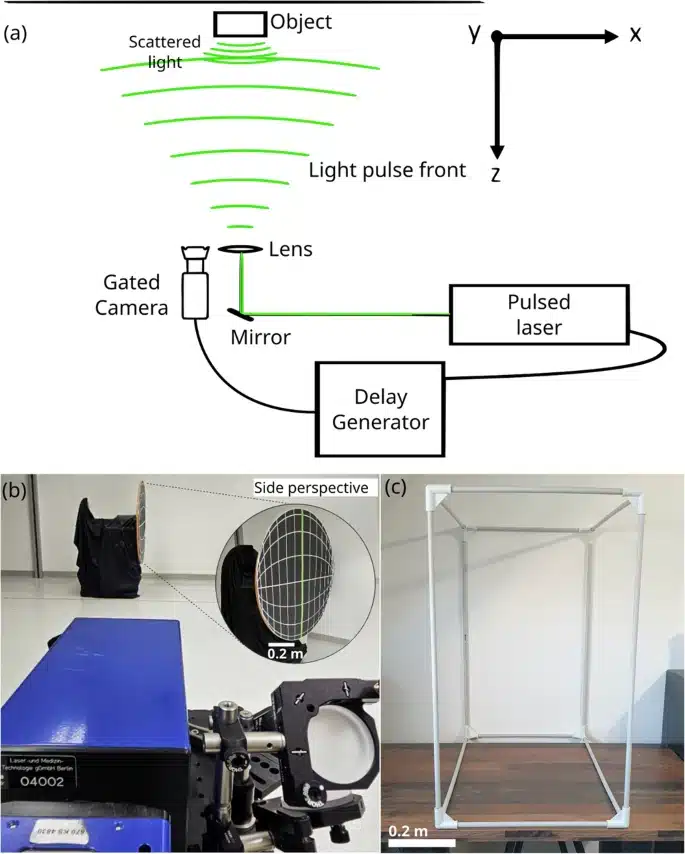
The ability to photograph light in motion also opens up exciting possibilities for future research in astrophysics and cosmology. As the technology is refined, it could allow scientists to investigate phenomena such as black holes, the behavior of light near massive objects, and even time dilation effects predicted by relativity. With this new tool in their arsenal, physicists are now able to explore the nature of light and motion in ways that were once only possible in theory.
First Appeared on
Source link






