



ICE Expands Watchlist Effort – Ken Klippenstein
Today we learned about the resignation of homeland security spokesperson and resident shock jock Tricia McLaughlin, who cast Renee Good and Alex Pretti as domestic terrorists before their bodies were even cold.
But when I reported on homeland security’s secret watchlists last month, I learned that there was one word that even a firebrand like her wasn’t willing to say.
“There is NO database of ‘domestic terrorists’ run by DHS,” McLaughlin said in a statement.
It is also today of all days, as McLaughlin prepares to exit the public stage, that I learned a DHS contractor is looking for a “Criminal Analyst” to join their company to help ICE with its evidently growing watchlisting effort.
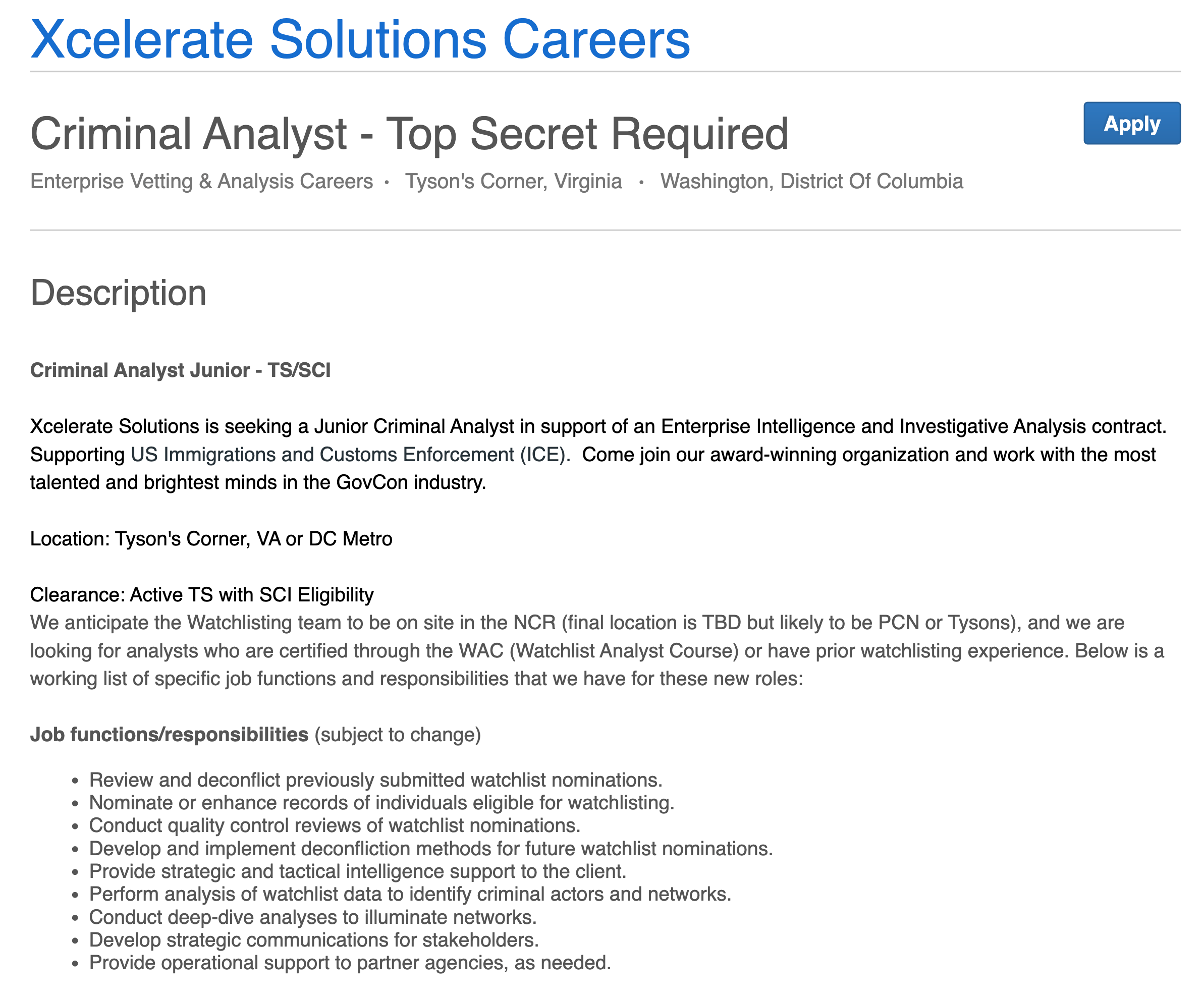
The company, Xcelerate Solutions, is looking for a Top Secret-cleared analyst to join the “watchlisting team” for the purpose of “Supporting US Immigration and Customs Enforcement (ICE),” to quote from the job announcement.
Xcelerate is a DHS, Pentagon, and FBI contractor founded in 2009 and intimately involved in the government’s larger “vetting” operation, from assisting the government in clearing its own personnel for access to classified material to then spying on those very people to ensure that they don’t leak that material.
The job announcement is graciously explicit about the work involved:
-
“Analysis of watchlist data to identify criminal actors and networks,”
-
“Nominate or enhance records of individuals eligible for watchlist,” and
-
“Review and deconflict previously submitted watchlist nominations.”
In other words, ICE has an entire watchlist apparatus that seeks out “criminals,” primarily illegal aliens and transnational criminals. This criminal analyst job might only refer to those individuals, especially because it uses the label “criminal” instead of terrorist to describe the target group. And that’s been ICE’s role—that is, before Donald Trump.
McLaughlin and others at DHS were forced to issue their denials of the existence of a domestic watchlist after a federal agent in Maine was recorded telling a protester who was filming him: “We have a nice little database and now you’re considered a domestic terrorist.”
ICE Acting Director Todd Lyons told Congress last week: “I can’t speak for that individual, but I can assure you that there is no database that’s tracking United States citizens.”
All of these denials rely on technicalities, my sources say. Officials argue that because their lists, records, investigative files, tip-offs, warnings and the like aren’t specific databases, they aren’t officially “watchlists.”
In the national security world, a “watchlist” is a specific legal term of art to describe the Terrorist Screening Dataset, which itself used to be called the Terrorist Screening Database because it once referred to one single watchlist (now there are many). By claiming they don’t have a “watchlist,” homeland security isn’t saying they aren’t tracking people; they are saying they aren’t using that specific administrative bucket. At least, that was before the job announcement revealed that indeed ICE was referring to a watchlist of its own.
The terminology is indeed confusing, intentionally so. The job description says “Targeting Folders,” “Continuous Evaluation Files,” or “Identity Intelligence Clusters.” Note the job description’s use of the word “Deconfliction.” That’s only necessary when there are multiple agencies doing overlapping things. You can’t have a “deconfliction” process if there isn’t a list to conflict with in the first place.
Last month I reported on the existence of several such watchlists maintained by the Department, with codenames like Sparta, Reaper and Grapevine. A senior DHS watchlist official who saw the story acknowledged to me privately that they exist but insisted that they aren’t technically watchlists. I don’t doubt he believes that. But these systems process and store identifying information about domestic targets. Some are apps, I’m told. Some are databases of specific data. But they are all watchlists or parts of an above Top Secret watchlisting enterprise.
Now, ICE is building a new watchlisting enterprise (the job announcement itself says the location in Northern Virginia hasn’t yet been decided) and though this specific “criminal” analyst might be assigned to target and track individuals other than Americans exercising their First Amendment rights, it’s not hard to see where this is heading.
Major media outlets have largely accepted the official denials that there is any watchlist, rather than examining the evidence. The problem stems from media norms that require documents to literally contain specific words before reporters will use them. In this case, that means waiting for a document stamped “WATCHLIST.”
But that’s rarely how these things work, especially when it comes to risk-averse bureaucrats who are masters at avoiding controversy by employing euphemistic language that says nothing.
I encountered the same dynamic when reporting on Mayor Mamdani’s short-lived reassignment of NYPD Commissioner Jessica Tisch. I called the new reporting structure—moving from direct report to the previous mayor to reporting through a deputy—a demotion. When Mamdani denied it was a demotion, media outlets criticized me for not using his language.
When a reporter refuses to call a demotion a ‘demotion’ because the Mayor says it’s a ‘realignment,’ they aren’t being objective — they are being a stenographer. The same deference to official language over common sense is why the media won’t say ‘watchlist.’
Lewis Carroll captured this problem perfectly in Alice in Wonderland:
“When I use a word,” Humpty Dumpty said in rather a scornful tone, “it means just what I choose it to mean—neither more nor less.”
“The question is,” said Alice, “whether you can make words mean so many different things.”
“The question is,” said Humpty Dumpty, “which is to be master—that’s all.”
I believe in calling things what they are.
— Edited by William M. Arkin
First Appeared on
Source link






