


Hypermobile EDS afflicts thousands in Wisconsin | Health
About 28 years ago, a woman walked into Dr. Nathan Rudin’s office with chronic pain from Ehlers-Danlos Syndrome, or EDS, and asked him for help.
He’d just finished his residency in physical medicine and rehabilitation at Northwestern University and was working as an attending physician at Johns Hopkins University.
And yet he had no idea what the woman was talking about.
“We were all taught in medical school that EDS is rare,” Rudin said. “You’re never going to run into this thing, so don’t worry about it.”
For many years, Rudin didn’t. So when the woman came into his office talking about EDS, he responded with a question: “What’s that?”
“You’ll know when I’m through with you,” he recalled the woman saying.
It was something like a prophecy.
Rudin is now a physiatrist, or a rehabilitation physician, at UW Health. He helps people with disabilities of all types — spinal injuries, strokes, brain trauma, chronic pain and more — improve their function and quality of life. He specializes in hypermobility disorders, characterized by abnormal flexibility from loose tissues. Essentially, he’s become an expert in EDS.
His waitlist includes about 900 people.
“Because everyone thought it was rare, nobody knew what to do with it,” Rudin said. “So those few of us who had some interest and some knowledge became very popular people all of a sudden.”
He estimates roughly 12,000 people in Wisconsin are living with hypermobile Ehlers-Danlos Syndrome, or hEDS, the most common type of EDS out of 14 variants. But only a handful of doctors know how to make the diagnosis in the state.
This lack of awareness means people struggle to get diagnosed and access the care they need. Many go decades without knowing what is happening to their bodies, why it’s happening or how to take care of themselves.
Rudin and other practitioners at UW Health are determined to teach others in both academic and clinical settings how to recognize and provide care for people living with the chronic condition, through both academic and clinical settings.
“It’s hard to have a condition that is not well understood. But we know that people are out there. And we really want to help them,” Rudin said. “There’s lots of learning to be done. There’s lots of teaching to be done.”
‘Something unique is going on’
The prevalence of hEDS is roughly one in 500 people. The other 13 types range anywhere from one in 20,000 to one in a million.
But hEDS is a distinct condition, Rudin said. While all 14 types involve hypermobility and fragile tissue, hEDS is the only variant without a known genetic marker, which means it can’t be genetically diagnosed like other types. Researchers don’t know what causes hEDS, other than that it’s inheritable from parent to child.
The unknown mutation of a specific gene or set of genes affects the connective tissue found all over the body. That means hEDS is a multisystem disorder, affecting anything and everything from the brain to the toes, eyes and bones.
“There’s evidence that something unique is going on biologically here,” Rudin said.
The condition often manifests as chronic pain, postural issues and an array of other symptoms, including heart and digestive problems, migraines, neurodivergence and dysautonomia — disruption to the body’s involuntary functions, like breathing and heart rate.
People with hEDS may be diagnosed with a multitude of related, comorbid conditions, like autism spectrum disorder, irritable bowel syndrome, and postural orthostatic tachycardia syndrome — an abnormal increase in heart rate when standing without a drop in blood pressure.
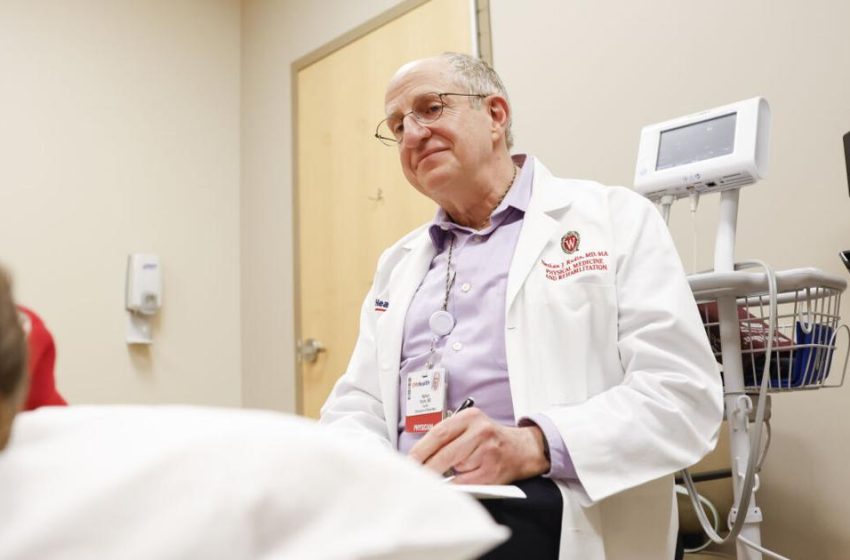
Dr. Nathan Rudin at the UW Health Park Street Clinic in Madison.
“There’s a perception that patients with these conditions are very complex and can be very difficult to manage,” Rudin said. “They are very complex. They can be difficult to manage in part if people automatically come in with that attitude. It can be a bit of a self-fulfilling prophecy.”
While it lacks a genetic basis for diagnosis, hEDS is deceptively simple to diagnose, Rudin said. The problem is that physicians don’t know to look for it and don’t feel comfortable trying to diagnose it.
Scientists from an international research group, called the Ehlers-Danlos Society, said in October that over 99% of people correctly diagnosed had used the current hEDS diagnostic criteria.
The criteria for diagnosing hEDS are based on three categories. Practitioners use a Beighton Score to determine a person’s level of hypermobility. This measure involves various maneuvers, like having patients bend their thumb toward the inside of their forearm and reaching down to touch the floor without bending their knees.
Medical professionals also look at family history and other symptoms unrelated to joint issues, such as skin elasticity. The last step is where things get “fuzzy,” Rudin said, and involves trying to rule out other connective tissue disorders.
The entire diagnostic test is one page.
“(Clinicians) can learn to do that,” Rudin says. “You don’t need to take a massive, days-long course in order to do it. You don’t need to go back to school. You can get the skills to do it.”
Barriers in recognizing EDS
Obtaining a diagnosis for hEDS takes an average of 10 to 16 years, according to a 2024 study of international EDS support groups. Rudin said many people wait more than two decades.
Brielle Aylesworth knows that experience well. Aylesworth first heard about EDS in high school after a friend received a diagnosis. She knew little about the condition at the time.
She said she had always been more flexible than people expected — popping into the splits at the drop of a hat — but didn’t think anything of it. So, when she dislocated her knee for the first time at age 13 while figure skating, hEDS wasn’t on her radar.
That changed 16 years later, when she tore the meniscus in her right knee playing softball. While recovering, she relied more on her left leg and the added stress became too much. The cartilage in that knee tore soon afterward.
Aylesworth had surgery, but eight weeks later — after going through physical therapy — she woke up and couldn’t walk. It took six months and three surgeons to convince someone that something was wrong.
Now 31 and living in Waupun, Aylesworth has been diagnosed with eight chronic health conditions but hasn’t been able to get an official hEDS diagnosis. A diagnosis would make accessing adequate treatment easier.
“It’s hard because with a diagnosis you don’t really get a whole lot of different treatment,” Aylesworth said. “But maybe at least I’d be able to know, ‘Oh, that party trick that you have isn’t a party trick and you probably should stop doing that.’”
Aylesworth said her physical therapist, along with her weight management doctor, knew little about hEDS when she mentioned the condition. When she asked for a referral, she obtained an appointment with a Madison physician — a different one than Rudin — who often diagnoses the condition. After waiting nearly 20 years for answers, that appointment is in March.

“ There are barriers in part because the condition is not well recognized,” Rudin said, “but then there are additional barriers because when the condition actually gets recognized, there are so few people to do the diagnosis and the care.”
Roxie Caswell said she went about four decades without an explanation for her childhood scars never fading.
“My skin just breaks apart where most peoples’ wouldn’t do that,” Caswell said.
While she was working at a Marshfield medical lab nearly three decades ago, a coworker approached her and surmised Caswell had EDS. The coworker said they had a patient with the same condition. Caswell mentioned the theory to her own doctor, who listed the symptoms but didn’t make a diagnosis.
About 9% of medical practitioners are comfortable with the most up-to-date diagnostic criteria for EDS, according to a 2022 study in the journal of Global Pediatric Health. A quarter of those clinicians didn’t know if any of their patients had EDS, though all had heard of the condition.
At age 54, Caswell said she met with a geneticist who estimated she has classical EDS, a variant that affects the skin more than hEDS. But Caswell’s insurance wouldn’t cover the tissue testing to make her diagnosis official.
Now 71, Caswell lives in Stanley with her husband and still doesn’t have a sure answer.
‘Could be my smoking gun’
If unable to find doctors with the knowledge and comfort to diagnose, people with EDS are, at best, left without answers, and at worst, dismissed, Rudin said.
When Brianne Miller was a young girl in gym class, she was labeled the “clumsy kid.” She struggled with pain, sleep and digestive issues. Her mom recognized something wasn’t right, taking her from one doctor to another, only for them to shrug at her daughter’s symptoms.
“They would say I had anxiety and I needed to be seen by a therapist or I was just looking for attention,” Miller recalled. “So I spent a good portion of my childhood and my teen years just kind of trucking along, really just struggling to do the things that teenagers are expected to be able to do and beating myself up over it.”
In her 20s, Miller couldn’t take it anymore. She pushed doctors to take her symptoms seriously and was rewarded with one diagnosis after another: chronic gastritis, irritable bowel syndrome, scoliosis, arthritis and more. But she never got a diagnosis to explain why all these issues existed.
Then in early 2025, while mindlessly scrolling through TikTok at her home in Janesville, Miller had a breakthrough. She watched a video of someone demonstrating the elasticity of their skin and noticed hers was similarly stretchy. More symptoms of hEDS appeared to overlap, too.
“As I saw the symptoms and all of that stuff, it was like, holy crap, this might be it,” Miller said. “Once I realized this could actually be something, like this could be my smoking gun, my explanation forever, I honestly got a little excited.”
Miller took what she learned to her doctor, who ran through the diagnostic checklist for hEDS in September 2025. She checked every box except being able to bend her thumb backward, she said.
Brielle Aylesworth, 31, grew up playing softball and doing figure skating. She suspects her hypermobility led to the multiple knee injuries that prevent her from participating now.
Most primary care physicians don’t think to test for hEDS, Rudin said. They may refer patients to a rheumatologist for joint pain, a specialist for stomach issues, and a cardiologist if the person gets dizzy or faints. The patient then accrues a list of comorbid conditions, like postural tachycardia syndrome, characterized by low blood pressure, temperature dysregulation and digestive issues.
But they walk away without an idea of what’s causing the symptoms: hEDS.
“People feel very medically ignored or bounced around from specialist to specialist to specialist,” Rudin said.
That’s what happened to 44-year-old Allison Weber from Green Bay. As a kid, Weber did every sport she could think of, simply because she could move and stretch her body in ways that others couldn’t: gymnastics, soccer, volleyball, dance, ice skating and eventually track.
Since then, she’s torn cartilage in her knee more times than she can count and tried every method of easing the pain, from steroid injections in high school to her current schedule of cold therapy injections every six months to block nerve pain.
Her symptoms spread to her wrists, shoulders and eyes before her doctor referred her to a geneticist, who diagnosed her with hEDS in her 20s.
But being careful couldn’t prevent her many other hEDS symptoms, including migraines, brain lesions, mast cell activation syndrome, anxiety and fatigue. Weber sees specialists for these symptoms, takes 42 medications, receives physical therapy and yet has never been able to find a doctor who specializes in hEDS.
“I have no idea what doctor is even supposed to be managing my EDS,” Weber said. “I’m constantly trying, but it’s so draining, emotionally, just making these phone calls and getting on all of the waiting lists.”
Movement for more awareness
Weber, Aylesworth and Miller said the key to making change is “awareness.” And Rudin agreed.
“Providers need to learn what is actually going on,” he said. “Knowledge is power, as far as this goes, and they don’t know a lot.”
Rudin has incorporated lectures about EDS into the University of Wisconsin-Madison’s medical school curriculum, hoping to expand awareness in academia. He’s also given lectures to various clinical departments to “sensitize” them to the condition and helped create an addition to UW Health’s electronic records that can help assess, diagnose and begin treatment for people with EDS.
“My hope is to get people more facile with this so that they know what to do for this population,” Rudin said. “I’m trying to train up other people as much as I can, both in the specialty arena and outside, so that we can take better care of these folks.”
Part of this educational training has extended to physical therapists like Daniel Deuel, who met Rudin while working in UW Health’s Pain Clinic. Deuel sees physical therapy as a way to make up for the lack of comfort in making hEDS diagnoses.
“Not many physicians are necessarily as hands-on with patients or as familiar with the musculo-skeletal system to that degree of intimacy,” Deuel said. “And that’s where physical therapy comes in.”
Deuel said physical therapists have an advantage in recognizing abnormal ranges of motion, skin irregularities and unusual scarring typical among people with EDS.
Rudin started training the Pain Clinic’s therapists to complete the diagnostic workup for people with hEDS in 2025. Though they can’t make an official diagnosis, completing the workup makes accessing future care easier, Deuel said.
Key to making this change is raising awareness among providers and universities, especially around how common hEDS really is, he added.
“Health care providers are taught, ‘If you hear hoofbeats, think horses, not zebras,’ because in America — in the West — if you’re hearing hoofbeats, it’s probably a horse, not a zebra,” Deuel said. “But sometimes it is a zebra.”
Part of instilling this message comes from public health campaigns.
EDS Wisconsin, an advocacy group, facilitated Gov. Tony Evers’ declaration that May 2025 be an awareness month for EDS and other hypermobility spectrum disorders. The Ehlers-Danlos Society continues to raise awareness and boost research around genetic ties to hEDS, despite cuts to the National Institutes of Health threatening funding for research more broadly.
Rudin takes this as a sign of reassurance.
“There are doctors out there who care,” Rudin said. “We don’t have perfect answers, and we probably don’t have fast answers to all the questions and solutions to all the problems. But we really are working on it.”
First Appeared on
Source link






