


Did you change your name when you got married? This proposed voting law could affect you
WASHINGTON – Congress is weighing legislation that would impose strict new proof-of-citizenship requirements to vote, a measure critics warn could prevent millions of eligible Americans from casting ballots, including women who changed their names after marriage.
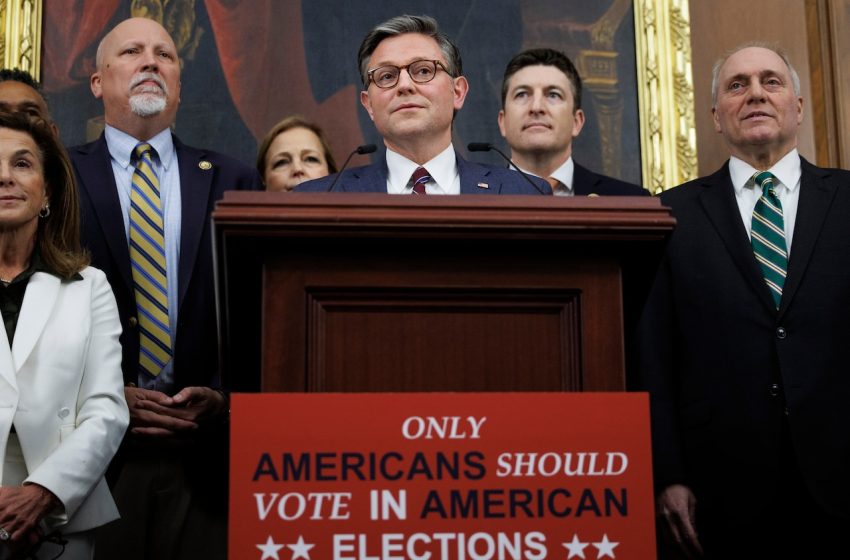
The SAVE America Act passed the U.S. House of Representatives last week in a mostly party-line 218-213 vote. It had support from all Ohio Republicans, who regarded its requirements as commonsense election security, and opposition from Ohio Democrats who condemned it as thinly disguised voter suppression.
Critics say the measure should be particularly alarming for the estimated 70 million American women who changed their names after marriage, as it would make it harder for them to prove they are U.S. citizens for voting purposes because their birth certificates no longer match their names. Voting rights advocates warn the legislation is part of a broader Republican push to reshape the electorate ahead of November’s midterm elections, where control of Congress is at stake.
“Trump said he would be a dictator on Day One – and blocking millions of citizens from voting is the next step,” said a social media statement U.S. Rep. Shontel Brown, a Warrensville Heights Democrat, posted before the vote.
“Democrats say voter ID is a barrier,” said a social media statement from U.S. Rep. Max Miller, a Bay Village Republican “The truth? They oppose this bill because secure elections don’t benefit them.”
The legislation would require presentation of documentary proof of citizenship — such as a valid U.S. passport or birth certificate — when registering to vote. It would also require valid photo identification before voters can cast ballots, requirements that go beyond what most states currently demand. States would also be required to share voter information with the Department of Homeland Security to verify citizenship.
The bill faces uncertain prospects in the U.S. Senate, where 60 votes are typically required to avoid a filibuster. The Republican party’s 53-vote majority often isn’t enough to overcome that requirement.
Senate Democratic Leader Chuck Schumer, a New York Democrat, has called the legislation “dead on arrival” in the Senate, comparing it to Jim Crow-era voting restrictions.
The bill’s House sponsor, Texas Republican Chip Roy, wants the Senate to skirt the 60 vote requirement by forcing Democratic opponents to deliver continuous speeches on the Senate floor until one side gives out.
Both of Ohio’s Republican U.S. Senators support the bill.
“This is very simple — if you aren’t an American citizen, you can’t vote here,“ said a statement from U.S. Sen. Bernie Moreno, a Westlake Republican, who described it as ”commonsense reform” that he’s shocked anyone could disagree with.
Federal law already prohibits voting by non-citizens in federal elections. Ohio law also forbids voting by non-citizens.
U.S. Sen. Jon Husted, a Columbus-area Republican who formerly served as Ohio’s top election official, told NewsMax that requiring voter ID has worked well in Ohio, with high voter turnout levels.
“It doesn’t create voter suppression, as the Democrats allege,” said Husted, who was Ohio Secretary of State from 2011 to 2019. “We show an ID for so many things that we do every single day, and we should do it to vote. And if the Democrats really want to restore confidence in elections, then show people that you’re willing to run them legitimately with photo ID in place.”
The League of Women Voters, a non-partisan voter rights organization, denounced the legislation as “a direct attack on freedom to vote.” In a statement, the group said it is “about restricting access to the ballot and deciding who gets to participate in our democracy.”
Millions of eligible voters could be blocked from casting a ballot under its restrictive documentary proof of citizenship requirements, the statement said. That includes voters who are already properly registered and previously provided proof of citizenship “but could still be turned away at the polls if they do not bring a passport or other qualifying document with them on Election Day.”
“Under the false banner of ‘election integrity,’ lawmakers are advancing policies designed to block lawful voters from participating in our elections,” the League of Women Voters’ statement said, adding the bill’s provisions would particularly affect “rural voters, voters of color, and nearly 70 million married women who have changed their last names, along with other voters who have been historically marginalized and already face barriers to casting a ballot.”
The legislation would require Americans to present “documentary proof of United States citizenship” when registering to vote in federal elections. Acceptable documents would include a U.S. passport, a REAL ID-compliant identification card that indicates citizenship, certain military records showing a U.S. birthplace, or a government-issued photo ID accompanied by a certified birth certificate, naturalization certificate, or similar documentation.
For voters whose names don’t match their citizenship documents — a situation affecting millions of married women whose birth certificates show their maiden names — the bill directs states to “establish a process” for handling such discrepancies.
Applicants could “provide such additional documentation to the appropriate election official of the State as may be necessary to establish that the applicant is a citizen of the United States in the event of a discrepancy with respect to the applicant’s documentary proof of United States citizenship,” the legislation says.
The bill does not specify what documents would be acceptable for resolving name mismatches, leaving that determination to individual states and guidance from the Election Assistance Commission.
The legislation also includes a fallback provision for applicants who cannot provide the required documentary proof. Under this process, such applicants could sign an attestation under penalty of perjury that they are U.S. citizens and submit “such other evidence” to demonstrate citizenship. A state or local official would then determine whether the applicant has “sufficiently established United States citizenship” for voter registration purposes and would be required to sign an affidavit explaining the basis for that determination.
By requiring documentary proof of citizenship and leaving the resolution of name discrepancies to state-by-state processes that have yet to be developed, the bill creates barriers that could prevent eligible voters — including women who changed their names after marriage — from registering to vote, critics argue.
A statement from Brennan Center for Justice President and CEO Michael Waldman said the legislation would “effectively require every American to produce a passport or birth certificate each time they register or re-register to vote.”
More than 21 million American citizens do not have those documents readily available, roughly half of Americans lack a passport, and millions don’t have easy access to a paper copy of their birth certificate, Waldman said in his statement. Millions more women whose married names are not on their birth certificates or passports would face extra steps just to make their voices heard, the statement said.
In addition, it said the SAVE America Act would eliminate or upend most methods of registering to vote. Mail and online registration would be essentially abolished, as would voter registration drives that add hundreds of thousands of citizens to the rolls every election cycle. Automatic voter registration would be severely limited in states across the country.
“There is no evidence of widespread voter fraud that justifies imposing burdensome show-your-papers requirements on every eligible voter,” said a statement from Xavier Persad, senior policy counsel for ACLU’s National Political Advocacy Department. “Laws like this have historically resulted in many eligible citizens being delayed or denied access to the ballot due to paperwork issues, database mismatches, or bureaucratic error. What we are seeing from elected officials: seizing sensitive voter data, calls to ‘nationalize’ voting, using violent federal agent presence as a bargaining chip — none of this is normal and we must protect our voices and our ability to hold these officials accountable.”
‘Designed to trip people up’
Ohio Republicans, like Husted and South Russell Republican Rep. Dave Joyce don’t believe the legislation’s provisions would block married women who adopted their husband’s last name from voting.
“The legislation I supported tonight takes critical steps to prevent voter fraud and ensure our voter rolls only contain U.S. citizens, while also taking steps to ensure individuals with name discrepancies, like married women, can seamlessly participate in our elections,” said a statement Joyce released after the vote.
Akron Democratic Rep. Emilia Sykes isn’t convinced.
She has repeatedly warned the bill would disproportionately harm women, people of color, young voters, and people with disabilities.
“In Ohio alone, more than 3.5 million women have or are married, and more than three quarters of these women have changed their name when they married,” Sykes said in a video posted to social media. “Under the Save Act, if your current name does not exactly fit and match the name on your birth certificate or citizenship papers, you could be blocked from registering to vote, even if you are a lifelong naturalized or American born citizen. That is a bureaucracy that’s designed to trip people up and keep people from voting.”
Sykes, who serves as vice chair of the Democratic Women’s Caucus, pointed to Ohio’s experience with strict voter ID laws as evidence that such measures don’t reduce fraud but do reduce participation.
“In Ohio, where we have some of the strictest voter ID laws, we have seen what happens when you implement them,” said Sykes. “The level of voter fraud is the same, but the amount of people who are not registered to vote increases substantially … The amount of voter engagement decreases, and particularly amongst people of color, young folks, the disabled, and guess what, women. This is not a design flaw. It is the purpose.”
First Appeared on
Source link






