


Hundreds Of Dead Geese Found On Beach In Jamesport, Across Long Island; Residents Search For Answers
(Warning: This post contains images of deceased geese).
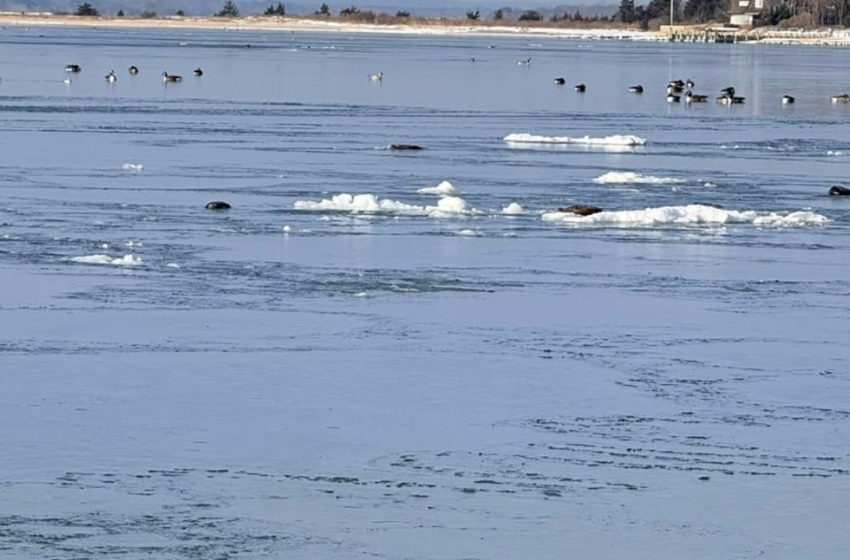
JAMESPORT, NY — In a sight that’s broken hearts around the East End and beyond, residents have reported seeing hundreds of dead geese littering the shorelines, and even floating out on the ice in the Peconic Bay
Maria Orlando Pietromonaco of South Jamesport wrote on Facebook: “Yet another neighbor reported counting 106 dead geese on the beach today.”
Find out what’s happening in Riverheadfor free with the latest updates from Patch.
Pietromonaco said she’d heard hundreds of Canadian geese honking overhead during the night, “some waddling through the streets, others perched all alone in various places. At least 15 dead, others look very sick.”
Pietromonaco and others speculated whether the geese were dying of starvation — with all food and water sources encased in ice — or from avian influenza.
Find out what’s happening in Riverheadfor free with the latest updates from Patch.
Amanda Devaux said she had been walking on the South Jamesport Beach at Miamogue Point and seen two deceased and three “ill-looking” Canadian geese. “It’s sad to see,” she said.
Devaux said she believed the large die-out of geese must be related to the avian flu. “Just too many sick one day and dead the next. We actually saw one flying and then just flew into the beach and was dead within minutes. The ones still alive on the beach seem disoriented and stumble. Some don’t even move when we walk by.,” she said.
The New York State Department of Environmental Conservation said it has had reports of more than 100 geese or ducks in the Jamesport area along the Peconic Bay, in addition to numerous reports of dead or sick waterfowl throughout Nassau and Suffolk counties.
Three birds were recently collected on February 16, in the Jamesport area, to undergo testing for Highly Pathenogenic Avian Influenza, or HPAI, the DEC said.
The DEC said it currently does not have any confirmed HPAI detections on the North Fork of Long Island during the 2025 to 2026 HPAI season; however, that does not mean there are not HPAI mortalities in wild birds in the area, the DEC said.
The DEC targets larger die-offs — 20-plus geese — or interesting species. The public should strongly consider that groups of birds found deceased are HPAI positive and should follow CDC safety protocols to reduce contact, the DEC said.
The DEC advised the public to avoid any contact with sick or dead birds and mammals that may be infected with HPAI.
HPAI continues to infect birds and mammals across the U.S. and Canada, including New York State, the DEC said.
HPAI is carried by free-flying waterfowl and other waterbirds, such as ducks, geese, and shorebirds, but can also infect domestic poultry, raptors, corvids, and mammals, the DEC said.
The DEC’s wildlife health program is monitoring the spread and impact of HPAI throughout the state and has an online reporting tool the public can use to report suspected HPAI mortalities:
Updates on HPAI can be found on the Cornell Wildlife Health Lab website.
There is no way to contain HPAI infection in wild birds, the DEC said, adding that the clinical signs for HPAI infection in wildlife are nonspecific and may be similar to other diseases or injuries.
Waterfowl, waterbirds, raptors, and scavenging birds are at higher risk of infection, but any species could potentially be infected, including mammals, the DEC said.
HPAI-infected birds may be asymptomatic or may exhibit signs of respiratory distress (sneezing or nasal discharge), lethargy, neurologic malfunction (ataxia, stargazing, or seizures), diarrhea, weakness, or sudden death, the DEC said.
Once a report is received, DEC’s field response is guided by the report’s details, including the number of sick or dead birds, bird species, and observations from new areas where HPAI has not yet been documented, the DEC said.
Of particular interest are reports of suspected outbreaks in all species of waterfowl, raptors, crows, shorebirds, and other waterbirds such as gulls, loons, and herons.
HPAI is widespread in wild birds and mammals, so not all reports will result in the DEC retrieving the animals for testing and/or disposal, the DEC said.
The public can help minimize risk and limit disease spread by preventing contact between domestic animals and wild birds, the DEC said.
In cases where DEC field staff are not responding to collect samples or carcasses from the landscape, the public should limit contact with dead wildlife and keep domestic animals away, the DEC said.
If removal of carcasses is deemed necessary, the public is reminded to wear disposable gloves, a mask, and eye protection — and to avoid direct contact with the carcass or carcass fluids by using a shovel and washing hands and clothing immediately after with soap and hot water. Carcasses should be triple bagged (garbage or contractor bags) and placed in an outdoor trash receptacle, the DEC said.
Get more local news delivered straight to your inbox. Sign up for free Patch newsletters and alerts.
First Appeared on
Source link






