


Why the U.S. dollar’s supremacy might be in real trouble this time
WASHINGTON (TNND) — The U.S. dollar has been a safe haven currency for several decades, but economic volatility, sanctions and now tariffs are prompting investors to consider other options. Some European officials believe they have a prescription to wean themselves off the dollar.
In recent months, investors flocked to gold and silver as they peered under every stone for someplace to park their cash. Bitcoin at one time was believed to be an alternative, until prices on the so-called gold-standard cryptocurrency tanked alongside riskier assets — the opposite of what is expected of a safe-haven.
Bitcoin has fallen almost 50% from its all-time highs early in President Donald Trump’s second term. It’s now hovering around $66,000.
FILE – Bitcoin tokens are seen on April 3, 2013, in Sandy, Utah. (AP Photo/Rick Bowmer, File)
Whether the Federal Reserve can maintain its largely independent status also drove up gold and silver prices and put unrelenting pressure on the U.S. dollar. Trump has been pressing for more influence inside the bank as he browbeats policymakers into easing up on borrowing rates, despite prolonged inflation concerns.
There are also fears that last year’s tax cuts will drive the national debt still higher as high interest rates increase cost of servicing the debt. Interest costs will grow by 76% over the next decade, going from $1 trillion in 2026 to about $1.8 trillion by 2035 if no serious intervention happens, according to a recent Congressional Budget Office estimate.
The dollar is likely to weaken further in the coming months, according to Cole Smead, portfolio manager at Smead Capital Management.
“We’re in a dollar bear market longer term,” he told CNBC at the end of January. “If you go back and look at these ‘American manias’ [in markets], if you go back and look at the telecom bubble and tech bubble the late 1990s, the dollar peaked in 2002 and within six years, you saw the dollar go to a low it hadn’t seen for [a] very, very long time.”
Reports show foreign holders of U.S. treasuries have fallen since Trump rolled out his stiff tariffs last April. The value of assets held at the New York Fed on behalf of foreign central banks is $2.7 trillion as of last October. It’s the lowest level since August 2012, Reuters reported last year.
The highest number of holdings — $2.9 trillion — came in March through April, which occurred around the time of Trump’s tariff announcement.
China’s holding of U.S. treasuries is also plummeting. Beijing now holds about $683 billion in treasuries, which is the lowest level since 2008, The Economic Times reported this month. At the same time, China is buying gold instead of bonds at a rapid clip, with its central bank marking its 15th straight month of purchases in January.
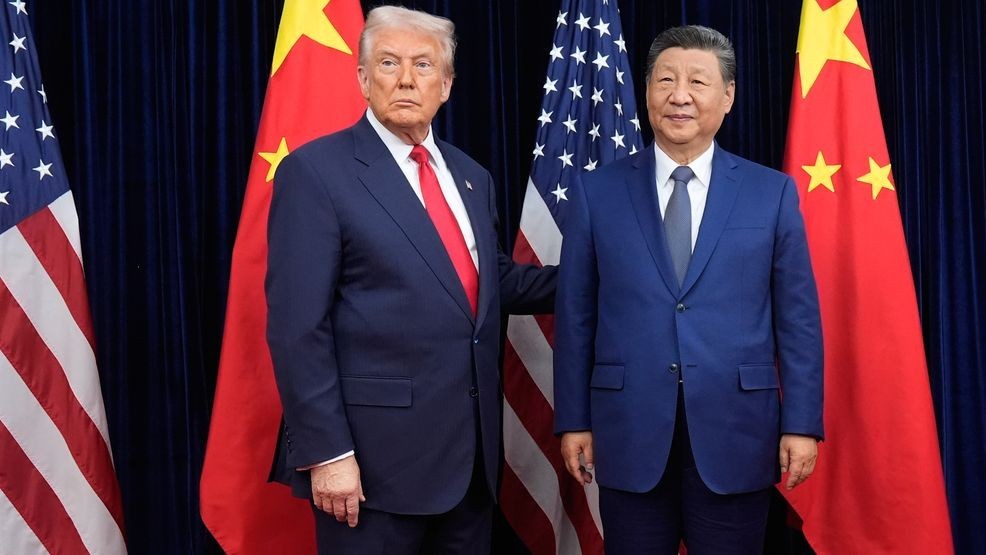
FILE – President Donald Trump, left, and Chinese President Xi Jinping pose ahead of their summit talk at Gimhae International Airport in Busan, South Korea, Oct. 30, 2025. (AP Photo/Mark Schiefelbein, File
This is prompting foreign investors and nations to weigh possible solutions, and especially regarding ways of diversifying payment methods. Whenever Europeans, for example, make a payment with a credit or debit card they are making themselves more dependent on the U.S.’s Visa and Mastercard services.
In the past, the U.S. has directed both companies to cut off their services to nations. That happened in 2022 when both companies shut off their payment method to Russia after the Kremlin’s Ukrainian invasion. While the move impacted Moscow at the time more than anyone else, European officials took notice.
European Central Bank president Christine Legarde raised a red flag, too. She said in a radio interview last year that this level of dependence needs to be addressed.
“It’s important for us to have digital payment under our control,” Legarde told The Pat Kenny Show. She went on to say that Europeans “rely on non-European infrastructure, the whole infrastructure mechanism that allows for payments, credit or debit, is not a European solution.”
Shortly after, there were reports of a solution.
Some of the bloc’s largest banks and payment processors developed the European Payments Initiative and launched Wero, which allows users in Europe to send money using just a phone number without a card or intermediary. So far, Wero has more than 47 million registered users in Belgium, France and Germany and has processed $8.5 billion dollars in transfers, according to the European Business Magazine.
The EBM pointed out that previous attempts failed because there were too many options and none of the payment solutions worked across borders. Sellers also accept Visa and Mastercard because consumers have long carried them, effectively locking in a large customer base, which creates a barrier for Wero in the market.
But Europeans who are supportive think there’s an appetite for the new method, given the volatility in American markets and shifts in geopolitics.
First Appeared on
Source link






