


Poison discovery shows early humans were very advanced hunters
On stone arrowheads left in a South African rock shelter, researchers found 60,000-year-old traces of plant poison.
A team working in Sweden and South Africa analyzed quartz tips from Umhlatuzana Rock Shelter in KwaZulu-Natal, South Africa.
A residue on one artifact can be a fluke, but repeats on older and newer arrowheads are harder to dismiss.
Layers that preserve time
Professor Sven Isaksson at Stockholm University led the chemical tests. His research tracks organic residues on ancient tools.
“Finding traces of the same poison on both prehistoric and historical arrowheads was crucial,” said Isaksson.
Umhlatuzana Rock Shelter sits in KwaZulu-Natal, and its deep layers hold stone tools from many occupations.
Independent dating suggests limited sediment mixing there, which helps keep artifacts tied to their original ages.
That kind of context matters because residue on the arrowheads is useful only if the layer stayed mostly intact.
The plant behind the poison
A bulb plant called gifbol (poison bulb), Boophone disticha, grows widely in South Africa and carries a very toxic sap.
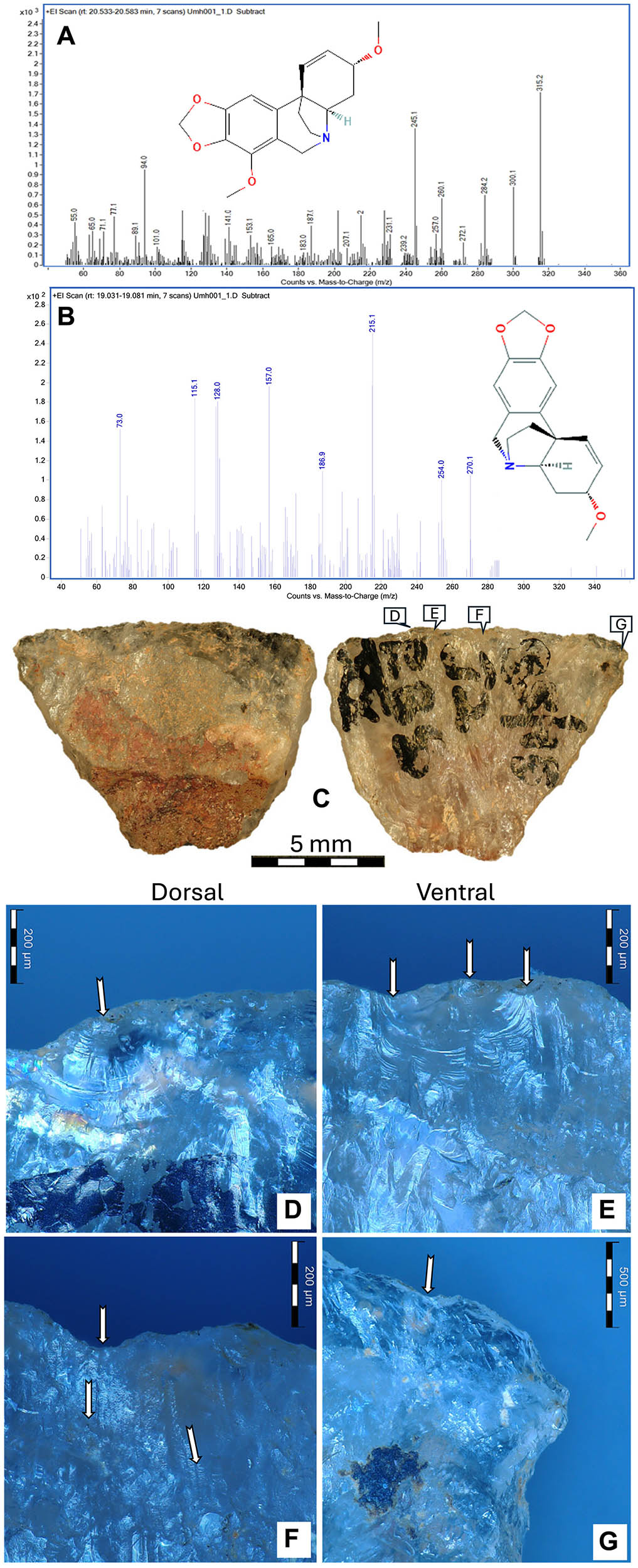
The alkaloids buphanidrine and epibuphanisine were recorded on five of the ten arrowheads. These plant chemicals are also found in all parts of the plant and can affect the nerves and hearts of animals.
Because the compounds match the plant’s composition so closely, the residue points to deliberate poisoning rather than an accidental smear.
Plant poisons work best when they reach blood, and a small wound can carry them quickly into tissues.
A modern case report describes bulb ingestion causing confusion and hallucinations, because its alkaloids disrupt chemical signaling in the brain.
![Boophone disticha (L.f.) Herb., microlithic poison arrowhead, and Umhlatuzana Rock Shelter.(A) B. disticha bulb and fan-like leaves (photo credit: A. Motala), (B) flowerhead (photo credit: G. Bowers-Winters), and (C) seeding structure (photo credit: R. Taylor). (D) An approximately 2000-year-old arrowhead from South Africa with transversely hafted microlith [(11); photo credit: by M.L.]. (E) Umhlatuzana Rock Shelter, with (F) the western profile exposed in 2018–2019, and (G) simplified stratigraphic drawing with ages in BP, the star indicating the layer from which the backed microliths were excavated. Credit: ScienceAdviser](https://cff2.earth.com/uploads/2026/01/13093812/arrowhead-poison_hunter-gatherers_60-thousand-years-ago_Science-Adviser_1m.jpg)
Hunting with delayed effects
For hunting, that slow breakdown in coordination can weaken prey over time, but the dose would have mattered.
Poison on a projectile does not need deep penetration, because the coating can act after a shallow cut.
Hunters could follow wounded animals for miles, then finish the kill when weakness set in.
That approach demands patience and teamwork, and it likely rewarded people who planned ahead and shared roles.
Plant poison on other arrows
A later set of arrow tips, kept in Swedish museum collections, carried a similar chemical signal.
Researchers found the same substances on 250-year-old arrowheads collected by travelers in the 18th century.
That match suggests the poison could persist in soil for ages, but it also hints at long-lived tradition.
Reading ancient chemistry
Laboratory work had to separate ancient molecules from natural grime left by the shelter and later handling.
The team used gas chromatography-mass spectrometry, a method that sorts chemicals by weight and timing, to identify specific compounds.
Even strong matches can mislead, so the best results come when chemistry and archaeology agree on context.
Modern fingerprints can leave oils behind, so residue studies need strict sampling and careful storage. Researchers sampled visible coatings away from touched edges, and they checked for common skin markers during analysis.
Those controls cannot erase every doubt, but they reduce the chance that later contact explains the poison traces.
Design and use of poisoned arrows
Size and shape matter in weapon parts, and these arrowheads fit a pattern seen in later bow hunting.
Microliths, small stone pieces set into shafts or bone, can leave impact scars when they strike hard tissue.
On some pieces, residue sat along the backed edge, which supports the idea that an adhesive held it in place.
Using poison means accepting a wait between the shot and the payoff, which changes how people hunt. Someone had to collect the bulb material, prepare it, and keep it away from children and food.
Those steps point to memory and teaching, but they do not prove a single group invented the method alone.
Knowledge that survives generations
Knowledge about plant poison can travel through stories and practice, and hunters may keep it alive for centuries.
The same species still appears in records of arrow poison use, suggesting people remembered what worked and why.
Continuity can also come from rediscovery, so chemical matches alone cannot map every link in the chain.
Chemical traces can show what was present, but they rarely reveal the full recipe or the mixing steps. The plant poison could have been heated, dried, or blended with other materials, and the old layer keeps those secrets.
Because only some residues preserve well, future work may find different plants at other sites or miss them entirely.
Early humans and plant poison
More sites in southern Africa hold arrow technology, and similar tests can check whether poison use was common.
Researchers can also try controlled shooting experiments, then watch how residue spreads along edges and bindings.
Each new match would widen the timeline for chemical hunting aids, but every negative result still teaches limits.
Taken together, the chemistry and wear on the arrowheads show that early hunters combined plant knowledge with careful toolmaking.
The finding strengthens debates about early human planning, yet it also calls for more samples before anyone claims a universal practice.
The study is published in Science Advances.
—–
Like what you read? Subscribe to our newsletter for engaging articles, exclusive content, and the latest updates.
Check us out on EarthSnap, a free app brought to you by Eric Ralls and Earth.com.
—–
First Appeared on
Source link






