


Ski mountaineering at the Olympics: Skimo is terrible.
Boy, am I ever embarrassed. Several days ago on this website, I was all Ski mountaineering is the hot new thing at the Milan Cortina Games! and You’re gonna love skimo! and Skimo! Skimo! Skimo! (That last one is a direct quote.) I was rambling on about bootpacking and hyping up Jon Kistler’s Instagram (now up to 1,476 followers!) and basically making myself into a ski mountaineering influencer.
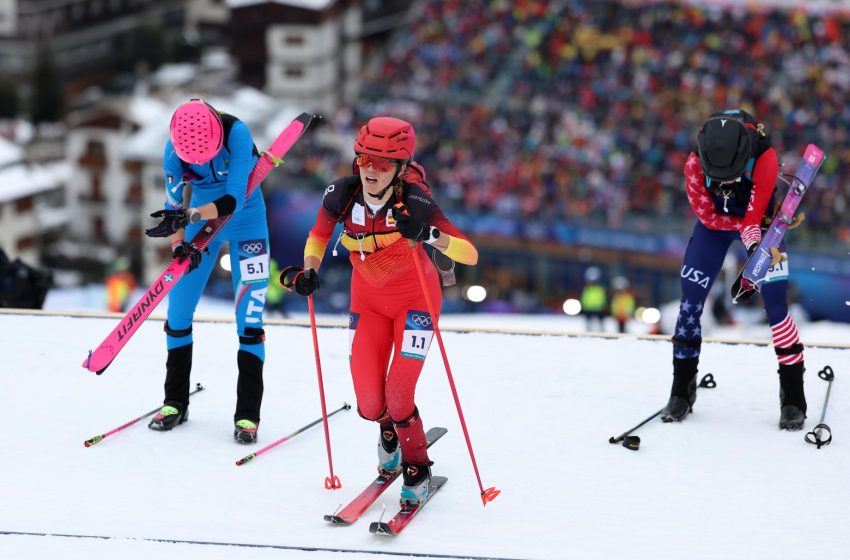
Then, over the last few days, I actually watched Olympic skimo, which consists of people sprinting up a mountain with skis on, changing out of their skis, sprinting up the mountain without skis on, ripping off something called “skins,” putting their skis back on, and skiing back down the mountain, all in around three minutes.
It gives me no joy to inform you that, as it turns out, Olympic skimo is boring and bad.
“What’s so bad about Olympic skimo?” you might be asking. The fact that you’d insult me with that question means that you did not watch a single second of Olympic skimo. Here’s a video—check it out, I guess.
The races were confusing to watch. The course layout seemed arbitrary. As unfun as it was to watch the competitors scoot uphill, it was even less fun to watch them fiddle with their equipment. Then, the downhill skiing part of the course was so unprepossessing that it looked like something I could complete without incident. And I stink at skiing!
Olympic skimo struck me as a sport that might appear on “The Ocho,” but only if the USA Mullet Championships and the Corgi Races at Emerald Downs both got rained out. The NBC color analyst, online skimo hype man and one-time Shark Tank contestant Max Valverde, tried his best to make the races come alive. He failed, just as he failed to get a deal on Shark Tank for a “product designed to fix bedhead quickly.”
I am man enough to admit that I was wrong about skimo. Yes, I botched this one. Sue me. (Do not sue me.) I was shocked, however, to see a handful of my Olympic-commentating peers pretend—or, even worse, sincerely believe—that Olympic skimo was fun and good.
“The first day of Olympic SkiMo RULED!” Rodger Sherman wrote, inaccurately, in his otherwise excellent daily Olympics newsletter. “The races were exciting and the crowd was hyped. And most importantly for me, a Weird Sports fan: It was weird as hell!” You know what else is weird as hell? The directorial filmography of Crispin Glover. Should watching Crispin Glover movies also be an Olympic sport? Huh, Rodger??? (Again, great newsletter, everyone should subscribe.)
At Yahoo, Dan Wolken argued that “it was neat to watch a sport so obscure that the biggest question for every athlete is how they found it in the first place. And all those stories are fun and different, and you could sense how much it meant to them to share that with a worldwide audience.” Well, Dan, I too have a story that I’d love to share with a worldwide audience, but I don’t see anyone nominating me for inclusion in the Winter Olympics! (The story that I’d love to share is this story, right here, about how Olympic skimo is terrible.)
Eight years ago, I ranked each of the 15 sports that appeared in the 2018 Pyeongchang Games. In those rankings, Nordic combined came in last, and deservedly so. That sport, which combines ski jumping and cross-country skiing into one big, boring package, is inherently inessential. In fact, Nordic combined, which is the only Winter Olympic sport that doesn’t include female competitors, is so blah that the IOC is considering removing it from the Olympic program for 2030.
Well, skimo is much, much worse than Nordic combined. Let me tell you why.
Back in 2018, I judged all those winter sports based on watchability, aesthetics, centrality to the history of the Olympics, and miscellaneous intangibles. Add them all together, and you get that sport’s WHAM Factor. Skimo has no WHAM Factor, nor a WOW Factor, nor even a MEH Factor.
Let’s start with watchability. The individual skimo events were only watchable because it happened to be snowing during the men’s and women’s races, and it is very soothing to watch snow fall against a Alpine backdrop. The skies were unfortunately clear during the mixed team relay events, which meant that skimo’s inherent unwatchability was all too plainly visible. The barrier to casual skimo viewership is high, in no small part because the Olympic course is not designed intuitively. Unlike slopestyle skiing and snowboarding, in which the different sections of the course lead riders to perform different styles of tricks, a casual viewer would have no way of knowing how or if the various aspects of the skimo layout require different tests of an athlete’s skill. Indeed, if that casual viewer were to watch the race with the sound off, they would likely mistake it for some sort of odd punishment, perhaps one that had been assigned by the International Olympic Committee to Olympians who had been deemed jerks.
In terms of its centrality to the history of the Winter Games, skimo has no history at the Winter Games. This year was its debut Olympics appearance, and as I wrote earlier this week, it seems likely that skimo made it into the Milan Cortina Games only because the host nation, Italy, is pretty good at it. France is pretty good at skimo too, which could mean that the sport will stick around through 2030. But France is good at a lot of other things, too, like parkour, and chanson-style cabaret. Can’t the French quickly come up with some hybrid sport that involves, say, jumping off a ski lift while singing a Jacques Brel song? That sport would also be very stupid, but it would have the benefit of not being skimo.
Now, let’s talk aesthetics, but only briefly, because it’s self-evident that there is nothing beautiful about skimo. First, the athletes sort of waddle uphill, in the manner of the zany chase sequences made famous by Benny Hill. (As I watched them waddle, I was hearing “Yakety Sax.” There should be no place in the Olympics for “Yakety Sax!”)
Then, there are the various wardrobe changes. There is nothing inspiring about watching people fumble with their skis and their bindings, and every competitor in Olympic skimo was always either about to fumble with their skis and bindings, currently fumbling with their skis and bindings, or just finished fumbling with their skis and bindings. You can talk about “transition zones” and call these portions of the race “very technical,” as Valverde did on the Olympics broadcast. But those of us who were unfortunate enough to watch know what we saw: Because the course was so short and the skiing so unchallenging—that hill looked to be at most a blue square—these equipment “transitions” decided who won and lost. Essentially, the Olympics just awarded a bunch of medals for changing in and out of skis.
Finally, when it comes to miscellaneous factors, I don’t want to disparage the skimo athletes, who clearly worked hard to reach the pinnacle of their sport. But indulge me in a thought exercise here. The Olympic sport that skimo most resembles is cross-country skiing, right? If any of the skimo athletes were to enter a cross-country event, I suspect they would finish near the back of the pack. Conversely, if, say, Jessie Diggins or Johannes Høsflot Klaebo had signed up for skimo, I could easily see them winning a medal even if they knew nothing about it.
Now, to be fair, the version of skimo we saw in the Olympics—skimo sprint—is a bastardized version of the sport. Skimo events can last for hours, involve traversing entire mountains, and test the limits of an athlete’s endurance—not just their skill at stripping and stowing their gear. Look at this clip from a skimo World Cup race:
Now that’s something that I’d like to see at the Olympics, sort of a rugged and vertiginous wintry marathon. However, I must render my judgment not on the skimo event we deserved but on the skimo event we got, which was, again, bad.
Sure, we could try to fix skimo in advance of the 2030 Games. But honestly, why take the risk? We should eliminate this entire enterprise from the Olympics, just to be safe—and not just for future Winter Games, but retroactively, too.
This would mean memory-holing the 2026 skimo program entirely, and retracting the medals that just got awarded. Spain will probably fight this decision, given that Oriol Cardona Coll’s men’s sprint gold was that proud nation’s first Winter Olympic gold medal since 1972. Sorry, Spain. The people—i.e., me—have spoken.
Goodbye forever, Olympic ski mountaineering. And skimo athletes, please stow your skins neatly and take all your equipment with you, lest it influence any children to take up this cursed pastime. We need to keep those kids focused on practicing for the 2030 debut of chanson parkour.
First Appeared on
Source link






