


Berlinale Awards Turn Political as Filmmakers Speak Out on Gaza
While the 76th annual Berlin International Film Festival came under repeated criticism for dodging political discussion during the festival’s run, the jury’s selections and the winners’ speeches at Saturday’s Berlinale Award Ceremony went a long way to make up the difference.
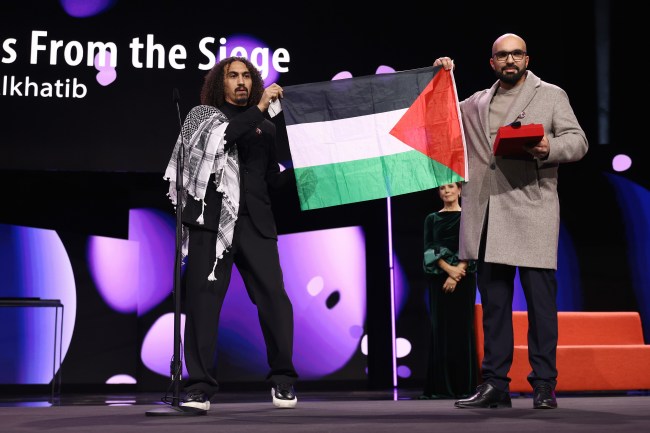
Director Abdallah Alkhatib, who won Best First Feature (and 50,000 euros) in the inaugural Perspectives section for “Chronicles of the Siege,” took the stage wearing a traditional keffiyeh while his producer Taqiyeddine Issaad held a Palestinian flag.
“I was under a lot of pressure to participate in Berlinale for one reason only,” Alkhatibe said. “To stand here and say, ‘Palestine will be free.’”
He continued: “And one day, we will have a great film festival in the middle of Gaza, in the middle of other Palestinian cities. Our festival will stand with the people living under the siege, under occupation, and under dictatorships around the world. We will speak about politics before cinema. We will speak about resistance before art, about freedom, before duty, and about a human being before culture. The long-awaited day is coming.
“And when people ask you what happened, tell them, ‘Palestine remembers.’ We will remember everyone who stood with us. And we will remember everyone who stood against us. Against our right to live with dignity, or who choose silence, we choose to be silent.
“Some people told me, maybe you have to be careful before you say what I want to say now, because you are a refugee in Germany. There is so many red lines, but I don’t care. I care about my people about Palestine. So I will say, my final word to German government, you are partners in the genocide in Gaza by Israel. I believe you are intelligent enough to recognize this truth, but you choose to not care. Free Palestine, from now until the end of the world.”
A few days into the festival, Berlinale chief Tricia Tuttle composed a lengthy statement in which she both defended the place of free speech at the festival and seemed to admonish those who would ask political questions at film festival press conferences. In response, over 80 current and former Berlinale filmmakers and artists signed an open letter condemning the festival’s “silence” on the Gaza genocide.
Across the festival’s juries, the Berlinale’s winners represented the political tensions that defined this year’s festival. The Golden Bear went to İlker Çatak’s “Yellow Letters,” a drama that tracks a Turkish family caught in the government’s crosshairs, while the politically charged “Prosecution” and “Traces” won the Panorama Audience Awards.
In accepting his award, Çatak said he prepared a political speech but chose not to share it because “so many smart people have said so many smart things and I want to leave the stage to the wonderful people that I made this film with. They are the real heroes for this award.”
However, he did say that there was a scene in his film that “reminded me of the last few days here in Berlin. Filmmakers against other filmmakers, artists against creatives. But we are not enemies. We are allies. The real threat is not among us. It’s the autocrats. It’s the right-wing parties. It’s the nihilists of our time who try to come to power and destroy our way of living.”
The Golden Bear for Short Film went to “Someday, a Child,” Marie-Rose Osta. The audience interrupted her speech with cheers.
“I stand here divided in two,” Osta said. “From one side, the filmmaker in me is super overwhelmed to be receiving this cute, beautiful bear that is going to change my life. And from the other side — and here it goes — the human in me. A Lebanese woman, a witness, and I must share my story with you.
“I made a film about a child. With superpowers, who brings down two Israeli fighter jets, because their intrusive sounds wake him up from his sleep. That is cinema. But in reality, children in all of Palestine and in my Lebanon do not have superpowers to protect them from Israeli bombs. The cease fire continues to be violated by Israel, both in Gaza and Lebanon. No child should need superpowers to survive a genocide. If this award means anything at all, except that it’s going to make me a very happy person, let it mean that Lebanese and Palestinian children are not negotiable.”
It made for a challenging environment. At times, Luxembourgish actress and television presenter Désirée Nosbusch visibly struggled with the stress of remaining the charming emcee.
“We really do hear you but I just think, you know, this is a platform here or a stage where we want to celebrate all the filmmakers that are here with us tonight,” she said after Alkhatib’s speech. “So if, I mean, dialogue, it’s maybe not the right moment to have it right here. But please, we hear you, definitely.”
Before Wim Wenders presented the Golden Bear to Çatak, he praised Tuttle: “We went through a storm together.”
The Berlinale leader closed the ceremony, saying: “Tonight this stage has been very much like the Berlinale itself. It’s never been a place for silence. It’s a place for artists to speak and sometimes they speak in ways that are uncomfortable or contested, but it is important that we hold that space. If we don’t speak, who knows what happens?”
First Appeared on
Source link






