


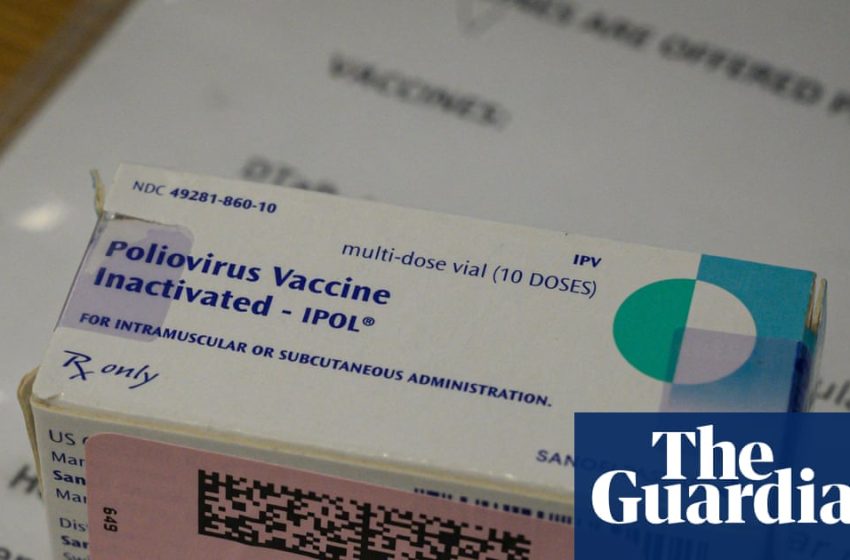
Fears of polio resurgence as US vaccine adviser questions need for childhood shots | US healthcare
With preventable infectious diseases surging and a top US vaccines adviser saying all vaccine recommendations may be reconsidered, experts are bracing for more polio cases while survivors say the medical system is not ready for polio.
“We don’t have a healthcare infrastructure to take care of a polio outbreak,” said Grace Rossow, an operating-room communications coordinator in Illinois, who has long-term health issues following a case of polio as an infant.
“They don’t know how to treat it. It is a massive problem if we have a resurgence of polio.”
There is no cure for polio; treatment for acute cases usually involves supportive care. Between a quarter and a half of patients develop post-polio syndrome, a lifelong condition. Yet with the advent of highly effective vaccines, doctors who have seen polio cases have become increasingly rare.
Art Caplan was one of the last Americans to get polio in the Boston outbreak in the 1950s. He was seven when his neck and legs began to develop paralysis. He spent six months living at Massachusetts general hospital on a floor devoted to children with polio. Sometimes the other children would transfer downstairs to iron lungs when they could no longer breathe on their own; sometimes they would die from their illness in the beds next to him. After months wondering whether he would be next, Caplan suddenly regained use of his legs for reasons no one has been able to fully explain.
But even after his miraculous recovery, he spent years in physical therapy learning how to walk again. Now he uses a walker, as his legs have weakened again. Through the decades, he’s seen polio experts leave the field as they aged and retired.
“There’s nobody left. They don’t see it,” said Caplan, now a professor of medical ethics at NYU Grossman Medical School.
Gordon Allan, a surgeon who is the orthopedic residency director and the total joint reconstructive fellowship director at Southern Illinois University School of Medicine, said: “Orthopedics has really changed a lot now from the people who trained me.”
He learned from the previous generation of doctors how to treat post-polio, but even then, there were fewer patients.
“No one practicing has first-hand experience,” Allan said. He is now “at the tail-end” of specialists who know what might be done to alleviate long-term issues, he said, adding: “Orthopedics was quite different because of polio, and all that stuff just faded away.”
Patients with post-polio have weakening muscles and bones, which affects their ability to walk without mobility aids, and falls can easily lead to broken bones. They may develop scoliosis and other problems. They struggle with extreme joint pain, fatigue, temperature regulation, attention, and secondary complications from paralysis.
In orthopedics, Allan said, surgeons would perform procedures such as tendon transfers around the hip, knee and ankle to help improve strength. Those procedures are now rarely done on ankles. Allan doesn’t know of anyone doing complex tendon transfers around the hip, he said. “That’s a lost art.”
Sometimes post-polio patients develop deformities and angularities in their bones, requiring total knee or hip replacements – but those procedures are markedly more complicated given poor bone quality, and rehabilitation after surgery is much more complex with muscle weakness. The risks of falling and breaking the replacement joints are also high, Allan said.
“The best prevention is: don’t get polio,” he said, highlighting the importance of vaccination.
Rossow contracted polio as an infant in an Indian orphanage. She was born in 1992, long after the vaccine was developed but before it was administered to most children in India; there are still some challenges to doing so in the country. She first fell ill somewhere between the age of four and nine months. Her left leg is paralyzed; she now uses a wheelchair.
“I have a great medical team that actually listens to me, and that is one of the barriers to care that I worry future polio survivors will have, because people do not know polio, they do not understand polio. The way I describe polio is: it is the ‘hold my beer’ of medicine. Anything that you think will actually treat it, will not. Physical therapy makes us worse,” Rossow said.
“I’ve had neurologists who just don’t know anything about polio because they’ve never seen it – no fault of their own, not like they’re practicing outside of their scope by any capacity, but they just know nothing about me.”
The polio vaccine has “absolutely been a victim of its own success”, Rossow said. “People aren’t scared of polio any more,” she said, and they don’t understand the risks. “People don’t really see the daily side of living with a vaccine-preventable disease. With polio, you’re never going to fix us, and that’s the problem. The only thing to fix polio is the polio vaccine.”
For Caplan, the experience “absolutely” shaped him.
“It got me to be very pro-vaccine,” he said.
When Kirk Milhoan, the chair of the Advisory Committee on Immunization Practices, said the vaccine advisers were reconsidering routine childhood vaccines because the risks of illnesses such as polio had dropped, “that makes me furious”, Caplan said.
“If you could gather up the kids I saw die or become really severely disabled from 50 years ago, they would want you arrested … It’s horrifying, and the height of irresponsibility to leave the door open even a crack,” he continued.
As more families choose not to vaccinate, particularly after the US stopped fully recommending several key vaccines, Caplan said: “You are begging to have a recurrence of the disease.”
Rossow also warned that those “deeply religious and antivax families who just do not believe these diseases exist or will harm them” were unfortunately “the families affected most, due to lack of vaccination, and likely those children will suffer”.
In insular communities where many people reject immunization, “you could really get polio under way before anybody realized that it was there”, Caplan said. “Preparation also means having huge reservoirs of vaccine available to rapidly deploy when the inevitable recurrence happens.”
First Appeared on
Source link






