


What is Bonesmashing? Inside the Extreme Looksmaxxer Technique
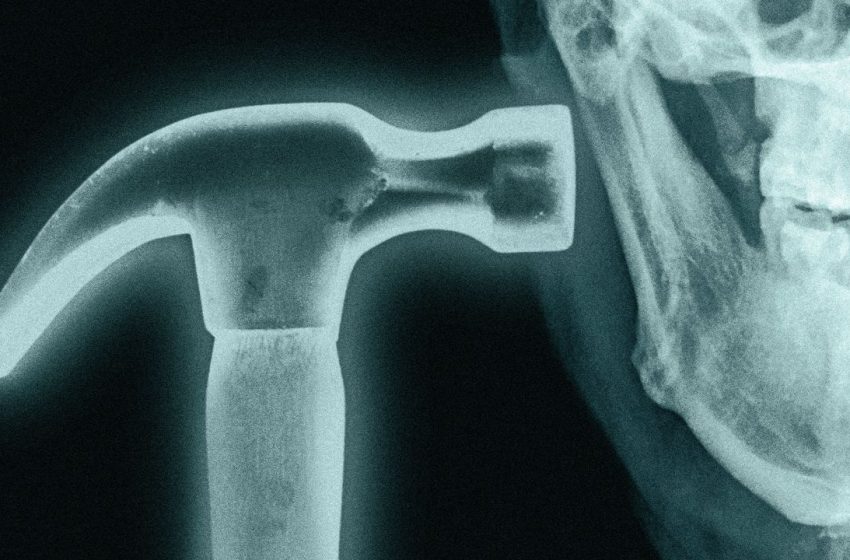
When you’re a teenager, your parents like taking stuff away from you: videogames, sleepover privileges, the car keys. When Braden Peters, who you know as Clavicular, was a teenager, his mom took away his hammer. She wanted young Clav to stop bonesmashing—that is, tapping his face repeatedly with a hammer to change his face shape.
Now 20, Clavicular, the most famous looksmaxxer in the world, continues to bonesmash. And as looksmaxxing goes from edgelord forum fodder to dinner table conversation, its most notorious face-shaping technique has found the spotlight too.
Bonesmashing was invented by looksmaxxers, a mostly-male Internet subculture of extreme aesthetic self-improvement. Looksmaxxing was developed in the early 2010s on openly misogynistic forums like PUAHate, SlutHate, and Lookism. As an ideology, it places appearances above all, believing that how you look determines who you date, how much money you make, and everything else in life. In the 2020s, looksmaxxing exploded in popularity on TikTok, buoyed by personalities like Clavicular who introduced many of its extreme procedures to the masses.
Looksmaxxing techniques generally fall into two categories: softmaxxing—relatively benign methods like skincare, diet, exercise, and grooming—and hardmaxxing—more extreme interventions like surgery or injecting steroids and peptides. Because bonesmashing is said to alter a person’s facial bone structure, it’s considered to be the latter.
Bonesmashing is done by repeatedly tapping the chin, cheekbones, and jaw with a hammer. (Or some recommend a massage gun.) The goal, in theory, is to cause minor damage to the underlying bone, which will change the shape of the face as it heals to give you a squarer face, a stronger jawline, or a more pronounced chin. Looksmaxxers attribute bonesmashing’s efficacy to Wolff’s law, discovered by 19th century German surgeon Julius Wolff, which states that healthy bones adapt and strengthen in response to loading. The idea that bones grow and strengthen under repeated stress is why some knuckle boxers punch walls and kickboxers roll bottles over their shins, though there’s no research to back these practices up. “The very basic premise, that repetitive mechanical load can influence bone density or remodeling, is not completely divorced from science,” says Dr. Joshua Rosenberg, facial plastic surgeon and Associate Professor of Otolaryngology at Mount Sinai. “It’s just wildly misunderstood and misapplied here.”
You’re probably thinking, there’s no way people actually do this. It’s hard to get an accurate sense of how many people actually hit themselves in the face with a hammer, but it’s not zero. There are YouTube tutorials, Instagram users tracking their progress, and forum posters claiming that bonesmashing ascended their eye area “from SUB 5 to HTN” on the PSL scale, the looksmaxxing rating system. Translation: hitting the bone around the eye socket took them from ugly to pretty handsome.
Bonesmashing is big enough that doctors have sent at least two letters to the Journal of Stomatology, Oral and Maxillofacial Surgery warning about the practice’s spread on social media. One letter, from Dr. Ricardo Grillo of Brazil, cautions that the risks “encompass a range of severe maxillofacial injuries” which can cause “cosmetic disfigurement, functional impairment and other potential long-term consequences.”
“Of course, it’s a stupid idea,” says Dr. Grillo. “The list of risky points is enormous.” He adds that other risks include the formation of scar tissue on [facial] muscles and vascular and neurological damage. Furthermore, “there is a risk of facial asymmetries since this trauma is not controlled.”
Dr. Rosenberg notes similar risks. “The idea that you can create ‘controlled’ microfractures, trauma, or whatever term you want to use, in any bone—particularly in the face—is inherently flawed because it’s not controlled,” says Dr. Rosenberg. He notes that hitting your cheeks hard enough could cause a zygomaticomaxillary complex fracture “that results in depression and asymmetry of the cheek, not enhancement.”
First Appeared on
Source link






