


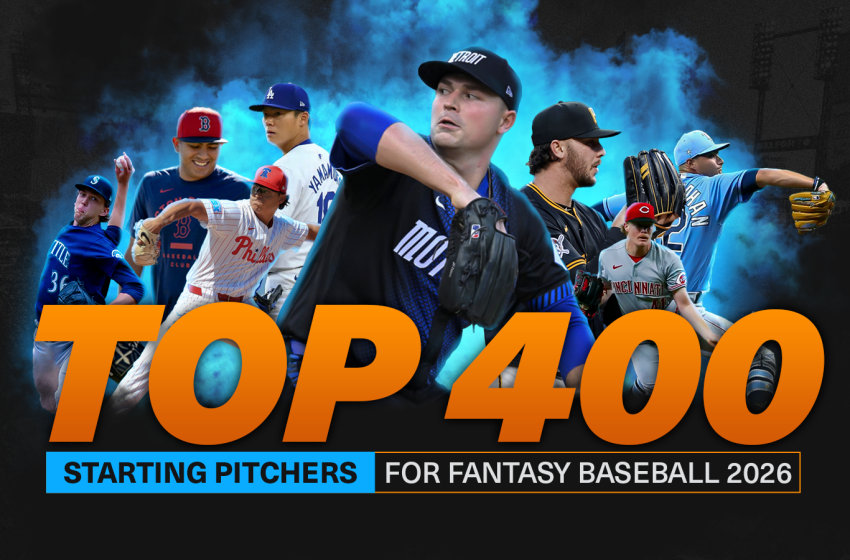
Top 400 Starting Pitchers For Fantasy Baseball 2026 – SP Rankings 1-20
Welcome to the ultimate guide to drafting Starting Pitchers for 2026 Fantasy Baseball. I’ve ranked the Top 400 (actually 430…) starting pitchers for the year ahead in an attempt to determine every SP who could help your fantasy teams this season.
However, before you scroll down to the Top 1-20, it’s incredibly important that you read this introduction. It highlights how I rank pitchers and why this is not a projection of the end of season Player Rater. It’s my strategy of how I draft pitchers, embracing the burn and churn nature of the game.
Remember, these ranks are based on a 12-teamer, 5×5 roto format. Adjust accordingly to your situation. I’ve also added the Top 100 SP table at the bottom of this article.
For a table of the entire 400 SP (really 430!) and to read this article Ad-Free (or to simply support me for putting all of this together!), make sure to subscribe to PL+ or PL Pro where I have these rankings inside a massive Google Sheet, with my blurbs included. You can access the sheet inside our subscriber Discord.
To get the full context of these rankings, please make sure you…
Read The Notes
Tier 1 – STUD
1. Garrett Crochet (BOS, LHP)
The discussion last off-season revolved around the shift to Boston and whether Crochet was capable of volume worthy of the workhorse label. 205.1 IP later and yeah, I think he’s capable. Among the three musketeers at the top of the SP ladder, you can place Crochet wherever you like, and given his combination of volume, strikeouts, and Win potential, I have Crochet as my #1 SP for 2026. Even without the elite extension of 2024 (that made me more concerned that I obviously should have in April last year!), Crochet’s skillset was pristine. Sinkers, cutters, and sweepers overwhelmed LHB, while the four-seamer/cutter combo earned a ton of strikes, whiffs, and…worse contact that you’d expect. There were times he wasn’t able to locate either effectively and despite the sweeper acting as a vicious two-strike offering, there were moments he needed an extra weapon earlier in counts.
That’s it. That’s the “flaw”. Expect an ERA well under 3.00, a WHIP around 1.00, a 30% strikeout rate, at least six frames per inning, and flirtation with the most Wins in the bigs. But there’s another flaw! FINE. Crochet pitched into the playoffs and was pushed more than ever in 2025, which could spell injury for the year ahead. I’ve heard this argument plenty over the years and generally, pitching over 200 IP in a season means the pitcher is capable of surviving a season, just like he did across 2024. I’m not more concerned than any other SP.
If you’re aiming to draft an SP early (I personally go for hitters, but that’s me), I’d take the third of Crochet/Skenes/Skubal. If you have to choose one first, chase the pitcher with the highest chance of Wins – Crochet.
Quick Take: He’s a stud. He’s been built up to withstand a 200+ inning workload while providing elite ratios, strikeouts, and Win totals. He’s it.
2. Paul Skenes (PIT, RHP)
Aces gonna ace. Skenes’ ability to throw exceptionally hard, locate well, and three different pitches at 94+ mph with different movement is bonkers. He actually has three flaws in his arsenal – a mediocre feel for spin, a four-seamer with an average SwStr rate to RHB, and a lack of depth to fend off LHB – but he so easily navigates through lineups with weak contact to RHB, while the four-seamer carves up LHB at an 18% SwStr rate that he’s returned two straight seasons of sub 2.00 ERA ball. He’s a crafty/command pitcher who happens to have elite velocity. You know what’s wild? I don’t think he’s mastered his approach yet. I mean, he’s still 23-years-old and is still figuring out how to best use his weapons. His quality floor is so high that I have him ranked above Skubal (GASP!) and I’m stoked to watch him pitch for another season. He’s just so good.
Quick Take: He’s dope and makes us feel dope. He allowed absurdly low ICR marks on everything to RHB, while he’s still figuring his secondaries for LHB, letting the four-seamer cook at a 18% SwStr in the meantime. Expect elite marks across the board, though he’ll likely have slightly less volume than Crochet and Skubal.
3. Tarik Skubal (DET, LHP)
He’s good. You know he’s good. He’s a SWATCH but happens to throw 97+ mph and can push over 100 at times and that’s all kinds of awesome. If you want him as your SP #1, sure, go ahead. I have Skubal behind Crochet and Skenes for simple reasons: He shouldn’t earn as many Wins as Crochet and Skenes’ arsenal speaks to better ratios. But then again, he could go 200 IP and feature 250 strikeouts with a sub 2.50 ERA and sub 1.00 WHIP, which is absolutely beautiful. So you do you. Imagine how good he’d be if he could get his slider down and return more than a 7% SwStr to LHB…
Quick Take: You know Tarik is dope and makes us feel dope. His elite velocity, absurd changeup, stellar control, and consistency to go at least six frames is rare in today’s game, and even if we expect slight regression to his velocity or execution, Skubal will still be far above those outside the top tier.
Tier 2 – AGA 1
4. Bryan Woo (SEA, RHP)
I view Woo as Zack Wheeler 2.0. His four-seamer and sinker combination is one of the very best in baseball, dominating based on command, difference of movement, 95/96 mph velocity, and one of the flattest attack angles in baseball, allowing him to go 70% fastballs and not think twice. He’s trying to do more with his breakers – a slider and sweeper – but he still struggles to locate them consistently and lack the depth to become overwhelming options. Ohhh, so that’s why he’s Wheeler 2.0. Yup. Wheeler shockingly doesn’t have the greatest secondaries, but his fastballs are just that good. Like Woo.
And I have him as my #4 SP, which I imagine goes against many other experts this year. The reasoning is simple: I’m not as concerned as others about the injury scares of 2024 after going 30 starts of 187 IP in 2025, and his fastball foundation is as good as any in baseball. There’s room to grow with his secondaries, he pitches for a winning team in a great park, and has a long leash in every start. His quality floor is superb and he doesn’t have the same innings cap as Yamamoto as Woo isn’t in a six-man rotation. Say it with me y’all. The whistles go WOO WOOOOO!
Quick Take: Woo’s four-seamer and sinker are one of the best fastball duos in baseball, propelling him to back-to-back stellar seasons without the secondaries found in his peers. It creates a rock-solid floor with room to grow if he can nail down the slider and/or sweeper while he has a clear path to 200+ innings and strikeouts with a sub 3.00 ERA and sub 1.00 WHIP on a winning team. Just stay healthy, alright?
5. Yoshinobu Yamamoto (LAD, RHP)
I’d have Yamamoto as my #4 SP if he weren’t in a six-man rotation. He’s an elite command pitcher with three main offerings: a filthy splitter for strikeouts, a 95 mph four-seamer with a flat 1.6 HAVAA that he still doesn’t elevate as much as he should, and a curveball with massive two-plane movement (96th percentile total break!) that returned a 40% CSW to RHB last year, collecting an unexpected number of strikes given its large break. Cutters can appear away to RHB, but their true talent is getting inside to LHB and ending at-bats early (it’s fantastic), while the sinker is 99th percentile iLoc as it lands inside over 80% of the time to RHB. Lovely.
Elite command?! He walked nearly 9% batters last year! I looked into this, because it really didn’t make sense. Yamamoto has a clear plan for all his pitches (attack cutters inside to LHB, splitters are down, curves are located, sinkers are always inside to RHB, etc.), and there was one single anomaly this season: Eight walks on his sinker to RHB. Remove those and it’s a 7.5% walk rate. That sinker has one of the lowest zone and strike rates in baseball and while it is highly effective at jamming batters when aggressive, it fails when batters are passive in three-ball counts, allowing free passes. Just stop throwing three-ball sinkers, cool?
The other adjustment? Finding a way to not allow a 50%+ ICR on his four-seamer to RHB. If you’ve followed me, you’ll remember my bit yelling at Yamamoto to get his four-seamer upstairs more often, which does work in two-strike counts (24% putaway rate!), but I question why he lets it sit comfortably over the plate earlier in counts, too. It also makes his 90 mph cutter on the outside edge less effective as it carries more movement, but lands close enough to the expected four-seamer location, allowing for an easy adjustment and too much hard contact as well.
His four-seamer and cutter attack to RHB has me wondering what his hit rate should look like in 2026. At the very least, it’s not the sub-6 mark we saw last year (those never repeat) with his high ICR fastball displaying Koufax as a clear sycophant when the heater returned just a .236 BABIP to RHB, while he was so good to LHB in the other direction. It’s a land of extremes and it simply won’t happen again, which should raise the WHIP, reduce the innings, and make it an overall worse season. And don’t forget – 30 Starts in 2025 included his Japan series outing and fortunate circumstances that allowed him to go as much as he did. 28 is the general expectation, capping his volume around 170 frames at best. It’ll be quality frames, absolutely, but I can’t go SP #4 without a higher ceiling.
Quick Take: He’s dope and makes us feel dope. The attack to LHB is suffocating with cutters in, splitters away, curves for strikes, and four-seamers above the splitter for 28% called strikes – the most in baseball. He was fortunate against RHB (50% ICR on four-seamers!) and negative regression is likely coming for him, while 30 starts and 170+ IP are unlikely to repeat. With a capped volume ceiling, I question how aggressively he should be drafted, though the quality per inning will be excellent.
6. Max Fried (NYY, LHP)
Fried is as safe as they come. He’s not going to wow you with a strikeout an inning, but those cutters inside to RHB carry genuine surprise cut and the sinker to LHB is a weak-contact machine. With Cole and Rodon sidelined, he’s the foundation of this rotation, and the Wins will flow accordingly.
The curveball at 75 mph with 99th percentile drop is the putaway to both sides, though it’s almost too big, which limits its strike rate. The missing piece? His changeup fell from a 19-20% SwStr in 2022-23 to 14% last year against RHB, and the sweeper is not the elite breaker we normally see to LHB, returning under 60% strikes and distant from the tighter slider we saw earlier in his career. If either the changeup or slider/sweeper take a step forward, Fried has the potential for a 26%+ strikeout season. Until then, he’s your ratio rock. Pair him with a K-forward arm and enjoy the quality ratio floor with a boatload of dubs.
Quick Take: Fried’s cutter to RHB and sinkers to LHB provide elite ERA stability and great home run suppression. The changeup and sweeper need to take a step forward for Fried to flirt with the champions, but you’ll be hard-pressed to find an unhappy manager with Fried on their roster.
7. Cristopher Sánchez (PHI, LHP)
Sánchez was dope and made us feel dope. After a high WHIP season with few strikeouts, Sánchez improved his sinker and slider, returned more strikeouts, which reduced the hit rate, and thus lowered his ERA and WHIP. So when we consider Sánchez for 2026, we have to ask: Will he still hold a 26% strikeout rate?
The sinker and slider gains are likely here to stay. Sánchez not only added a tick of velocity to his fastball, but he found an extra three inches of vertical depth on the pitch, turning the pitch into a whiff offering to LHB at a 12% clip. Pretty bonkers considering that his previous career high was just 8%. Yes, its putaway rates shot through the roof as well (33% to LHB?!) and we should see some small reduction in strikeout efficiency here.
His breaking ball was far easier to watch, too. Sánchez fought with the pitch to land down-and-away to LHB in prior seasons, but tightened its range in 2025, dotting the corner often and doubling its putaway rate to LHB, boosting its SwStr from 16% to 23%, and dropping its ICR to a stupid good 19%. Yeah, that’ll catalyze a breakout season, alright.
Meanwhile, the changeup is still a dominant offering, and it exploded in 2025. Its reduction of use to LHB in favor of sliders allowed him to become more efficient with the pitch in two-strike counts, letting its putaway rate balloon from 27% to 39%, while carrying a 31% SwStr to LHB. That’s absurd. Its two-strike efficiency also improved against RHB, where the slowball labored with a sub 20% putaway rate in 2025, and finally became the finisher it was meant to be, boasting a 29% putaway rate against RHB for the season. It all came together.
Before I go on, I have to mention the forearm soreness that gave us all a scare and reduced his velocity for about a couple of weeks. Place whatever health risk you want on that, I’m going to generally ignore it and still consider Sánchez a fantastic play for 2026.
I personally don’t believe those putaway rates are here to stay, but I also don’t believe Sánchez is a 20% strikeout arm. I’ll do the lazy thing and split the difference, suggesting he’ll live around a 23-24% rate, which will raise his WHIP north of 1.10 and ERA close to 3.00. There is a Logan Webb-esque worry that the strikeouts and hit rate will oscillate, but there is one major difference between Webb and Sánchez: One is a SWATCH and the other can only watch with envy.
Quick Take: Sánchez is unlikely to maintain the same two-strike efficiency that catalyzed a 26% strikeout rate, but his increase in velocity and drop on his sinker, merged with an improved slider to LHB allowed his changeup to soar for 200+ frames. Assign whatever regression you’d like, let it be ratios, strikeouts, or innings, at least we can agree his quality-per-start will still be elite.
8. Logan Gilbert (SEA, RHP)
How much weight are you putting on Gilbert’s Grade 1 forearm strain? The 3.43 and 1.03 WHIP arm missed roughly six weeks on the IL between the end of April and mid June and while he had a few rough patches early on (four games of 4 ER in his first eight starts back), he got his footing by August and sprinted to the finish line with just 11 ER and a 30% strikeout rate in his final seven outings. What’s bonkers to me is how good the results were despite Gilbert not pitching at his peak.
The slider wasn’t spotted well. At all. This thing was hurled into the middle of the zone at an 86th percentile – you don’t want that to be a high number. And yet, it still was a successful pitch, feeding off the tunneling created by the high(er) four-seamer at 95/96 mph and his elite 7.6 feet of extension. Oooof. The addition of a splitter is welcome one as a #3 pitch to both LHB and RHB, serving as an excellent putaway offering that isn’t relied upon to find a strike when needed. His curveball shows plus at times, especially when he can wield it, but those times are too rare for me to believe he’ll ever really be more than four-seamer/slider with a splitter for strikeouts. Unless he ever wants to figure out a sinker, but I doubt it.
In the end, the Mariners will let him go all year as long as his arm will let him. His ratio floor looks pretty dang good with his low walk rate, home park, and strikeout ability. He does the things you want, even without the greatest command, and if he can turn the corner to actually keep his slider down as it was in 2024, then you have yourself another stud season ahead.
Quick Take: Gilbert is a stud due to his elite extension, great fastball, and even better slider. The addition of a splitter pushed his strikeout marks to match the very best in fantasy, and the only hurdle left is keeping his slider down. His forearm strain likely catalyzed the worse command last season and getting close to a year removed from the tear, he may be out of the woods. That would outline another 200 frames of elite production for another season.
9. Hunter Greene (CIN, RHP)
If Greene avoids the IL this season, he’d be the #4 SP with the holy trinity and even spark discussions if he’s better than at least one of them. After all, Greene sat 97+ mph in 2024 and added two ticks more to 99+ mph in 2025 (three on the slider to 89/90 mph!), while improving his ability to throw strikes with his slide piece. And no, it’s not the splitter that is doing all the work – it’s a 50% strike rate offering with a horrific putaway rate – it’s the slider’s ability to go down-and-in that fuels strikeouts against LHB.
You all know the four-seamer is elite (#1 PLV SP four-seamer!) and it really comes down to how often he throws. I don’t see him with the same injury tag as Glasnow, Sale, deGrom, and Snell, but I also have to acknowledge a career high of 150 IP in 2024, sandwiched by two seasons under 115 IP. What was his injury last season? Not upper body as we normally fear for elite velocity arms, but rather a groin strain that bothered him twice across the season. Far better than elbow pain n whatnot, though his body is taking a toll for the massive force needed to create this velocity.
Decide for yourself what is best. 140-150 IP seems fair, and in shallower leagues, his value improves as Greene + the replacement arm off the wire is easily a Top 10 SP.
Quick Take: The four-seamer’s velocity jump, with a better feel for strikes with the slider, turned Greene into the stud we always wanted him to be. The only hesitation is volume, and we cannot bank on more than 150 frames after eclipsing 115 just once in his last three seasons. I have no idea where to actually rank him, and part of me wants to shout “All SPs have injury risk,” and throw caution to the wind. Your choice.
10. Hunter Brown (HOU, RHP)
Oh look, here comes Nick, galivanting down the hall like he’s smarter than us, ranking Hunter lower than others. Uhhh, that’s just how us tall people walk and I think it’s more of a “swing the limbs and try not to fall,” but I DIGRESS. For all of y’all who have followed me over the years, you’re the real ones who know that I don’t “stick to my guns” for the sake of it, nor do I float like a leaf in the wind of the industry. I’ll switch my take if there are proper changes that outline that take, or if I review my process and make a necessary tweak.
I don’t see any reason to change my view of Hunter Brown. Well, at least not to make him flirt with a Top 5 SP ranking entering 2026.
On the basic level, his 2025 didn’t add up to sustainability. A 28% strikeout rate with a sub 13% SwStr rate ain’t right, a sub .270 BABIP with a near 50% groundball rate is far too low, and an 82% LOB rate is regression 101. In short, fewer strikeouts, more hits (6.5 hits per nine is wild) and a higher WHIP with possibly a touch more walks as a result.
It’s all expressed in his arsenal. Brown is essentially a two-fastball guy with a wide supporting cast that doesn’t do a whole lot outside of his curveball, which became a major putaway pitch suddenly in 2025 to both LHB and RHB. And I legit love watching the pitch with elite movement for its 83/84 mph velocity, but it’s also a sub 60% strike pitch, with the role of getting strike three.
The best skill in Brown’s utility belt are a four-seamer/sinker pair that he commands incredibly well. And he must, considering they have deadzone movement. After shifting his four-seamer from up-middle to up-away against RHB, the strike rate went down (as expected), but its ICR plummeted from 47% to just 35%. Yes, adding an extra tick of velocity out of nowhere to sit roughly 97 mph is also a major deal, and the two combined were the biggest catalyst for his successful season.
It only works if he spots the sinker and Brown does beautifully for a 72% inside location to RHB, creating distinct pitch separation from his four-seamer. That sinker was unstoppable last season with a 26% ICR (!) across 37% usage, and that’s just bonkers.
LHB are still a bit of a problem for Hunter, if you can believe it. His four-seamer was able to overperform against them in 2025, carrying a -10 Hit Luck, 8% HR/FB rate, and a 37% ICR that I cannot buy into, while the changeup returned just 54% strikes, and his sinker + curve filled in the rest with plenty of hard hit balls. It’s still an issue he hasn’t solved.
It was the perfect season for Mr. Brown. Maybe it’s a new velocity plateau and the curveball + four-seamer will continue to carry 28% putaway rates, keep the strikeouts flowing, and suppress hits better than 90% of his peers. At the very least, a regression is still miles away from harmful, and I consider him a relatively safe pick. However, I don’t see his ceiling as safe as guys like Woo, Greene, Gilbert, etc., which has me a little lower than the rest of the crowd.
Sorry for all the rambling, I took a long time diving in on Brown to ensure I wasn’t fueled by old emotion. Remember, I just want every pitcher to be dope and Brown is no exception. Now go, and please find yourself a fantastic #2 pitch for LHB.
Quick Take: While it’s clear that Hunter will struggle to replicate the glory of 2025, Brown’s four-seamer and sinker command at 96+ velocity with an effective curveball to put away batters makes him a stable volume arm for all leagues at the cost of a lower realistic peak ceiling relative to his peers.
11. Shohei Ohtani (LAD, RHP)
I cannot believe I am typing these words right now. As of February 1st, Ohtani the pitcher is a FANTASY SLEEPER. It’s a result of Ohtani’s ADP being dictated by “one-player Ohtani” leagues, and without the proper number next to him, the limited frames from last year have many going with others who just had a full season. But here’s the thing: Ohtani has always been an elite SP. The small 50+ inning sample (four postseason games!) gave us the same elite pitcher of old, this time with an improved slider and a slight uptick in velocity, if you can believe it. There’s less frisbee action on the sweeper, though 30%+ strikeouts and a sub 1.10 WHIP for his fourth straight season as a SP sure makes me feel like he’s back to the norm.
And now, after all the rehab you’d want + not pitching in the WBC, Ohtani is set up to go every six days for the Dodgers as he enjoys the TJS honeymoon. Imagine the Dodgers baby him like the Rays did with Rasmussen last year. That was 150 innings and I don’t quite grasp the idea of 110-120 IP as the projections I’ve seen floating around. The gap between him and Yoshi is pretty small in my eyes (about 10+ more IP and slightly more W because of it is the only difference to me) and I’m ranking them closely as such. I’d even expect the new slider to get a larger spotlight in the year ahead to help deal with LHB and who knows, maybe he’ll get the feel for his splitter as an out pitch to LHB once again. You want this.
Quick Take: Ohtani, the pitcher, is elite and I don’t believe he should have the same injury question marks as his peers, with the only ding being a six-man rotation. 30% strikeout rate with an elite ERA and WHIP while pitching for a winning ballclub is all the makings of a stud arm who I want everywhere. And watch the slider take a step forward to make him even more consistent.
Tier 3 – AGA 2
12. Logan Webb (SFG, RHP)
My initial instinct entering the offseason was to be down on Webb. He’s the same guy as he has been, except that he’s still tinkering with what he does and that WHIP is going to hurt. Well…maybe it won’t. And let’s even say that Webb has a 1.20 WHIP again. The benefit of a low 3s ERA with ~200 strikeouts (that’s assuming a 23% strikeout rate or so, a drop from last year’s 26%+ clip) and double-digit Wins heavily outweighs the WHIP impact. And that’s the floor! Webb’s ability to go deep into games so very often is so uncommon that I have to reward him for his durability, even if I don’t expect his changeup to hold a 30% putaway rate to RHB or his sweeper to keep a 27% putaway rate to LHB. That’s okay! Let’s just hope Arraez latch onto Webb’s 3rd percentile BABIP last year and yanks it further down toward .370 and beyond. If he doesn’t, then it’s possible his hit rate sits near 8.0 instead of pushing 9.0+ like last year and BLAMO! That’s a stud season. I’ll take it.
Quick Take: Webb’s durability is unparalled and after five straight years of a sub 3.50 ERA, it’s hard to deny the floor he provides, even with the WHIP concerns due to his absurd groundball rate. I don’t quite believe the uptick in strikeouts will last for another year, but even a strikeout per inning returns 200 punchouts and that’s just lovely.
13. Joe Ryan (MIN, RHP)
His four-seamer is incredible, not because of its velocity or movement, but due to his 99th percentile HAVAA, solid extension, and fantastic ability to keep it up in the zone. Without fantastic secondaries keeping batters off hunting the heater on every pitch, Ryan is susceptible to the longball – 16 HRs off the heater in 2025 and 19 in 2023 – though his embrace of a sinker to RHB is helping the cause, increasing its horizontal movement a touch while raising its usage north of a 15% clip, a mark that I expect to increase in 2026 as I hope for it to find the inside edge more often. Those aforementioned HRs are the biggest concern for managers drafting Ryan, and yet, he’s held an ERA above 3.60 just once in his last four seasons, while displaying incredible WHIP marks, and nearly fanning 200 batters twice in three seasons. The fact he has been so effective without a filthy #2 pitch against RHB or LHB could be seen as a negative, but I see is an expression of his incredible fastball foundation and a shorter path toward growth than expected for someone already having as much success as Ryan.
He’s one of the safer arms to snag as your SP #1.5/#2 in drafts and who knows, maybe he’s on a better team come August, removing the possibility of morale affecting production in the second half as it did in 2025 (yes, that’s how I interpret his downturn late in the year). When your safe arm can strikeout 200 batters, you should have a massive grin on your face.
Update: I realize you’re reading this after knowing he was pulled for an MRI on his back. The great news? He’s still a go for Opening Day. I’m not worried, we see guys who are a little extra stiff in their first game all the time.
Quick Take: His teres strain of 2024 wasn’t a factor in 2025 and I consider him a workhorse for the season ahead, especially with free agency heading his way in 2026 (it’s a $13 million mutual option…which we know won’t happen), and what I see is double-digit Wins, a fantastic ratio floor, a boatload of strikeouts, and even a touch of upside if he ever figures out an above-average secondary pitch. You should feel great grabbing him this season.
14. Freddy Peralta (NYM, RHP)
Peralta had himself a brilliant 2025, boasting the lowest ERA of his career and recording a WHIP under 1.10 for just the second time across eight seasons in the bigs. There was a fair amount of HOTEL influence with an 85%+ LOB rate and a .256 BABIP that did the heavy lifting (6.3 hit-per-nine is just wild), though there were some small tweaks that could be here to stay.
Peralta shifted on the rubber from first base toward third base, steering his pitches more armside than ever before. It didn’t raise his zone or strike rates, and his four-seamer dropped to just a 10% SwStr rate to LHB, but he is getting more cut on the heater now, and it may have influenced his decision to lean into his changeup and curveball more than the slider. The hook became his favorite putaway offering to both LHB and RHB, while the changeup had increased usage to RHB and befuddled many batters. If only he could just get them over the plate more often and Peralta would be the reliable stud we’ve always wanted him to be.
That four-seamer’s elite HAVAA with unexpected vert and horizontal movement at 94/95 mph is absolutely legit, even if his extension has fallen from elite to above-average over the years. The new staff in New York are likely to tinker and aid Peralta during the season to ensure he doesn’t show too much of Professor Chaos, which makes the move away from pitcher-friendly Miller Park a lot more digestible (yes, pitcher-friendly! The stadium I refuse to call anything but Miller Park promotes strikeouts y’all). For a guy known as a Cherry Bomb across his career, he’s suddenly looking like one of the more stable options out there as an SP #2. Would you look at that.
Quick Take: Peralta had a fortunate 2025 with a silly hit rate and 85%+ LOB rate that mask a pitcher who made some tweaks and is generally the same guy he’s always been – terrible at throwing inside the zone, but finds strikeouts and has a strong foundational fastball. It’s possible the gains in ICR, shift on the mound, and larger emphasis on his changeup and curve catalyzed weaker contact, though their impacts shouldn’t be this massive in 2026. After three straight 30-start seasons, Peralta looks to be a solid #2 once again.
Tier 4 – AGA Injury Risk
15. Jacob deGrom (TEX, RHP)
Hey look! It’s the guy who forced me to answer so many “He’s thrown just X number of innings in the past Y seasons, how can you possibly rank him so high?” questions last season. And now that deGrom threw 172.2 IP in the first season he’s had a healthy elbow, here I am, looking at the near-38-year-old with an injury history and suggesting we don’t push our luck. Is that a good case? I’m not sure. I really don’t like playing the will-he-get-injured-or-stay-healthy game in my rankings, but it’s a real cloud over deGrom. The good news? He’s still a phenomenal pitcher. Not quite as studly as before when his four-seamer returned 18%+ SwStr rates (now 12%) and his slider laughed and boasted a 33% SwStr to RHB (not 18% like last year), but he’s still excellent. The fastball could be spotted more, maybe more trust in the changeup or curveball or a lean into a sinker to RHB is what he needs, but in reality, he’ll be great when he pitches. But how much will we get? After all, he did miss a moment last August with shoulder fatigue. Well, whatever it is, if you combine it with whoever you snag from the wire, it’ll look like an SP #4 at worst (assuming he goes at least 100 IP), and who knows? It’s possible deGrom can do it all over again.
Ah, rolling the dice on health. A tale as old as time. Go with your gut.
Quick Take: deGrom’s quality per inning is great, even with a small dip in vert + slightly worse fastball command and his slider’s reduction of SwStr rate. When he’s on the field, he’ll be great. His brief shoulder fatigue last year, combined with a small worry that the TJS honeymoon could be on the horizon, has me concerned you won’t get another season of 30 starts, though he’s healthy now and that’s a cool thing.
16. Cole Ragans (KCR, LHP)
Ragans was all PEW PEW PEW in his first three starts, then he endured a groin strain, missed some time, returned, and missed three months with a rotator cuff strain, possibly due to the inconsistent cadence on the bump. But when he came back, oh BABY was it beautiful. The four-seamer laughed through RHB bats for 27 whiffs in three games, where he averaged about 70 pitches per start. I think that shoulder is fine. You may not realize that Ragans’ four-seamer has the most total break of any four-seamer in baseball, despite having just 16″+ of vert. His absurd run on the pitch paired with the rise is what makes it so dang tough to hit at 95+ mph, and you should absolutely expect that to continue.
That fastball makes Ragans a SWATCH who happens to have an elite heater, like Skubal. The difference between the two? Left-handers. Ragans obliterates RHB with the changeup and heater with deserved hubris, hurling them over the plate without fear (I still miss the glory days of the cutter and slider, but I get it), while LHB have humbled Ragans, even before he took off. In fact, the new slider that was a gamechanger was added to take care of LHB. Unfortunately, the slider declined in 2024. Its hard contact spiked in concert with a dip below a 60% strike rate, and it’s a problem. Ragans’ lack of LHB four-seamer whiffs or trust in his changeup to LHB means the slide piece needs to strike fear into the hearts of his enemies in order for the two-pitch LHB approach to work. I wonder what Ragans would look like with a sinker + featuring more changeups to LHB. It would put less pressure on nailing his slider location (it can be spotty at times), ultimately reducing deeper counts with quick outs via the sinker, which lowers the WHIP via fewer walks and hits.
At any rate, Ragans is sure to flirt with a 30% strikeout rate once again and consistently toss 90+ pitches a game. The only real worry is the volume after going on the IL for two different injuries last season, including one involving his shoulder (always a scary thing). That said, I’m a big fan of pitchers making an appearance in late September to showcase their health and pave the way for a smooth offseason, and at the very least, Ragans should be firing on all cylinders out of camp. Play the injury risk game as you’d like, just note that Ragans is one of the only arms who can perform at the level of the Holy Trinity inside Tier 1.
Quick Take: Ragans is a SWATCH with a phenomenal fastball, and there’s more to unlock with his approach to LHB that can propel him to a comfortable spot among the Top 5 SP. The biggest question? His health. A groin strain preceded a three month stint on the IL nursing a rotator cuff strain, and it’s hard to ignore the shadow looming over 2026. That said, Ragans’ three stud starts in his return from the IL to close out the season is as good of an argument as you’ll find to suggest a healthy arm entering the year.
17. George Kirby (SEA, RHP)
I have this feeling that Kirby is ready for a dope season. I also have a terrible feeling his recurring shoulder problems are not going away and that I’m reading too much into his BSB approach in September. But hot dang, he’s so close! Kirby is a sinker/breaker arm at heart, despite all the four-seamers he throws, and all I want him to do is go inside with sinkers and lean heavily on the breaking pitches, while saving his four-seamer upstairs as much as possible for two-strikes. Just two-strikes.
But seriously, those curveballs and sliders are ridiculous. So much sweep, so much depth, and at 84-88 mph is bonkers. He’s just keeping both too high in the zone and allowing batters to smack them often. It’s frustrating because it works so well when executed right.
Kirby could flip a switch and become one of the best pitchers in baseball if he utilized his pitches correctly. Stop throwing sinkers up-and-away to RHB and focus on the inner third. Get sliders and curveballs down and in town instead of up and mid. Stop using four-seamers 72% of the time in early counts and only 16% of the time in two-strike counts to RHB. It’s all right there, you’ve done the hard part, now just change the mental approach, dangit!
But who knows. Maybe he’ll keep doing what he does now, which allows for some disaster nights but mostly is productive with few walks. The floor here is missing a significant amount of time but with still quality per inning when on the field. The ceiling is Top 5 SP in baseball, I’m not kidding. Sure makes it hard for me to decide where to rank him, doesn’t it? I guess I have to put you closer to the injured folk than at the top. Sigh.
Quick Take: Kirby’s sinker and breakers are absurdly good, but his approach is hurting him more than anything. His four-seamer is stealing too much of his focus despite deadzone movement and a shift to use the pitch as a surprise offering over a driver of strikes would open the door for an incredible season. Kirby has a poor history of shoulder injuries, though, and there is heavy concern they could shorten yet another season in 2026, making him a high risk/high reward play.
18. Tyler Glasnow (LAD, RHP)
I wrestled with Glasnow’s ranking and at the end of the day, he’s an injury-prone pitcher who will be quality when he pitches. His four-seamer’s cut action destroys LHB and his curveball is one of the most effective two-strike pitches in baseball, due to his 100th percentile extension and hard velocity. The slider took a step back last season as he yanked the pitch gloveside far too often to RHB, dragging its zone rate and strike rate down with it, flirting with the slums of a 50% strike rate despite comfortably sitting above a 60%+ mark in previous years. Yes, there’s your walk problem, and no, it should not be the same in 2026. I’d be shocked if it weren’t his off-season plan to figure out the slider.
But where do we actually rank him? I’m not entirely sure, though he should rise higher and higher the shallower your league is – after all, he’s a Top 5 SP in baseball when on the mound. I often consider my ranks as “How will I feel on April 26th?” That is, a month into the season, pre-season rankings are out the window and the perception of players shifts dramatically. Glasnow is likely healthy and looking dominant at that point and boy will it feel great having him instead of an SP #3, right? But he’s going to get hurt. Sure, he likely will. And we’ll deal with that when it happens. That’s the fun of fantasy, isn’t it? Figuring out the SPs to fill in the gaps and enjoy the elite moments when you have them.
Guess I’m drafting a lot more Glasnow than I thought. Huh.
Quick Take: Glasnow is a Top 5 SP in the majors when pitching regularly. With that in mind, what you should do with Tyler is based on your league. The shallower the league, the higher the value as Glasnow’s replacement in-season will be of higher quality, making Glasnow’s elite innings a valuable commodity. I find myself gravitating toward him in drafts, considering about 120-130 of strikeouts + three months of his replacement, with elite ratios in the time he pitches. That sure feels like it’s worthwhile.
19. Chris Sale (ATL, LHP)
The man backed up his miraculous 2024 with another AGA season…until he fractured a rib diving for a ball and missed over two months. That’s really all there is to it: He’s going to help your team when he pitches, but the realistic volume ceiling is far lower than the majority of his AGA peers. In shallow 10-teamers and lower, it’s worthwhile given the slew of great options on the wire during the time he misses. However, for 12-teamers and beyond, I’d much rather draft a pitcher I can believe is there from tape-to-tape. And it’s no lock he’ll still be elite. True, but it’s pretty safe after his last two seasons, and that’s acknowledging his refusal to throw changeups. The slider and four-seamer combo is simply that good, and his sinker is saved for 15% usage against LHB, which had a 5.94 PLV last year. Yeah. That good.
If you want to take a chance and make it happen, pop the cork with your fingers snapping, then spin the wheel. Round and round it will go, and here’s to it landing on 150+ innings. Let’s be real, you know that’s not going to happen.
Quick Take: He’s a stud pitcher…when on the field. His 2024 was an anomaly and it’s unwise to expect 150+ IP again. I’d rather take a more secure arm for quality volume.
Tier 5 – AGA Holly
20. Kyle Bradish (BAL, RHP)
Bradish returned from TJS in late August 2025 and picked up where he left off. The slider and curveball still feature their elite movement and miss bats, and the fastballs are still the major inhibitors preventing a true Top 5 SP season. I dig the four-seamer approach to feature it outside the zone and continue to keep its Ball-In-Play rate lower than league average (batters lace the pitch far more than other heaters), while his feel for inside sinkers to RHB is a huge plus. If only he could command the four-seamer on the inside edge to LHB, leaning into its heavy cut-action…
I usually dislike favoring pitchers with questionable fastballs, but Bradish is the modern representation of the Stuff McNasty from Cleveland’s glory days: Questionable heaters with two stellar secondaries that miss a whole lot of bats. The slider is one of the best in baseball with major sweep and drop at 87 mph, while his curve’s -13″ vert at 84+ mph is a rare sight. The strikeouts are sure to flow with both offerings heavily a part of the mix.
The common pushback toward a Bradish draft pick is his expected workload. He’s only thrown 71 innings in the last two seasons! Yes, that’s what a mid-season TJS looks like. We’ve seen multiple pitchers have similar returns and have few (if no) restrictions the following year: Skubal, deGrom, Bieber, etc. My rule is simple: If a pitcher has had a large workload in the past (Bradish threw 168.2 IP in 2023), teams will overlook an injured season and expect them to match their former workload when healthy in spring. In fact, I’d argue Bradish’s rehab is ideal for a full season – instead of being pushed heavily after surgery, Bradish had an abbreviated 2025, acting as another rehab, like Xzibit has appeared to pimp his season. We put a rehab IN YOUR REHAB. It’s what you want for Bradish to feel 100% to go in April.
The Orioles should be a solid team to play for, in a good park with an offense that is destined to score more runs than last year. I just can’t see Baltimore slowing down Bradish as the season progresses, with the only concern for his workload coming in the form of a few 75-pitch games instead of a 90+ outing. And that’s a hypothetical floor. Feel confident drafting him as a workhorse for your teams this year.
Quick Take: Bradish returned from TJS and looked just like his former self with two elite breaking balls and the ability to travel to the sixth with ease. His workload concerns are overblown – similar situations have returned full seasons the following year – and his situation in Baltimore sets him up for stellar production.
Labels Legend
Aces Gonna Ace
Ace Potential
Holly
Toby
Cherry Bomb
Hipster
Vargas Rule
Frizzle
Streaming Option
QS Bonus
Wins Bonus
Strikeouts Bonus
Ratios Bonus
Rotation Spot Bonus
Team Context Effect
Stash Option
Injury Risk
Playing Time Question
Full Top 400 Starting Pitcher Rankings
Photos by Icon Sportswire | Adapted by Justin Paradis (@JustParaDesigns on Twitter)
First Appeared on
Source link






