


Interesting nuggets from Brian Gutekunst’s combine press conferences
The Green Bay Packers don’t communicate much in the offseason, evidenced by the fact that the team hasn’t even scheduled a press conference yet for new defensive coordinator Jonathan Gannon, who was hired over a month ago at this point.
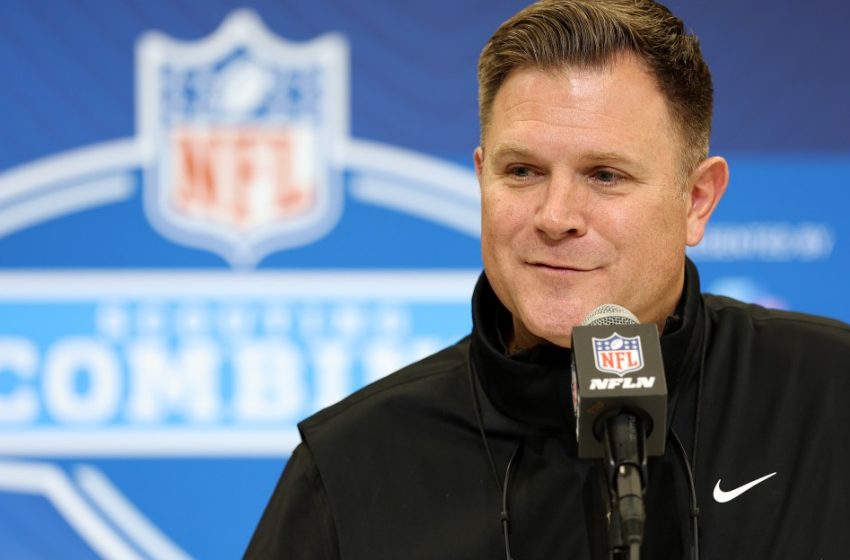
Brian Gutekunst had two separate press conferences at the combine on Tuesday, just the second time he’s spoken to the press, at least behind a podium, since the Micah Parsons trade presser. Thankfully, we were able to have our own Tyler Brooke down there, who got Gutekunst on the record about the offensive line’s growth over the past couple of seasons. Beyond just that quote, though, here are a couple of things that stood out to me about Gutekunst’s pressers, regarding 2026. Let’s make some mountains out of molehills.
The Packers are already well over the salary cap right now, and Gutekunst hasn’t committed to anyone being released, be it left guard Aaron Banks, center Elgton Jenkins, defensive end Rashan Gary or cornerback Nate Hobbs, for cap relief. Green Bay really has two options going into the new league year to become cap compliant. None of those options involves them being able to sit pat.
- Dump salary to create cap space (most likely coming in the form of Jenkins or Gary).
- Heavily borrow from the future seasons’ cap space to keep their team together.
On top of that, if they want to sign outside free agents, they’ll need to create cap space for that, too. Then the extensions of players like receiver Christian Watson, tight end Tucker Kraft, edge defender Lukas Van Ness and defensive tackle Devonte Wyatt (which might actually drop his 2026 cap hit) also come into play. Beyond the simple cap math, outside free agent signings will also offset potential 2027 compensatory draft picks that the team could earn by losing the likes of quarterback Malik Willis, receiver Romeo Doubs, left tackle Rasheed Walker, center Sean Rhyan, edge defender Kingsley Enagbare and linebacker Quay Walker.
To put it simply, there are a lot of pressures on the Packers in 2026, because of the structure of the league, to actively stay out of the free agent market, unless they want to put the team on a credit card (from a cap standpoint). Gutekunst was asked about that reality on Tuesday.
So the most important thing, I think, is the 2026 season and how we’re going to chase a championship. That’s the most important thing. That will never change. You do have to balance it to make sure that you can be competitive year in and year out. So, again, you don’t want to pile up that credit card a little too so that you can’t be competitive down the road.
Personally, I think the Packers want to be as good as they can for as long as they can. It’s just their nature. They’re looking for sustainability, even if it means lower peaks.
If you look at their cash spend since the pandemic, when teams really learned how much future cap space they can borrow from, Green Bay has been a middle spend team. Their numbers haven’t been super consistent from year to year, though. In 2022, Green Bay’s last big push with quarterback Aaron Rodgers, the Packers were the second-highest cash spend team in the NFL — and paid for it on the cap for the next two years. In the other five post-pandemic seasons, the Packers have ranked just 24th in player spend.
So when Gutekunst says “that will never change” about this supposed relentless chase for a championship, I sort of roll my eyes. They really pushed all their chips in for one year (2021), but have otherwise been pretty conservative in terms of borrowing from the future (which I don’t even believe is a bad strategy, but don’t expect me to buy the company line).
He also added this when answering another question:
Our 2026 will mostly be defined by that, the guys who are already here and what they do to get better.
Gutekunst was put on the spot and asked which positions his team needs more competition at. From my point of view, it’s center, where Elgton Jenkins and Sean Rhyan could both be 2026 free agents, and nose tackle, where the team struggled to replace Kenny Clark, leading to a great first-quarter defense in 2025 that slowly decayed throughout the course of the game.
Here’s how Gutekunst responded:
Throughout, quite frankly, but certainly in the secondary we’re going to need to add some competition, probably inside linebacker, you know, throughout the offense.
A couple of thoughts here:
First of all, I take secondary to mean cornerback, since four of the team’s top five safeties are still under contract in 2026, and I doubt that Green Bay is looking to displace Xavier McKinney, Evan Williams or Javon Bullard. Kitan Oladapo has also looked good in limited reps, but he’s already stuck behind the logjam at the position, too. It doesn’t take a rocket scientist to realize that the Packers need cornerbacks who are under contract for 2027, as the only one currently under contract for the next two years is Nate Hobbs, who the team could potentially move off of this offseason. I’m not sure they draft a 2026 starter, but I think they almost certainly come out of the draft with a potential 2027 starting cornerback.
The inclusion of a linebacker is much more interesting to me. First of all, the team seemed fine with Edgerrin Cooper playing the Will position and Isaiah McDuffie playing the Sam position in their previous 4-3 defense, with third-round pick Ty’Ron Hopper being the backup Will/Sam and McDuffie being the backup Mike behind Quay Walker. But Walker is set to be a free agent, so maybe this is a hint that the team has already internally moved on from him being a starting option at Mike in 2026.
Beyond that…did you catch that? “Inside linebacker?” Usually, if you’re referring to a 4-3 defense, the “inside linebacker” would be called either a Mike linebacker or a middle linebacker, not an inside linebacker. Inside linebacker is generally a term used for 3-4 defenses, where the edge defenders (4-3 defensive ends) are considered to be outside linebackers.
Almost all of the quarters system guys are based out of a 3-4. The most recent example of this is Christian Parker, who took over the Dallas Cowboys’ defense this offseason and has stated that they will transition to a 3-4 defense for the first time since 2012. New Packers defensive coordinator Jonathan Gannon played more Cover 4/quarters than any team in the league over the last five seasons, so it’s been my assumption that he will be bringing a 3-4 quarters system to Green Bay, as he did with the Arizona Cardinals.
Earlier this month, Gutekunst said that he didn’t know what Gannon was going to do, schematically, with the defense, but he might have let the cat out of the bag with his verbiage here.
The reason why the quarters system guys (like Vic Fangio in Philadelphia or Mike Macdonald in Seattle) love to base out of a 3-4 defense is that the line of scrimmage defenders sort of have to be run-first defenders, since you’re generally lining up with four defenders in far off coverage. To make up for that fact, they have line of scrimmage defenders (defensive line and 3-4 outside linebackers) play “a gap and a half” in the run game. It helps to play three 300-plus-pounders (in a 3-4 base) instead of just two (which is what would happen in a 4-3 base) if you’re trying to slow-play the run game with inside linebackers and safeties that are playing coverage first, which is common in the scheme.
It’s almost necessary at the NFL level to play a 3-4 defense (or a subpackage equivalent like Penny) if you’re going to play out of quarters frequently, as Gannon’s defenses have. The front has to match the coverage, if that makes sense.
An update on the 3-4 point:
First Appeared on
Source link






