


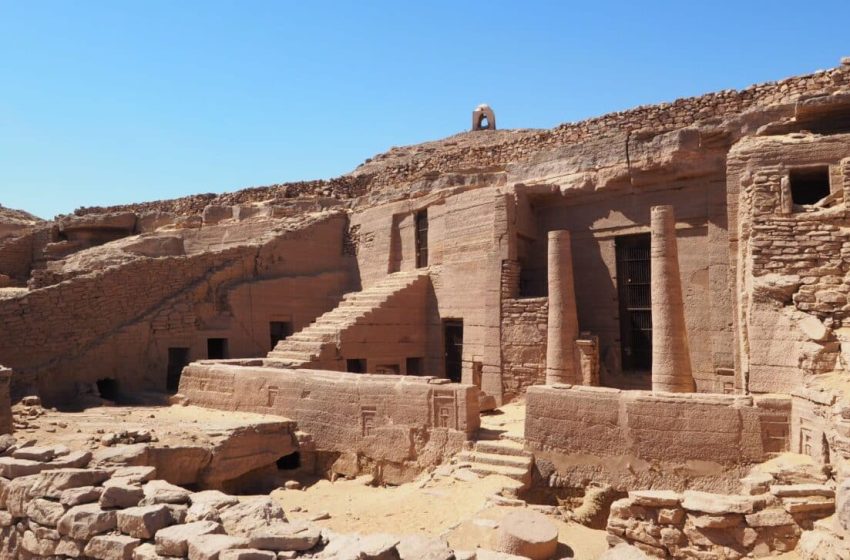
A Tomb Complex that’s 4,000 Years Old
A remarkable funerary complex has been uncovered near Aswan, shedding new light on the burial practices of ancient Egypt. Excavations at the Qubbet el-Hawa site have revealed a series of rock-cut tombs dating back to the Old Kingdom, with exceptional finds offering insights into both the spiritual and material culture of the time. This discovery deepens our understanding of southern Egypt’s role as a sacred and ritual hub across multiple dynasties.
The site of Qubbet el-Hawa, located on the western bank of the Nile opposite Aswan, has long been known for its extensive collection of tombs, including those of high-ranking individuals. The recent excavation, conducted by the Supreme Council of Antiquities (SCA), has unveiled well-preserved burial shafts, ceramic offerings, and personal adornments. These findings reflect the site’s sustained use over centuries, from the Old Kingdom through the Middle Kingdom, highlighting its enduring significance for funerary practices in Egypt.
Old Kingdom Tombs and Their Continued Use
Archaeologists working in the Qubbet el-Hawa area have uncovered a series of rock-cut tombs that were originally constructed during the Old Kingdom, circa 2686–2181 BC. These tombs show clear evidence of reuse in later periods, particularly the First Intermediate Period and the Middle Kingdom. According to Dr. Hisham El-Leithy, Secretary-General of the Supreme Council of Antiquities, this finding is significant for understanding the evolution of burial practices at the site.
While initially built for the Old Kingdom elite, the tombs were repurposed in later eras, underscoring the site’s lasting ritual and strategic importance. The reuse of tombs during different dynasties is a well-known phenomenon in Egyptian archaeology and provides a unique glimpse into the continuity of religious and funerary customs.
Remarkable Finds: Ceramic Vessels and Funerary Goods
One of the standout discoveries in the tombs is a collection of approximately 160 ceramic vessels, many of which are intact and in excellent condition. These vessels, which were used to store perishable items like liquids and grain, provide a crucial link to the funerary practices of the time. Epigraphers on-site found inscriptions in hieratic script on many of the vessels, indicating their role in ensuring the deceased’s provisions for the afterlife.
According to Mohamed Abdel-Badie, head of the Egyptian Antiquities sector of the SCA, these finds reveal the meticulous care given to ensuring that the deceased were provided for in their journey to the afterlife.
Beyond the ceramics, the excavation also yielded a variety of personal adornments and funerary items. Among the most notable were copper-alloy mirrors, alabaster cosmetic containers, and colorful necklaces, reflecting the aesthetic tastes and material wealth of those buried at the site.
These artifacts, which belong to the Middle Kingdom (circa 2055–1650 BC), further confirm that the area continued to be used as a funerary space during later periods. The discovery of amulets, small figurines representing deities, adds another layer of understanding to the religious and protective practices surrounding death in ancient Egypt.
The Role of Qubbet el-Hawa in Southern Egypt’s History
The ongoing excavation at Qubbet el-Hawa is part of a broader effort to document and preserve the historical significance of the site. With burials spanning from the early Old Kingdom through the Greco-Roman period, the site offers a rare continuous record of ancient Egyptian funerary practices.
The discovery of these newly unearthed tombs, along with the treasures they contain, adds valuable data to the understanding of ancient Egyptian culture, particularly in the southern part of the country.
As Sherif Fathy, Egypt’s Minister of Tourism and Antiquities, noted, these findings contribute not only to scholarly research but also enhance Egypt’s international cultural appeal. The excavation is expected to yield more discoveries, potentially uncovering additional tombs and artifacts that could provide further insights into the lives of those who chose Qubbet el-Hawa as their final resting place.
First Appeared on
Source link






