


What It Will Take to Change the Regime in Iran
The Islamic Republic of Iran is, quite possibly, at its weakest point since its founding, in 1979. In June, Israeli and U.S. attacks destroyed its uranium enrichment capacity and many of its air defense systems. In December and January, the country experienced the most widespread domestic uprising since the birth of the Islamic Republic. Throughout, it has faced spiraling economic and environmental crises that it cannot fix. None of these events has knocked out the Islamic Republic. But there is no doubt it is down.
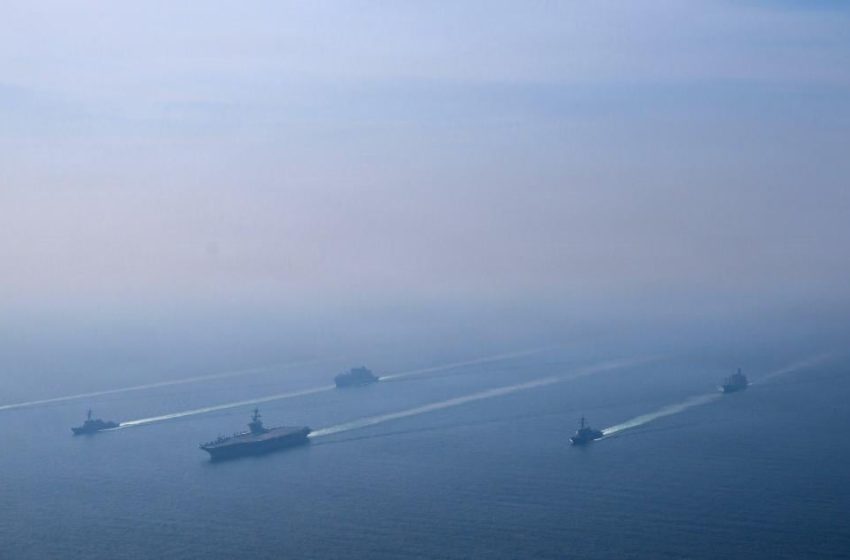
Now, U.S. President Donald Trump is threatening to attack the country. He has made it clear he has little tolerance for the regime’s efforts to rebuild its nuclear program or the extraordinarily brutal way it cracked down on protests. “If Iran violently kills peaceful protesters, which is their custom, the United States of America will come to their rescue,” he said last month. “We are locked and loaded and ready to go.” The president has since amassed U.S. air and naval assets in the region, and he is considering a variety of strike options.
But that doesn’t mean major attacks are guaranteed. In fact, thus far, the administration’s decisions raise more questions than they answer about what Washington aims to achieve and how. Right now, Trump is practicing gunboat diplomacy, hoping that the threat of force will coerce the Islamic Republic into making a nuclear deal better than the one he left in 2018. If that fails, he is mulling decapitation operations or limited strikes in order to get the regime to bend.
It is easy to see why the Trump administration is prioritizing diplomacy and limited strikes. The Islamic Republic may be weak, but it is still lethal and capable of harming U.S. forces and civilian targets throughout its region. The president, meanwhile, has repeatedly proved reluctant to start a protracted military campaign. But the reality is that after decades of trying and failing to change Tehran’s behavior with sanctions, sabotage, and, more recently, one-off strikes, the time has come to go big. The regime is simply too ideological to be cowed by a few rounds of bombing. The Iranian people, meanwhile, have made it more than clear that they are ready to transform their country. The United States can and should help them by using its military power to neutralize the Islamic Republic’s military capabilities and degrade its repressive domestic apparatus.
Such measures could inspire the masses of Iranians who took to the streets in December and January to do so again. Just this week, Iran witnessed smaller-scale campus protests, showing that animosity against the regime very much remains. If regular protests resume, American military power could level the playing field between the street and the state, giving the country’s demonstrators a chance to succeed.
DEAL OR NO DEAL
The Trump administration may have threatened Iran with major military action. But there are reasons to think that, for now at least, it might have other ideas. For starters, the president’s comments on Iran this year have oscillated between threats of war and the imperative of a nuclear agreement. “Hopefully Iran will quickly ‘Come to the Table’ and negotiate a fair and equitable deal,” Trump wrote on Truth Social in late January. “I would rather have a Deal than not but, if we don’t make a Deal, it will be a very bad day for that Country,” he posted a month later. During the February 24 State of the Union address, Trump declared that although his “preference is to solve this problem through diplomacy,” he would “never allow the number one state sponsor of terror … to have a nuclear weapon.”
Tehran claims the two sides have made progress in their talks. But thus far, Iranian officials have, expectedly, refused to give up core elements of their nuclear program, so there is reason to think that Trump will be compelled to attack—even as the two countries continue to negotiate indirectly. If past is prologue, he will keep such action short and sharp. In his first term, for example, the president ordered the assassination of Qasem Soleimani, a prominent commander in Iran’s Islamic Revolutionary Guard Corps (IRGC), with a drone strike in January 2020. In June 2025, he directed the use of massive ordnance penetrator bombs against Iranian enrichment facilities. And the recent extraction of Venezuelan president Nicolás Maduro from Caracas by U.S. military forces took place in the span of one evening. Notably, Trump has cited the Maduro operation while threatening Iranian Supreme Leader Ali Khamenei. “Like with Venezuela,” the president said in a Truth Social post describing Washington’s naval buildup around Iran, the U.S. military is “ready, willing, and able to rapidly fulfill its mission, with speed and violence, if necessary.”
But a quick, one-and-done operation is extremely unlikely to down this regime, even if it succeeds in killing Khamenei. The Islamic Republic may have once been a sultanistic state built on the personal cult of its founding supreme leader, Ayatollah Ruhollah Khomeini. But over the last three decades, Khamenei (Khomeini’s successor) has institutionalized his rule and his regime both by empowering loyalists throughout a considerably larger state bureaucracy and by supporting competing power centers. As a result, the Islamic Republic looks more like a series of pillars than it does a pyramid, with a powerful deep state made up of security officials with their own vested interests in maintaining the regime.
Seen in this light, many of the leaders and veterans of the IRGC are less Khamenei’s subordinates than his partners. Indeed, it is unclear to what extent the 86-year-old Khamenei is actually running the regime day-to-day. The Islamic Republic, for example, made remarkably quick military decisions during the 12-day war with Israel in June, when Khamenei was likely in a bunker and, according to a New York Times report, not using electronic communications. It did so even after many senior IRGC officers were killed in just one night by Israeli attacks.
The Venezuela model, in other words, will not work in Iran. In fact, a singular and spectacular strike on Khamenei might have the opposite of its intended effect. Rather than fostering division and thus jeopardizing the regime, remaining officials would be more likely to close ranks, at least initially. They would keep the system running and try to seek revenge.
GOING BIG
To some analysts, the fact that limited strikes will fail is reason enough to think twice about employing the military. “Iran will not cave to major demands simply because of a bombing campaign,” wrote Nate Swanson, a former White House adviser on Iran, in a cautionary Foreign Affairs piece. “An attack by the United States on Iran could result in unexpectedly deadly retaliation—and a much longer and potentially damaging conflict.” Unless Iran is bluffing, this analysis is correct. But it is not a compelling reason to avoid using the military. Iran is the world’s foremost state sponsor of terrorism, one of the most outright anti-American governments in the world, and the country with the largest ballistic missile arsenal in the Middle East. Nearly a half century of experience has shown that the Islamic Republic will not meaningfully moderate any of this behavior or treat its citizens any better. Washington now has a historic opportunity to bring down the regime, and it cannot pass it up out of fear. Indeed, the fact that Iran would almost certainly escalate in response to a limited U.S. strike is all the more reason to go big from the beginning and avoid settling into the kind of gradual escalation that turns wars into quagmires. Washington cannot let Tehran dictate the pace or terms of the conflict.
None of this means that the United States needs to launch a massive ground invasion and single-handedly topple the regime. In fact, part of why Washington should strike now is that Iran’s own people are prepared to do much of the work themselves. For the past decade, while the United States has treated “regime change” as a pejorative term, unarmed Iranians have increasingly taken to the streets to seek systemic change in what has become a national uprising. Today, it is clear that Iranians are willing to make tremendous sacrifices to get rid of their leaders. That is why the regime had to kill at least 30,000 people, according to the estimates of human rights groups, to put down the most recent protests, and why some Iranians have nonetheless continued to demonstrate in the weeks since. Iranians therefore do not need U.S. troops to march into Tehran. What they need is for the American military to weaken the regime enough for them to succeed.
Trump can start by having the U.S. intelligence community carry out covert operations designed to pave the way for kinetic activity. Intelligence operatives, for instance, should surge secure communications technology, including satellite Internet devices, into the country so that Iranians can still have Internet access even if their government cuts off domestic service. The administration should also authorize information operations aimed at undermining the resolve and cohesion of Iran’s security forces. Finally, the administration should direct the intelligence community to identify and help Iranian security forces that are willing to defect.
A one-and-done operation is extremely unlikely to down the Islamic Republic.
Then, the United States can proceed with airstrikes. It should begin by suppressing and destroying the regime’s air defenses to gain aerial superiority. Doing so shouldn’t be all that complicated, given Israel’s success in knocking them out in past rounds of fighting. But there are platforms the Israelis did not suppress or destroy, and others that Iran has repaired. Afterward, Washington should move against the long pole in the tent of Tehran’s deterrence: its formidable ballistic missile arsenal. Iran can use these weapons to complicate the United States’ approach by inflicting damage on military assets, regional energy infrastructure, maritime shipping, and even on civilian targets in Israel. Rather than wait for Iran to launch large volleys of these projectiles in hopes of overwhelming U.S. and allied defenses, Washington must collapse the network of subterranean bases where medium- and short-range ballistic missiles are kept, which Iranian officials have long hailed as “missile cities.”
To be clear, the United States and, potentially, its partners will sustain losses from Iranian missiles. But by preemptively striking and destroying these bases, Washington can help limit the damage from any Iranian counterattack. If Tehran disperses its mobile launchers after bringing them above ground, the United States should dedicate real-time intelligence, surveillance, and reconnaissance assets to identify their locations and strike them, as Israel did during its 12-day war. (Israeli estimates claim that the country’s attacks on these launchers reduced the regime’s firing capacity by at least 33 percent.) From there, the United States can handicap Iran’s future missile capacity by targeting production facilities, which open-source intelligence suggests are located in or near the cities of Isfahan, Khojir, Parchin, Semnan, and Shahroud.
Degrading Iran’s missile infrastructure will do more than make it easier for Washington to conduct the rest of its military campaign. It could also help ordinary Iranians. Drastic as it might seem, some regime supporters have floated using missiles against Iran’s own people. Likewise, if the Islamic Republic’s missile and nuclear infrastructure is destroyed and its contents entombed, the regime’s representatives will have less leverage when negotiating with U.S. officials or protesters over a political transition. For that reason, the United States would be wise to attack Iran’s remaining nuclear sites, especially as the regime is moving to harden or rebuild them.
PAVING THE WAY
Still, hitting Iran’s missile and nuclear program is unlikely to help Iranian demonstrators in the near term. To do that, Washington should also target the regime’s political institutions and security installations, both as a means of inspiring protesters and to make it harder for the Islamic Republic to coordinate and effectively suppress demonstrations.
Some American analysts might object to targeting Iran’s political institutions as a violation of the country’s sovereignty. But Iranians would likely welcome such a campaign. The country’s people are highly nationalistic, but they are nonetheless looking abroad for help in their fight against the regime. During the latest round of protests, for example, Iranians made English-language videos describing their plight. Others named streets in Trump’s honor, in hopes of getting the president’s attention. When Trump subsequently promised that help “is on the way,” he raised their expectations and likely fostered continued protests. As one demonstrator told The Wall Street Journal in a text message, “We’re all staring at the sky, hoping Trump will bomb us, just to destroy Khamenei and his regime.”
Trump failed Iranians then. But he can correct course now. He could begin to help them by striking state institutions that have ordered or supported the crackdown on Iranians such as the office of the supreme leader, the Ministry of Intelligence, the IRGC counterintelligence directorate, as well as institutions enabled the regime to shut off the Internet. Washington should also use overt and covert means to blind, impede, and militarily pick apart Iran’s wartime command-and-control structures—including those on the supreme national security council, the defense council, and the armed forces’ general staff. The United States could then move to targeting bases and command centers housing other parts of the IRGC, the Basij paramilitary (whose members patrol Iran’s streets and put down protests), and the so-called special units of the country’s law-enforcement forces, who handle crowd suppression. Finally, if Washington determines that Iran’s proxy foreign militias are entering the country to slaughter demonstrators—as appeared to happen during the last round of protests—it should not hesitate to use force against them. These militias, after all, are already designated by the U.S. State Department as foreign terrorist organizations and already have the blood of Americans and U.S. allies on their hands.
Such actions will probably eliminate many key regime officials, including even Khamenei. In striking this wide variety of targets, the United States would show Iranians that it wants to change Iran for the better, not just limit the damage the regime can do to foreign adversaries. Washington should hit these sites even if key officials and leaders are not there. Doing so will still reduce the regime’s repressive capacity, impede continuity of government operations, and send a strong signal that can motivate the Iranian people.
Washington must fracture the Iranian regime.
As it carries out strikes, the United States will need to reduce the regime’s capabilities all across the country, not just in Tehran. That means U.S. officials should target every IRGC and Basij provincial command and battalion headquarters, as well as the command centers belonging to Iranian police forces. Doing so would inspire further protests while making it harder for the regime to suppress them. Nothing is likely to galvanize Iranian protesters more than seeing local security forces come under attack.
Finally, the United States must be prepared to use not just bombers and advanced fighter jets but lower- and slower-flying drones and aircraft, which could provide close air support to crowds squaring off against regime militants. Such attacks would help the United States take out mid- and lower-level commanders, drilling down on the chain of command of Iran’s security forces. It might also prompt these officials to retreat. As rank-and-file Iranian forces begin worrying about their survival, their instinct for self-preservation might kick in and override lingering loyalty to their units and commanders. Iran’s security services, in turn, might finally fracture.
This fracturing would be the key to how Iranians finish off the regime. As the Islamic Republic’s forces are sandwiched between U.S. airstrikes and popular pressure, they will have every incentive to either lay down their weapons or flip and join with the protesters. In the latter case, they might bring their guns with them, transferring coercive power to the street. Both outcomes could embolden demonstrators to press their advantage. They might take over police stations and occupy government and municipal buildings. With the security forces out of their way or actively helping them, protesters could seize state television, radio, and other communications platforms and broadcast the end of the Islamic Republic. Such an outcome would have parallels to the 1979 revolution: the Islamic Republic celebrates February 11 as “Islamic Revolutionary Victory Day” because it is the day when the Iranian armed forces declared their neutrality, effectively abandoning the existing government and handing the country over to its revolutionary masses.
The collapse of the Islamic Republic would, of course, be turbulent. Many analysts fear that Iran would simply get a new strongman, possibly someone who rises up from the ashes of the IRGC. But that is far from foreordained. Newly empowered protesters could use their new platforms to call for the country’s large civilian bureaucracy to keep working in order to maintain government functions. They might also bring in Iran’s exiled opposition leaders, who have been planning for and could help lead a transition. For Washington to eschew military options out of fear of instability would thus be to make the perfect the enemy of the good. The real source of destabilization in and around Iran, after all, is not the prospect of regime change. It is the Islamic Republic itself.
ONE WAY OUT
When Trump was asked about what an acceptable “endgame” with Iran would be, he replied: “to win.” After decades of Iran’s unabated anti-Americanism and hostility, it should be clear to all that winning means toppling the Islamic Republic. The regime is the arsonist behind many of the Middle East’s fires and a terror to its own citizens. Washington should employ sustained military force in order to break it and thus pave the way for Iranians to take back their country.
That doesn’t mean helping take down the Islamic Republic will be easy. The United States will run into significant challenges. It will encounter unknown variables, including the resilience of Iranian security services when facing American firepower and the Trump administration’s own risk tolerance once it encounters difficulty. But at this point, bold action is the only way to break the current dynamic. The United States has both the capacity and the capability to weaken the Iranian government while mitigating the resulting dangers. The Iranian people have the drive and determination needed to finish off the regime. Together, the two have everything they need to win and make a new Iran.
Loading…
First Appeared on
Source link






