


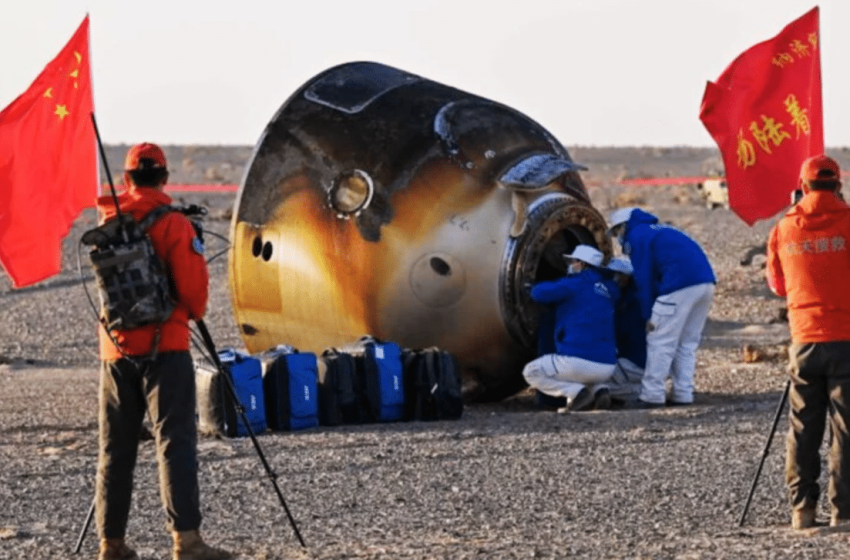
Chinese Spacecraft Damage Revealed to Be Far More Serious Than Previously Announced
In early November 2025, Chinese astronauts aboard the Tiangong space station made a shocking discovery that could have altered the trajectory of their mission. Initially, reports from state news agencies suggested the damage to the spacecraft’s viewport was minimal, likely caused by a collision with space debris. However, recent revelations shed light on the true extent of the damage, revealing that the cracks were far more severe than previously reported. The incident triggered immediate action, with the crew’s return delayed, and a replacement spacecraft sent to ensure their safety.
The Alarming Discovery
As the Shenzhou-20 crew members performed routine checks on their spacecraft, they were faced with an unexpected and unsettling sight. As reported by Space.com, mission commander Chen Dong recounted his first reaction to the discovery:
“I spotted something like a triangular on the viewport,” he said. Upon closer inspection, Chen initially thought a small object, such as a leaf, might have stuck to the outside of the window. But the reality quickly set in. “My first thought was whether a small leaf had somehow stuck to the outside of the window,” Chen said. “But then I quickly realized that couldn’t happen because we were in space. How could there possibly be a fallen leaf there?”
The situation soon revealed a far more critical issue: the cracks were not just surface-level imperfections but had penetrated the spacecraft’s window, exposing the vulnerability of the vessel to potential space debris damage. As the astronauts analyzed the cracks using specialized equipment, it became clear that the damage was more than just cosmetic and required immediate action. The space station’s crew relied on careful observation and analysis to assess the structural integrity of the spacecraft, which would ultimately decide whether or not they could return safely to Earth.
Reassurance From the Crew
Despite the alarming discovery, the astronauts maintained a calm and pragmatic approach. Wang Jie, an aerospace technician and fellow crew member, expressed confidence in their safety.
“I wasn’t really nervous, actually,” Wang explained. “The outermost layer of the viewport is a protective layer, and inside it there are two pressure-bearing layers, and we are safe as long as the cabin pressure doesn’t change.”
This understanding of the spacecraft’s design, coupled with the reassurance of the ground team’s readiness, gave the astronauts a sense of control over the situation.
Wang continued, emphasizing the reliability of their mission support team:
“I also know well about our ground team that no matter what happens, they will go through analysis and experiments to determine whether we can return safely,” he said. “So I wasn’t too worried.”
While the astronauts weren’t panicking, the incident underscored the complexity and risks of space travel, particularly in the face of unpredictable threats like space debris. The astronauts’ confidence in their training and the capabilities of their mission support network was critical in managing the potentially hazardous situation.
The crew of China’s Shenzhou-20 mission shared details of how they detected and responded to a suspected window crack struck by space debris on their return capsule, which has inspired many with the courages and composure of the astronauts in coping with space emergency.… pic.twitter.com/hOosK3mMCD
— CCTV+ (@CCTV_Plus) February 17, 2026
The Ground Team’s Response and Technical Solutions
In response to the cracks discovered in the viewport, the China National Space Administration (CNSA) swiftly acted, launching an emergency spacecraft without a crew to transport the astronauts safely back to Earth. During re-entry, the CNSA used a specialized “porthole crack repair device” that astronauts installed in the Shenzhou-20 capsule to enhance its heat protection and sealing capabilities, ensuring the spacecraft would hold up during re-entry despite the damage. This innovative solution not only addressed the immediate concerns but also highlighted the adaptability and ingenuity of the CNSA in handling unexpected challenges.
After the capsule’s safe return, an additional issue arose during the landing phase. Due to the absence of a crew member to manually deploy the parachute, the main parachute failed to detach automatically. This delay could have resulted in the capsule being dragged along the ground in strong winds. Xu Peng, the on-site commander at the Dongfeng Landing Site, detailed the situation:
“As a result, the main parachute did not automatically detach upon landing, and in strong winds, it could have dragged the return capsule along the ground.”
Quick thinking by the ground team, who swiftly reached the landing site to cut the parachute, ensured that the capsule remained in place after landing, and no further complications occurred.
First Appeared on
Source link






