


Lab-Grown Brains Growing More Powerful
Back in 1907, American biologist Henry Van Peters Wilson discovered that sponges will re-form into living creatures after their cells are broken apart through a fine mesh screen — demonstrating that the cells of living organisms contained something telling them how to build complex, multi-cellular structures.
Researchers dined out this for decades, and their subsequent discoveries led to the isolation of pluripotent stem cells — “master cells” that can divide endlessly and become any type of cell in the body — first from mouse embryos in 1981, then from human embryos in 1998.
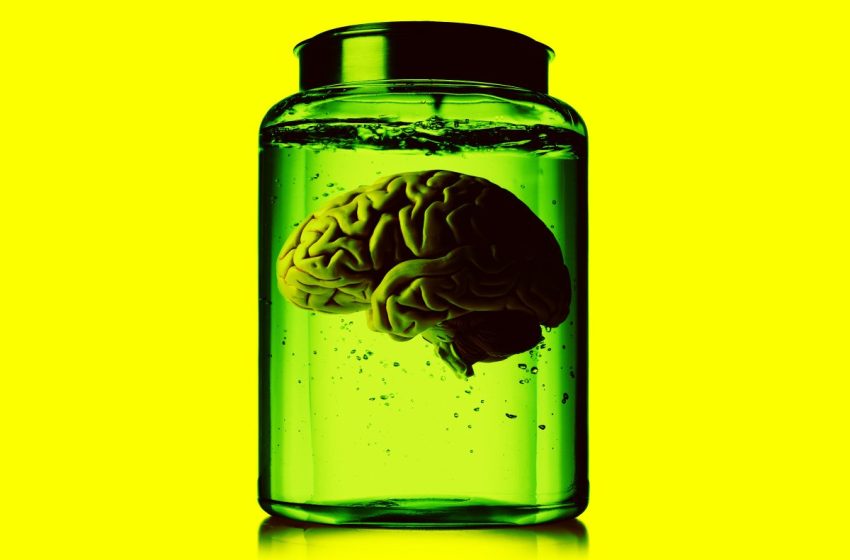
Lab-grown brains finally came onto the scene in 2013, when a team of scientists led by Madeline Lancaster created the first brain “organoid”: a tiny, three-dimensional cell culture mimicking the human brain. These mini-brains, made out of stem cells, contain real neurons, thus allowing researchers to study brain development, model neurological diseases, and test drugs before human trials. (As you might guess, the practice is not without controversy.)
Now, scientists at the University of California, Santa Cruz are taking lab-grown mini-brains into their toddler era, after demonstrating that brain organoids can process information in real time.
In a remarkable breakthrough published in the journal Cell Reports, researchers were able to effectively coach lab-grown brains into solving the “cart-pole” problem. The cart-pole problem is an engineering benchmark used in robotics, artificial intelligence — and now cognitive science — to measure how effective systems are at processing information.
The test basically involves balancing a broomstick upright on your palm. Gravity forces you to constantly adjust your position — move too much or not enough, and the broom falls. Every human needs to solve this problem in order to stand and walk upright. Luckily for us, we have our animal instincts (and more importantly, our inner ears) to guide us through; brain organoids have no such advantage.
Yet by coaxing their mini-brains with electrical signals guided by a reinforcement learning algorithm, the UCSC researchers were able to “coach” the organoids from a cart-pole “win” rate of just 4.5 percent to a whopping 46 percent.
“You could think of it like an artificial coach that says, ‘you’re doing it wrong, tweak it a little bit in this way,’” Ash Robbins, the study’s lead author said in a press release. “We’re learning how to best give it these coaching signals.”
In essence, their success proves that brain organoids are capable of goal-directed learning, similar to the kind of trial-and-error a toddler goes through as they learn to walk. It’s a remarkable achievement for brain science more broadly, coming some 120 years after Henry Van Peters Wilson tore his sponges to shreds.
“These are incredibly minimal neural circuits. There’s no dopamine, no sensory experience, no body to sustain, no goals to pursue. And yet, when given targeted electrical feedback, this tissue is plastic enough and structured enough to be pushed toward solving a real control problem,” said Keith Hengen, an associate professor of biology at Washington University in St. Louis. “That tells us something important: the capacity for adaptive computation is intrinsic to cortical tissue itself, separate from all the scaffolding we usually assume is necessary.”
More on neurology: Scientists Preparing to Simulate Human Brain on Supercomputer
First Appeared on
Source link






