


NASA Confirms the Moon Is Moving Away 3.8 Centimeters a Year, And It’s Gradually Changing Earth’s Rotation
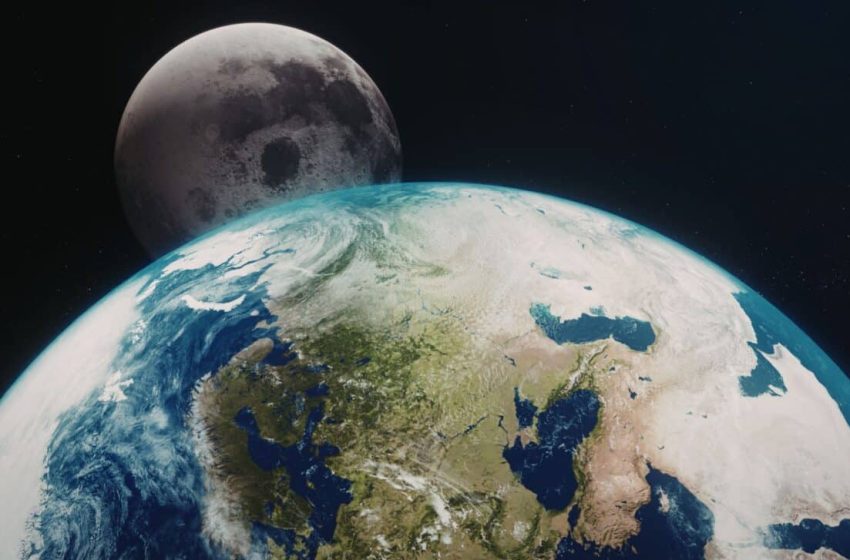
The Moon is moving away from the Earth at a measurable rate, subtly stretching the length of our days and reshaping the balance of the planet. What seems like a stable celestial dance is, in reality, a slow transformation unfolding over millions of years.
For centuries, the lunar cycle has appeared constant, governing tides and eclipses with reassuring regularity. Yet modern measurements reveal that this stability is only apparent. The distance between Earth and its only natural satellite is increasing year after year.
This gradual shift matters because it affects the very mechanics of our planet’s rotation. The link between tides, orbital motion, and day length is not theoretical. It is documented through fossil records and laser measurements.
Prehistoric Shells Record Earth’s Faster Spin
Seventy million years ago, during the late Cretaceous period, a day on Earth lasted about 23 and a half hours. According to a 2020 study published in Paleoceanography and Paleoclimatology, researchers reached this conclusion by analyzing growth lines in fossilized shells of the bivalve Torreites sanchezi.
These microscopic striations, similar to tree rings, record daily growth cycles. By counting them, scientists determined that a year at the time contained approximately 372 days. More days within a year imply shorter individual days.
The data indicate that the Moon was closer to Earth, exerting a stronger gravitational pull and influencing the planet’s rotation more intensely. The finding is not speculative. It rests on physical evidence preserved inlimestone deposits.
Tides Drive the Moon Away
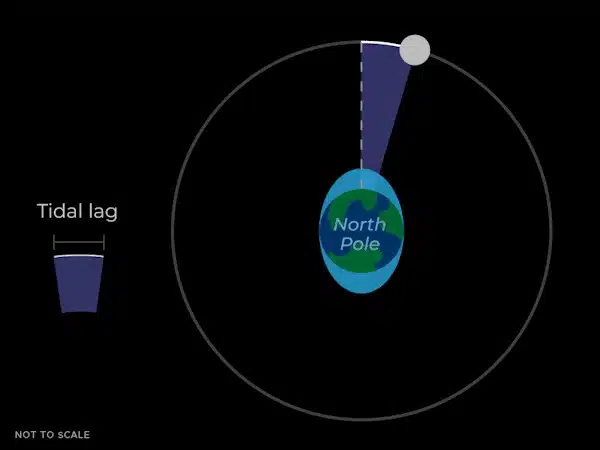
The reason for the Moon’s retreat lies in tidal physics. As Earth rotates, the lunar body’s gravity pulls on the oceans, creating two opposing tidal bulges. These bulges are slightly offset from the Earth’s satellite’s position because Earth spins faster than the orb orbits it.
That offset creates a gravitational torque. The bulge pulls ahead of the Earth’s cosmic partner, transferring rotational energy from Earth to its satellite. As a result, the Moon gains orbital energy and shifts to a higher orbit. Based on measurements detailed in a NASA press statement:
“One of the biggest revelations is that the Earth and Moon are slowly drifting apart at the rate that fingernails grow, or 1.5 inches (3.8 centimeters) per year. This widening gap is the result of gravitational interactions between the two bodies.”
Earth Slows Down as the Moon Pulls Ahead
As the silver orb gains energy, Earth pays the price. The energy required to widen the lunar orbit comes directly from the planet’s rotational momentum. In practical terms, that means Earth’s spin is gradually slowing.
In an article for The Conversation, astrophysicist Stephen DiKerby of the University of Michigan noted that the phenomenon is invisible on a human timescale but irreversible. The length of a day increases incrementally as rotational energy is transferred outward.
The difference is almost microscopic, just fractions of a second over immense timescales. But stretch that across millions of years, and it becomes meaningful. The Earth and its natural satelitte may seem locked in a steady dance, yet their relationship is anything but frozen.
First Appeared on
Source link






