


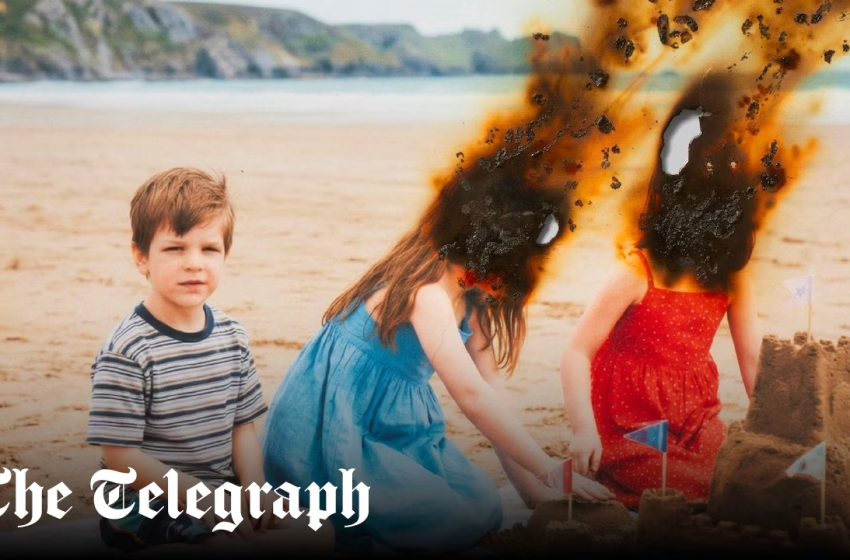
What it’s like to treat and raise highly dangerous children
Recently, during an early morning walk, I listened to a friend describing the havoc wreaked by a “problem child” at the after-school club her six-year-old son, Jake*, was attending. Jake had known Beth* for a few years already; the two had previously been in nursery together. Even as a four-year-old, Beth had been frighteningly violent. She yelled and screamed, hit and bit, regularly sending Jake and other classmates home with bruises. Unlike other children, Beth never seemed upset about hurting others, and getting in trouble didn’t faze her in the least. Once, Beth punched a classmate and then smirked at the adults in the room as if to say, “What are you going to do about it?”
Both Beth’s parents and the nursery staff were at a loss about how to address her behaviour. And the problems continued. Not long before this conversation with my friend, Beth had become so violent that the after-school co-ordinators gave her access to the entire gymnasium where the club normally took place and sequestered all of the other children in a nearby library, just to keep them safe.
My friend had sent countless polite emails and requests for the staff to manage Beth’s behaviour better, to no avail. She said: “[I received an] acknowledgement that the child’s actions are not OK, but that’s where it ended, instead of a plan to intervene.” She was inclined to push to have Beth kicked out of the club. But before she did, she wanted my advice. She knew that as a social and personality psychologist, I had spent the past 20 years studying people with dark personality traits: psychopathy, narcissism, Machiavellianism, sadism. What did I think she should do?
Although my work focuses on adults, these traits don’t suddenly pop up once we have grown up and reached maturity. Our characters can evolve throughout our lives, but most people still recognise aspects of their personality – defined as patterned ways of thinking, feeling and behaving – that have been around since early childhood.
When it comes to the darker traits, psychologists have shown that we can reliably measure “callous-unemotional (CU) traits” in children as young as two. For children this age, screening questions generally ask carers whether the child seems to show no emotions, doesn’t care about hurting others to get what they want, and if they are unbothered by being in trouble. These traits, like other aspects of personality, exist on a continuum. Everyone lands somewhere, from very low to very high. But research has revealed that displaying high levels of CU traits as a child increases the odds that you will show high levels of psychopathy when you grow up.
The word “psychopath” is loaded. It conjures up images of serial killers such as Ted Bundy or fictitious monsters like Hannibal Lecter, and the (mistaken) belief that the condition is completely untreatable. Applied to children, such a label could be a devastating and self-fulfilling one. For these reasons and more, psychopathy isn’t a term that psychologists use to describe children. At the same time, these behavioural patterns can’t be ignored.
There are well-recognised mental disorders that describe similar behavioural patterns. “Conduct disorder” is marked by a persistent pattern of aggression, deception and serious rule violations. While CU traits alone are not sufficient for a diagnosis for conduct disorder, practitioners can specify that a child diagnosed with conduct disorder has “limited prosocial emotions” – clinical speak for the same pattern of cold disregard for others. Such jargon can make this behaviour seem benign, but it’s not: this was the diagnosis given to Scarlett Jenkinson, one of the teenage killers of transsexual teenager Brianna Ghey, by a consultant forensic psychiatrist during the murder trial.
First Appeared on
Source link






