


Iran Still Has a Nuclear Option That Could Hurt Americans
While U.S and Israeli attacks on Iran have decimated its leadership and degraded its arsenal, Tehran still retains a never-before-used nuclear option that could hurt American consumers and hit Donald Trump’s Achilles’ heel. It could close the Strait of Hormuz or otherwise disrupt traffic through the narrow waterway, driving up global oil prices and forcing Americans disgruntled over affordability to pay more for gas. Iran has never closed the strait before, but threats of deliberate closure or fear of accidental disruptions caused by conflict have repeatedly driven up oil prices in the half century since the Islamic Revolution brought the clerical regime to power.
Why It Matters
About a fifth of the world’s oil and 20 percent of its seaborne gas pass through the strait every day. Blocking or disrupting tanker traffic through the strait could deprive global oil markets of all or most of the shipments from six of the world’s 20 largest oil exporters. U.S. gas prices could jump from $2.95 on Sunday afternoon to the mid-$3 range by April or May, Patrick De Haan, head of petroleum analysis at GasBuddy, told MarketWatch. Higher U.S gasoline prices could rapidly become politically untenable for Trump and the Republicans who support his Iran strategy after their party faced a drubbing in state and local elections late last year at the hands of Democrats running on the high cost of living. Democrats plan to make affordability the centerpiece of their campaign for midterm elections in November.
What To Know
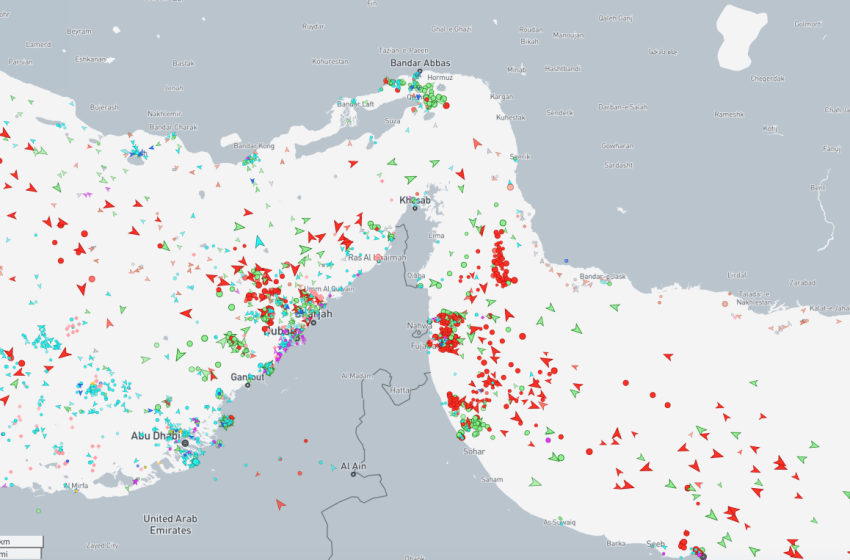
The price of Brent crude, the global oil marker, rose 13 percent to more than $82 a barrel as trading recommenced in Asia on Monday. A timelapse of shipping traffic through the Strait of Hormuz shows a significant drop during Saturday and into Sunday although it is not total. At least one liquefied petroleum gas tanker could be seen transiting the route early on Sunday.
The Tasnim news agency, which is close to Iran’s Islamic Revolutionary Guard Corps, said the strait was closed to all traffic, although there was no immediate announcement from the government itself. Newsweek contacted Iran’s foreign ministry for comment.
The Iranian threats to shipping followed U.S. and Israeli attacks on Iran. President Trump said these aimed to eliminate a building danger for Americans, but also offered a chance for Iranians to take power from the Islamic Republic’s leadership. He specifically threatened the Iranian navy.
Oman reported an attack on an oil tanker five miles north of one of its ports. Four sailors were wounded. Separately, it said a drone had struck Duqm commercial port.
The UKMTO maritime security information body said in an advisory note that it had received multiple reports from ships in the Gulf stating that the Strait of Hormuz had been closed. They had been received on VHF Channel 16, which is used for sending emergency messages at sea.
Major trading houses had been halting shipments through the Strait of Hormuz amid Iranian threats to shipping after the U.S. and Israeli strikes, according to the Lloyd’s List maritime intelligence service. It said insurance companies had responded swiftly, with dramatic price rises and war risk notices for some policies being canceled.
Shipping company Maersk said it was “suspending all vessel crossings in the Strait of Hormuz until further notice.” It also said it was pausing sailings through the Suez Canal and the Bab al-Mandeb Strait, which is at risk of attacks from Iran’s Houthi proxy force. Ships would sail around Africa instead.
The disruption pointed to likely sharp rises in the price of crude oil, which had risen in recent weeks because of the growing concerns of possible war between the United States and Iran. Benchmark crude oil futures closed at just over 67 dollars a barrel on Friday, near a seven-month high.
A map from MarineTraffic, which tracks global shipping, shows a buildup of ships at either end of the strait after reports of Iranian threats to vessels using the waterway as well as Iranian missile and drone attacks on Gulf Arab countries that host U.S. bases.
Why Hasn’t Iran Closed the Hormuz Strait Before?
The strait is relatively easy to disrupt: It’s about 21 nautical miles at the narrowest point, with two-mile-wide shipping lanes running in both directions. Iran could attack tankers, threaten them, or board and seize ships. It also has thousands of naval mines at its disposal.
But Iran has had reasons not to close the strait. Doing so would disrupt its own trade in oil when it desperately needs cash. Also, the U.S. has tended to move very aggressively against such moves. In 1988, during the latter stages of the Iran-Iraq War, a U.S.-flagged oil tanker stuck an Iranian mine. America retaliated with Operation Praying Mantis, which dealt a crushing blow to Iran’s navy. That followed years of Iran and Iraq attacking each other’s oil shipping in the strait in the Tanker War.
And then there’s China, a key Iranian partner. China receives about 25 percent of the oil that passes through the strait and would be hit harder than America—which gets well below 10 percent—by a closure.
What People Are Saying
MarineTraffic: Amid reports of missile strikes and retaliatory actions across the region, several oil majors and trading houses have reportedly paused crude and fuel shipments through the strait as a precaution.”
Iran’s Tasnim News Agency: “Vessels in the area are receiving repeated messages from the Islamic Revolution Guards Corps (IRGC) telling them that no ship is allowed to cross the strategic strait.”
U.S. President Donald Trump: “We’re going to annihilate their navy.”
UKMTO: “Mariners are advised that VHF broadcasts or statements indicating closure of the Strait of Hormuz are not legally binding and do not constitute a lawful restriction on navigation under international law… Vessels are advised to transit with caution and report any suspicious activity, kinetic activity, or electronic interference to UKMTO.”
Trading Economics: “Oil prices are set to jump sharply when trading resumes Sunday night, as unprecedented U.S. and Israeli strikes on Iran have intensified Middle East tensions and heightened concerns over potential disruptions to global energy supplies.”
What Happens Next
How far oil prices rise and for how long depends on multiple factors, including whether Iran seeks to enforce a closure of the Strait of Hormuz and succeeds as well as whether OPEC countries significantly increase production to bring prices down. Several OPEC producers, such as leading exporter Saudi Arabia, came under attack from Iran. They agreed to output increases on Sunday, but unlikely by enough to avoid price increases. U.S. naval forces can also be expected to counter any Iranian efforts to disrupt oil supplies.
Updated on 03/01 at 6:20 p.m. ET with additional information and an updated headline.
Updated on 03/01/2026 at 9.15 a.m. ET with attacks on Oman and Maersk stopping transit of the Strait of Hormuz and also rerouting shipping around Africa
Updated on 03/01/2026 at 9.25 a.m. ET with latest market prices
First Appeared on
Source link






