


F1 chartering flights to ensure key staff arrive at Australian Grand Prix on time
Formula 1 has chartered flights to ensure key team staff arrive on time for this weekend’s 2026 Australian Grand Prix, after the ongoing conflict in the Middle East heavily disrupted travel through the region.
The first event of the 2026 season is scheduled to take place at Melbourne’s Albert Park track on Sunday Mar. 8, with approximately 1,500 paddock personnel typically expected to attend each race. This figure includes team staff, race organizers and officials, plus media and hospitality personnel.
All 11 teams have bases in F1’s European heartlands, while the championship recently held two of three 2026 preseason tests in Bahrain. The Gulf island was hit by retaliatory fire from Iran, after the United States and Israel launched a missile attack on the country on Saturday.
U.S. Naval Forces Central Command, one of the installations struck in Bahrain, is approximately 20 miles (32km) from the Bahrain International Circuit and about seven miles from the Bahrain International Airport.
Many F1 personnel were scheduled to travel to Melbourne via airports in the Middle East, given its status as a major global transport hub across cities including Dubai, Abu Dhabi (both in the United Arab Emirates) and Doha (in Qatar). The airspace around these countries has been closed, which has caused major disruption to travel through the region.
Many team staff who began their journeys to Melbourne just as the conflict began have successfully been rebooked onto commercial flights to other hubs in Asia, such as Singapore, China and Hong Kong. But in an effort to ensure efficient travel for staff still in Europe as the Melbourne race week began, F1 has arranged three charter flights to transport approximately 400 paddock personnel, sources briefed on the matter told The Athletic.
This previously occurred during the COVID-19 pandemic, when travel was largely shut down across the world in 2020, while F1 arranged to hold races in Europe and the Middle East.
Speaking to Australian network Channel Nine, Australian GP CEO Travis Auld said, “you’re talking about teams, drivers, Formula 1 personnel. I’m guessing there’d be close to 1,000 people that would have already booked their flights and would be landing somewhere between sort of today, tomorrow, Wednesday.
“So they had to all be changed, but a lot of people around the world are on the same thing and so you’re competing obviously with that increase in demand. But they’ve been able to sort it out is the important part.”
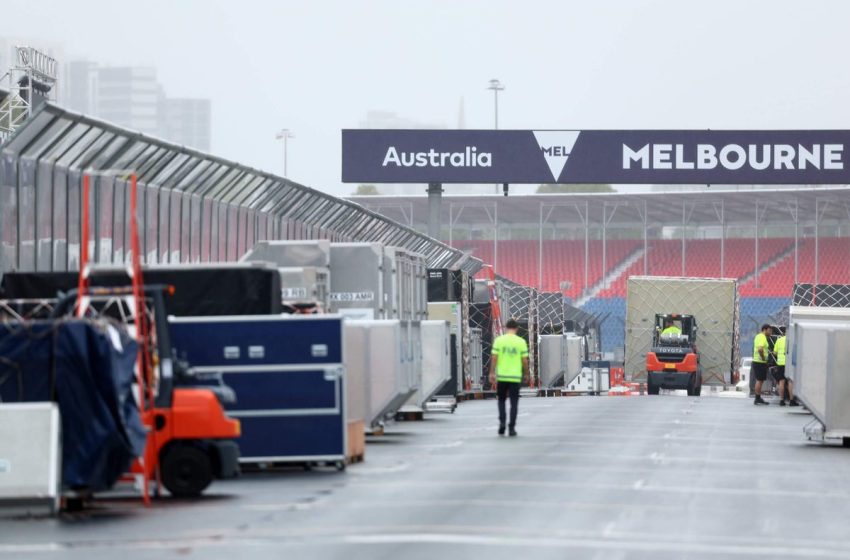
All the freight equipment F1 needs to hold the race had already arrived in Melbourne as the conflict began. This includes the 22 cars that are set to contest the Australian GP.
F1 also charters ships to transport other important paddock equipment — such as the kit F1 teams need to install their garage setups in pit lanes — to each race on a schedule that runs throughout the year. The teams are required to have two or three versions of this kit, with the equipment not being used moved around the world while other races are taking place using the rest.
F1 has moved to reorganize its calendar in recent years to ensure races are grouped together by geographical region to assist with more efficient freight transport.
“All the freight is here and ready to go and so we’re in a space where we’re really confident there’ll be no impact (on the race by the travel disruption from the conflict),” added Auld. “The drivers will be here, the engineers will be here, the team principals will be here — they’re the ones that have been prioritized.”
Auld speaking on Monday (Kierra Thorn/Getty Images for Australian Grand Prix Corporation)
A Pirelli tire test that was scheduled to involve the Mercedes and McLaren teams over the weekend was canceled as a result of the conflict. Staff required to run these tests are separate from race crews and none of the Mercedes (George Russell and Kimi Antonelli) or McLaren (Lando Norris and Oscar Piastri) race drivers were due to take part.
A Pirelli statement released on Saturday said personnel involved “currently in Manama (Bahrain’s capital) are safe in their hotels. The company is working to ensure their continued safety and to arrange their return home as soon as possible.” Bahrain’s airspace has been closed since Saturday.
The Bahrain GP is scheduled to take place on Apr. 12, followed by the Saudi Arabian GP in Jeddah a week later. During the 2022 event at the latter, a Houthi missile hit a nearby oil refinery. The race went ahead as planned, after lengthy discussions with the F1 drivers.
An F1 statement on the current uncertainty around its early season schedule read: “Our next three races are in Australia, China and Japan, not in the Middle East — those races are not for a number of weeks.
“As always, we closely monitor any situation like this and work closely with relevant authorities.”
The Chinese GP will follow one week after the Melbourne race. Most paddock personnel and freight are expected to travel directly to Shanghai, rather than return to Europe — although several teams have previously brought some staff back to their European factories in between races on such tight turnarounds.
The 2026 season is scheduled to conclude with races in Qatar and Abu Dhabi, countries which have also come under retaliatory fire from Iran. These events are due to take place on Nov. 29 and Dec. 6.
First Appeared on
Source link






