


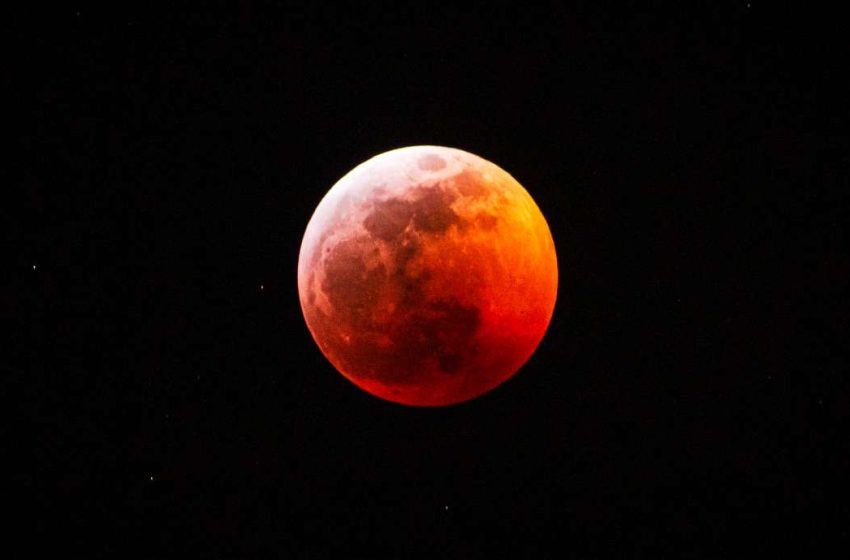
A lunar eclipse will form over Utah. Will you be able to see it?
SALT LAKE CITY — A rare celestial event will take place over the United States early Tuesday, but some Utahns will have a better chance to view it than others.
A lunar eclipse — when the moon turns a reddish color from Earth’s shadow as it slips between the sun and moon — begins shortly after 4 a.m. Mountain on Tuesday, with maximum eclipse at 4:33 a.m. in and around Salt Lake City, according to timeanddate.com.
The total eclipse will end shortly after 5 a.m. Some partial eclipse action is expected to begin at 2:50 a.m., before the main event, and more partial eclipse viewing will last until 6:17 a.m. after it.
While the timing is great for the West, taking place before sunrise — which is at 6:58 a.m. on Tuesday in Salt Lake City — remnants of a passing storm may cause some viewing challenges in parts of the state. Additional rain and snow showers will linger across northern Utah Monday night, with some clouds and mountain showers likely to remain in place before sunrise on Tuesday, said KSL meteorologist Devan Masciulli.
Cloud cover in Salt Lake City is forecast to be between 90% to 95% from 2 a.m. to 7 a.m., per the National Weather Service. The agency offers equally unenthusiastic forecasts for communities across northern Utah through central Utah, including the Wasatch Back, northeast Utah and the Tooele Valley, where cloud cover is expected to range from 75% to 95% during those hours.
But not all hope is lost. The agency’s projections don’t indicate where in the sky those clouds will be during the eclipse. Cloud cover is also forecast to be between 20% to 40% near Wendover and the Bonneville Salt Flats for people who live near there or are willing to make an early morning drive to view it.
It could be a toss-up in places like Richfield or Moab, but even better conditions are forecast for southern Utah, per the weather service. Cloud cover is expected to be between 0% to 15% from 2 a.m. to 7 a.m. in and around St. George and Cedar City areas in southwest Utah, for example. It might reach 30% in areas near Monticello in southeast Utah, as well.
It’s the only opportunity to view a total lunar eclipse this year. For those unable to fight the clouds or an early alarm, the next one won’t be visible until New Year’s Eve 2028.
The Key Takeaways for this article were generated with the assistance of large language models and reviewed by our editorial team. The article, itself, is solely human-written.
First Appeared on
Source link






