


Lights Out for Arab AI
Ripple effects of 2 Iranian strikes on AWS Data Centers over the weekend hit a lot of people this morning, and they could get much worse.
March 2, 2026
TLDR
On the same weekend that Iranian retaliatory strikes hit Gulf infrastructure, three of the world’s largest AI platforms — Claude, ChatGPT, and Google Gemini — experienced simultaneous service disruptions. The connection nobody is making yet: all of them depend on electrical infrastructure that is proving to be the softest target in modern warfare. Ukraine already taught this lesson. The Gulf is learning it now. The implications for the tens of billions of dollars in AI compute being built across the Arabian Peninsula are staggering, and almost nobody is talking about it.
The Lights Flickered
On Monday morning, March 2, 2026, users of Anthropic’s Claude AI woke up to a dead screen. Nearly 2,000 outage reports hit Downdetector at peak. The web interface, the mobile apps, the login systems — all down for over four hours. Anthropic attributed it to “unprecedented demand.”
They weren’t alone. OpenAI’s status page showed an ongoing ChatGPT disruption that ran for 14 hours. More than 20,000 users reported problems. Google’s Gemini API logged 27 outage reports in the same 24-hour window.
Three separate AI platforms. Three separate companies. One weekend.
Anthropic said it was a demand surge — users flooding in after a political blowup with the Pentagon. And that’s probably part of it. But there’s something else that happened this weekend, and it connects to the outages in a way that matters far more than anyone in Silicon Valley has publicly acknowledged.
Follow the Wire
Artificial intelligence doesn’t run on magic. It runs on electricity. Enormous, continuous, uninterruptible quantities of electricity. A single hyperscale data center consumes 50 to 100 megawatts — enough to power a small city. The GPU clusters training frontier AI models require months of continuous power without interruption. Lose power mid-training run and you can lose weeks of computation that cannot be recovered.
That electricity arrives through the grid. The grid runs through transformers. And transformers, it turns out, are the most consequential piece of undefended critical infrastructure on earth.
High-voltage power transformers — the 400kV units that step transmission power down to feed a data center campus — are custom-built for each installation. They weigh 100 to 400 tons. They have manufacturing lead times of 18 months to three years. There is a global shortage. There was a shortage before this weekend.
They sit in open yards behind chain link fencing. They require airflow for cooling. They’re connected to overhead transmission lines running across open terrain. They are, in every meaningful sense, undefended.
The Ukraine Lesson Nobody Read
If this sounds theoretical, it shouldn’t. There’s a war happening right now that has already proven this vulnerability at industrial scale.
In 2025, Russia launched 1,195 attacks on Ukrainian rail infrastructure — more than the previous two years combined. The targeted destruction included dozens of power substations. Not the trains. Not the tracks. The electrical substations that power the rail network. Because nearly half of Ukraine’s rail system runs on electric locomotives, and when you destroy the transformer feeding a rail corridor, that corridor goes dark for months.
Ukraine learned the same lesson hitting back. Ukrainian long-range drones struck Russian railway infrastructure in Adler, targeting the station, a rail bridge, marshaling yards, and — critically — the power transformers feeding the local rail network. In occupied Donetsk, Ukrainian strikes set fire to the Chaykino-330 substation, which delivers electricity to the entire region’s rail system. Ukrainian forces and resistance groups have been systematically burning relay cabinets, transformers, and the electrical objects that enable Russian railways to function.
Both sides independently converged on the same conclusion: the transformer is the long-pole item. You can repair track in hours. You can reroute a train in minutes. You cannot fabricate a custom high-voltage transformer in the field. Destroy enough of them and the system collapses — not because the tracks are broken, but because the power is gone.
Russia has been destroying Ukrainian transformers for over two years. Despite the full backing of the Western alliance and emergency procurement from every manufacturer on earth, Ukraine still cannot replace them fast enough. If the entire global supply chain cannot keep one country’s transformers replaced with full mobilization support, it cannot absorb a global phenomenon.
“Sparks and Fire”
Now apply that lesson to what happened this weekend in the Persian Gulf.
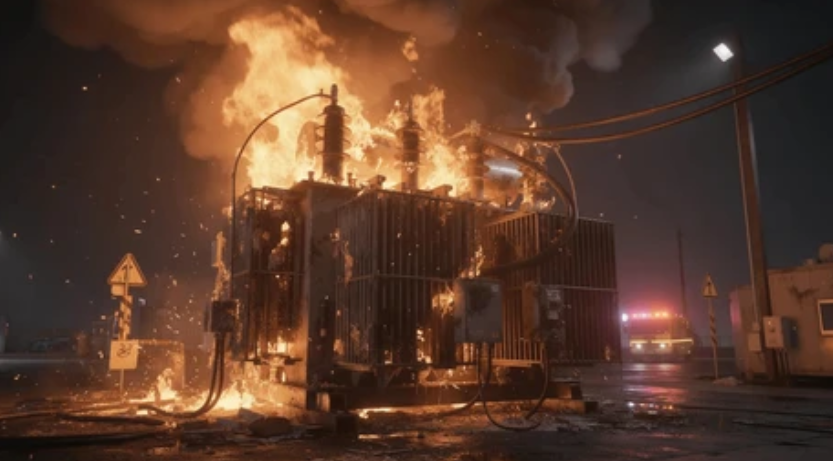
At 4:30 AM Pacific time on Saturday, March 1, Amazon Web Services reported that one of its Availability Zones in the UAE — mec1-az2 — “was impacted by objects that struck the data center, creating sparks and fire.” AWS would not say what the objects were. They would not confirm or deny any connection to Iranian strikes.
The fire department shut off power to the entire facility. Not just the affected area — the whole building, including backup generators. More than 24 hours later, power had still not been restored. The outage then spread to a second availability zone. AWS’s Bahrain region — ME-SOUTH-1 — simultaneously reported its own “localized power issues.” Two Gulf data center regions degraded or down. Thirty-eight distinct AWS services impacted: EC2, Lambda, EKS, VPC, RDS, DynamoDB, S3.
Read that language again: “sparks and fire.” That’s an electrical event, not a structural one. Transformer oil is extremely flammable. Switchgear arcs. When you strike the power infrastructure feeding a data center, you get sparks and fire. And when the fire department responds, they cut all power — because that’s the protocol. The building’s own safety systems become the mechanism of the outage.
A properly compartmentalized critical facility would isolate the affected zone and keep the rest running. The fact that the fire department shut down the entire building, generators included, suggests this wasn’t built to hardened infrastructure standards. It was built to commercial construction standards. And the recovery timeline — still not restored more than 24 hours later — is consistent with major electrical infrastructure damage, not a patched roof and a restarted server.
The Gulf’s Glass Jaw
For years, Gulf leaders made a simple promise to Silicon Valley: bring your data, your models, and your chips, and we will give you stability. The January 2026 Pax Silica initiative brought the UAE and Qatar into a U.S.-led framework to keep advanced AI chips away from China. Partnership agreements, export licenses, diplomatic frameworks — all designed around supply chain control and geopolitical alignment.
Not one of them contemplated the possibility that a regional adversary would launch missiles at the physical buildings where those chips were meant to run.
The numbers tell the story of what’s at stake. The UAE hosts 57 data center facilities with over 414 megawatts of live capacity and more than 1.4 gigawatts planned — a threefold expansion. Stargate UAE, backed by OpenAI, Oracle, SoftBank, and NVIDIA, is a planned 1-gigawatt compute cluster, part of a 5-gigawatt AI campus in Abu Dhabi. Microsoft has committed $15.2 billion to the UAE, with $5.5 billion earmarked for AI and cloud infrastructure. Khazna Data Centers, the dominant local operator, runs 30 facilities with 20 more planned.
Cushman & Wakefield ranked Abu Dhabi and Dubai as the top two emerging data center markets in the world in 2025. The industry was accelerating investment into this region right up until Saturday morning.
All of it sits within 90 miles of Iran. All of it runs on a power grid that Iran is actively striking. All of it is fed by transformers sitting in open yards, connected to overhead transmission lines, protected by chain link fencing and cameras.
The capacity concentrates near Jebel Ali and Al-Yalayis in Dubai, where redundant 400kV feeds converge with submarine cable landing points. The data centers cluster around the power and the fiber — which means the targets cluster too.
The Cascading Problem
The AWS strike proved something that should terrify every infrastructure investor in the Gulf: you don’t need to destroy a data center to take it offline. You just need to start a fire. Emergency protocols do the rest. The fire department cuts power. The generators go down. The facility sits dark while inspectors clear the building. Recovery takes days, not hours.
But the deeper problem is the one Ukraine has been living with for two years: the replacement problem. Every Gulf state hit by Iranian strikes — the UAE, Bahrain, Kuwait, Qatar, Saudi Arabia — now needs to repair or replace damaged electrical infrastructure. They’re all competing for equipment from the same tiny pool of global transformer manufacturers that was already backlogged for years.
And data centers go to the back of the line. Hospitals need power. Desalination plants need power. Airports need power. When the grid is stressed and equipment is scarce, the 100-megawatt AI training facility is not going to outbid the system that keeps drinking water flowing to a desert city of three million people.
Meanwhile, the surviving data centers can’t operate on a degraded grid. Power quality matters for precision computing. Brownouts, voltage fluctuations, rolling blackouts — any of these can corrupt training runs and damage sensitive equipment. Even if your building is untouched, a regional grid under stress may not be able to feed you clean, reliable power at the scale you need.
The insurance market will compound this. Maritime war risk coverage was withdrawn from the Strait of Hormuz within 72 hours of the strikes. Infrastructure investment insurance in the Gulf is next. You cannot insure a facility against a demonstrated, ongoing threat at rates that make the investment viable. And when you can’t insure it, you can’t finance it. Banks don’t fund uninsurable assets.
Every boardroom attached to a Gulf data center investment is meeting this week. Microsoft’s $15 billion. The Stargate 5-gigawatt campus. Khazna’s 20 planned facilities. The question is no longer whether the investment thesis works. The question is whether the buildings survive long enough for the thesis to matter.
What Comes Next
The world changed this weekend. Not because of the missiles and drones — wars come and go. It changed because a methodology was proven, broadcast, and made available to anyone paying attention.
The attack template is simple. The targets are undefended. The replacement timeline for destroyed equipment is measured in years, not days. And the knowledge required to execute this — that transformers are unprotected, flammable, and irreplaceable — is now common knowledge, spreading at the speed of a news cycle.
Ukraine took four years of grinding war to fully systematize the targeting of electrical infrastructure. The next actors who want to apply this lesson don’t need four years. They just need to read the news from this weekend.
The AI industry bet tens of billions of dollars on concentrating the world’s most critical computing infrastructure in a region 90 miles from a country we’re now at war with, protected by commercial security standards, powered by transformers in open yards. That bet looked smart two weeks ago.
The lights are still on in the Gulf. The question is for how long.
First Appeared on
Source link






