


What the Iran war means for the US-China balance
We’re told that President Donald Trump’s Middle East policy is all about China, that a master strategist is at work to isolate Beijing from the world by attacking one of its closest partners and a major oil supplier. The best way to interrogate such claims is to “steel man” them (the opposite of a “straw man”, which presents an opposing argument in the weakest terms).
So, let’s assume the bombing campaign underway against Iran will be an overwhelming success. Let’s ignore, for the moment, indications that the administration might be backing away from its regime-change objective, which the President laid out when he first addressed the American people after the bombing commenced. Let’s posit that, after several weeks of attacks, Iran’s regime is so weakened that it is toppled by its own people, who install a democratic government which withdraws Iran’s support for proxy forces around the region and renounces its nuclear program. This new Iranian government opens its nuclear facilities to UN inspection and surrenders its stockpile of weapons-grade fissile material (enough to make ten nuclear weapons; the present whereabouts of this stockpile are unknown to the United States).
Let’s further assume that, as Ross Babbage recently argued in The Interpreter in the days before the bombing campaign commenced, the emergence of a “pro-Western” regime in Tehran will deprive Beijing of a reliable source of oil, one that could be turned off if China invaded Taiwan. Babbage concluded that, thanks to the Trump administration’s “surprisingly deep strategic logic”, China and Russia will see their prospects “deteriorating and the cold winds of isolation … growing stronger.”
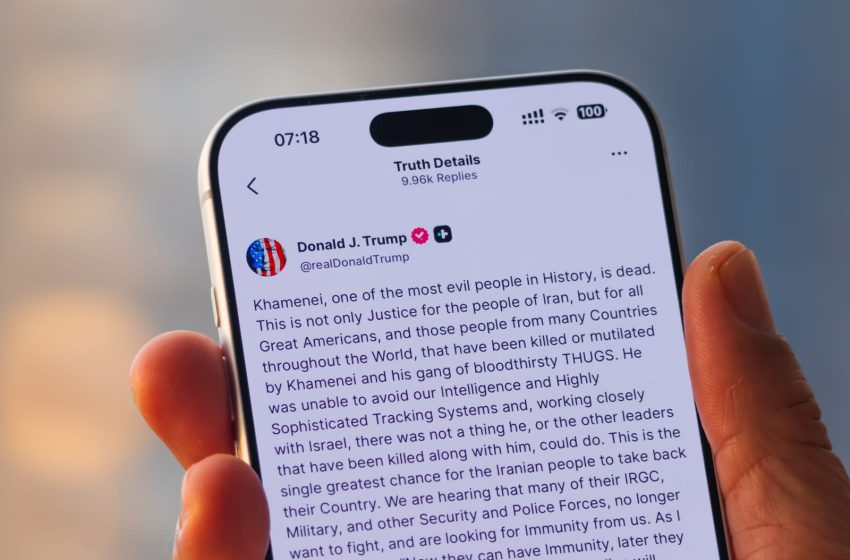
Trump has urged Iranians to overthrow the government in Tehran but has not fully committed to the goal.
Yet China gets only 13.4% of its oil from Iran, making such a loss serious but far from irrecoverable. Furthermore, although China is the world’s largest oil importer, it is also engaged in a massive effort to reduce its dependence on fossil fuels through a transition to renewable energy, so we should expect this point of leverage to decline over time. And we know from the experience of Russia’s war against Ukraine that sanctions are increasingly open to being busted or at least compromised, so we should also assume that China will be able to get illicit oil supplies even if it is sanctioned.
All these factors are likely to dampen the effect of any leverage that the US could gain from this best-case scenario.
We should also consider the broader consequences of any attempt to isolate China in the way Babbage suggests. It has proven difficult to decouple Russia from the world economy, but at least we can say the effort to do so has not been particularly costly for the US and its partners. That’s because Russia is not hugely important to the global economy – its GDP, in current US dollar terms, is only about 25% larger than that of Australia.
By contrast, depending on the accounting measure applied, China’s economy is either the biggest or second biggest in the world, and as Trump learned last year when China stopped rare-earth exports to the US in response to tariffs, size confers leverage. The proposition that China can be economically isolated by knocking off dictators in Iran and Venezuela fails to account for this. Launching a Russia-style economic isolation campaign against China would invite retaliation causing massive economic damage to the US and its partners.
This is not to question Babbage’s core logic: a “pro-Western” regime in Tehran, if such a thing could be achieved, would certainly complicate Beijing’s calculations about the reliability of its oil supplies. But the costs of any campaign to withhold such supplies could rise to a global depression.
Yet this Iran campaign is unlikely to convince Beijing that the US is prepared to run such risks. Instead, it signals that US risk tolerance is low. After all, the US is fighting exclusively by air and missile power and has explicitly ruled out committing ground troops (although that commitment might also be in doubt). Trump has announced the deaths of three US service members and warned of more to come, but even by the standards of the Iraq and Afghanistan wars, this will be a low-casualty campaign for the US.
Trump has urged Iranians to overthrow the government in Tehran but has not fully committed to the goal. He has said only that the US is creating the conditions for regime change, and that the rest is in the hands of Iranians. That gives him an off-ramp. Should Iranians prove reluctant or unable to take up this opportunity, he can say the Iranian people failed, not him.
Finally, my Lowy Institute colleague Jennifer Parker suggests another possible benefit of a successful US campaign in Iran: that it could heal a running sore in US foreign and defence policy, allowing Washington to pivot to Asia once and for all. But even if the US were able to withdraw its entire military presence from the Middle East, which Asian country would host them? And wouldn’t China then respond with an even greater build-up of its own, triggering an arms race it is well placed to win, owing to its vast industrial capacity?
These are meagre returns from a best-case scenario. The worst case will be highly advantageous for Beijing. The US may have triggered a cycle of escalation that provokes Tehran to use thousands of cheap drones or even ground forces against one of its near neighbours; it may bring an even more repressive and extremist government to power that races to nuclear-weapons capability; or it may provoke a civil war and create a failed state. All these scenarios entangle the US further in the Middle East. And in the process, it will have expended precious stocks of munitions that will weaken its deterrent against China.
First Appeared on
Source link






