


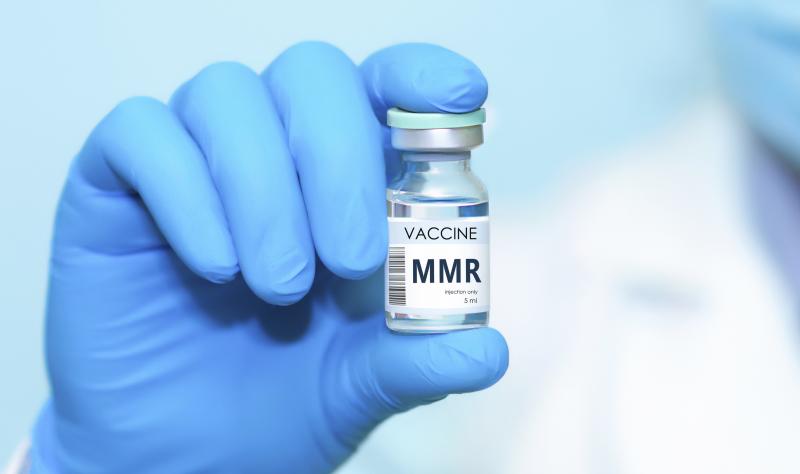
Bhattacharya urges measles vaccination as US activity increases
Yesterday Centers for Disease Control and Prevention (CDC) acting director Jay Bhattacharya, MD, PhD, posted a video on X promoting the measles vaccine as cases continue to mount across the United States.
“Measles is preventable and vaccination remains the most effective way to protect yourself and those around you,” Bhattacharya said in the video statement. Bhattacharya said trust is the foundation of public health, and that he would be ensuring the CDC was working with state partners to maintain trust and best practices.
Measles is preventable and vaccination remains the most effective way to protect yourself and those around you.
The video is an indication the White House may be applying pressure to the CDC and the Department of Health and Human Services (HHS) to back off some of the anti-vaccine messaging that dominated the agencies last year ahead of the upcoming midterm elections.
HHS Secretary Robert F. Kennedy Jr., is reported to be moving on from vaccines towards “real food” policies, a move that’s angering some of Kennedy’s supporters who expected the secretary to further dismantle vaccine infrastructure in the United States. But a series of large measles outbreaks has limited the strength of Kennedy’s anti-vaccine message.
South Carolina tracks 990 cases
Currently the largest concentration of measles cases is found in an ongoing Upstate South Carolina outbreak. As of today, state officials have recorded 990 cases in that outbreak; there are currently 52 people in quarantine and four in isolation.
Of the 990 cases in South Carolina, 923 are unvaccinated, 19 are partially vaccinated with one of the recommended two-dose MMR (measles, mumps, rubella) sequence, 26 are fully vaccinated, and 22 have unknown vaccination status.
A total of 85 case-patients in South Carolina are over the age of 18, with 637 between the ages of 5 and 17 years.
In related news, officials in Placer County, California, yesterday reported three confirmed measles cases and a suspected fourth case. The exposure for these cases came from a family member who had recently traveled to South Carolina, and all three confirmed cases are in teenagers in one household.
In Colorado, health officials yesterday confirmed a second case of measles at Broomfield High School. According to the Colorado Sun, neither of the two students infected at the high school were vaccinated. Colorado recorded 36 cases of measles in 2025, the highest state total in decades.
PAHO meeting pushed back to November
As of last week, the CDC has confirmed 1,136 measles cases so far in 2026 across 27 states. The United States was likely facing losing its measles elimination status after a disastrous year in 2025, when the US tracked more than 2,000 measles cases, the most in 30 years.
The Pan American Health Organization (PAHO) announced late last year they would be assessing US measles elimination status, which the country has held since 2000, during an April 2026 meeting.
But now that meeting is delayed until PAHO’s annual meeting in November.
“The decision to conduct these reviews during the regular annual meeting aims to simplify and harmonize the process within the Commission’s regular schedule,” PAHO said in a statement. “In the case of the U.S., it also takes into account the ongoing analysis being conducted by its health authorities, which includes complete viral genome sequencing, including the development of a bioinformatics platform for detailed molecular data analysis, alongside ongoing efforts to support outbreak control.”
According to the New York Times, the United States asked PAHO for the deadline to be pushed back, with some experts again noting the administration does not want to lose elimination status before the midterm elections.
Other said the delay was justified. In order to prove or disprove sustained local transmission of measles, scientists must show via genomic sequencing how and if the same measles strains are causing infections across the country for at least 12 months. Tandem outbreaks in Canada and Mexico complicate the picture.
Last year, Canada lost its measles elimination status, first gained in 1998. Mexico was also set to be reviewed in April but has also now been moved to November.
First Appeared on
Source link






