


Updated Basketball Arena Details: Costs, Revenues, Timeline for UNC
On Tuesday, Seth Trimble spoke to the emotional bond that the Dean E. Smith Center has provided for the Carolina basketball family and its fan base, closing his Senior Night speech by saying, “I really hope to see the Smith Center here for a long, long time.”
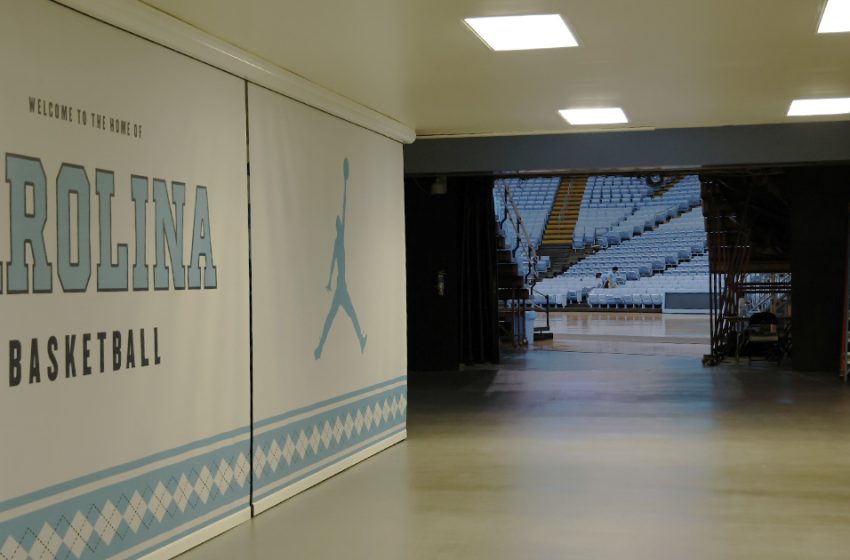
Many in and around the program share his view for the 40-year-old facility that sits on the south side of campus. It’s been a home away from home for many former players, and it’s been a beloved place where shared memories have formed and continue to thrive to this day.
The difficulty in turning this historic building, which is in desperate need of significant repair, into a state-of-the-art facility that will serve the program for the decades ahead will come at a significant cost, both financially and logistically, according to university officials. On Wednesday, UNC made public its years-long arena study results in its efforts at transparency in an increasingly controversial decision about the future of the Smith Center.
University leadership has put together a list of six strategic priorities/objectives to shape their decision-making process: (1) deliver the premier basketball-first collegiate arena; (2) preserve the legacy and tradition of Carolina basketball; (3) provide best-in-class student-athlete training facilities; (4) improve student seating for maximum in-game impact; (5) offer an elite fan experience; and (6) increase revenue opportunities to ensure competitive success and status as a top-tier program.
“To me, we have to hit all six of the strategic objectives,” Steve Newmark, UNC’s executive associate athletic director, told reporters this week. “That is absolutely critical, because at the end of the day, we believe those strategic objectives will be indicative of whether we can maintain success and continue to be a top tier basketball program, which is so important to not just athletics, but to the university and the whole North Carolina Community.”
Since 2022, UNC has spent $1.3 million in partnering with various architects, construction companies and consulting firms to determine the site options, costs, funding and revenue potential. Those experts include Tipping Point Sports, Legends, Populous, Mortenson, Venue Solutions Group, Ayers Saint Gross, HR&A Advisors, Kimley-Horn and Clancy & Theys Construction.
The study documents provide a summary of features and financials and detail the projected costs and revenues for all seven options under consideration. That list consists of new builds at the current site, Bowles Lot, Odum Village, Friday Center and Carolina North, in addition to Repair & Maintain and Renovate at the current site.
According to the documents, the five new build options predominantly offer the potential for modern fan amenities, training upgrades, improved student seating, revenue opportunities and the ability to play home games in Chapel Hill during construction. The exceptions are limited amount of training upgrades at the Bowles Lot site due to space and the inability to play home games in the case of a Smith Center rebuild.
Carolina North offers the highest possibility of mixed-use potential due to available space, while Odum Village and Friday Center provided moderate mixed-use potential. New builds at the current site and Bowles Lot included low mixed-use potential, while it’s absent for either upgrade scenario at the current site.
The three primary options at this point are Carolina North, Odum Village and Renovate, with Repair & Maintain on the periphery as a fourth.
| Carolina North | Odum Village | Renovate | Repair | |
| Total Costs | $786 mil | $703 mil | $591 mil | $153 mil |
| Gifts/Philanthropy | $404 mil | $404 mil | $257 mil | $0 |
| Annual Net Rev | $62 mil | $62 mil | $42 mil | $9.6 mil |
| Debt Repayment | $25 mil | $26 mil | $29 mil | $13 mil |
| Annual Cash Flow | $26 mil | $25 mil | $4.1 mil | ($3.8 mil) |
Carolina North, which was the preferred location before backlash from segments of stakeholders occurred in December, comes with the highest price tag – $786 million – and the highest revenue potential. All five new builds project $404 million in capital gifts & philanthropy and up to $62 million in annual net revenue.
While that $404 million figure is substantial, Legends provided more than a dozen examples of arena projects in which the firm had provided revenue projections and found that the projects returned on average 107% of what was estimated, according to Rick Steinbacher, UNC’s senior associate athletic director for capital projects, facilities and event engagement.
With $25.3 million in annual debt repayment, Carolina North offers the highest annual net cash flow potential at $26 million. That figure does not include additional revenue from an entertainment district and/or a mixed-use development.
In the spring of 2024, UNC’s leadership group encouraged university officials to look at other possible on-campus sites beyond the current site and Bowles Lot. There were six sites that were considered, including frat court, Ramshead Deck and the center of campus athletics area where Woollen Gym and Fetzer Gym reside, but only Odum Village was determined as a viable option.
Odum Village’s total project costs come in at $703 million with the same capital gifts & philanthropy ($404 million) and annual net revenue ($62 million) as Carolina North. Debt repayment would be slightly higher, thereby resulting in a slightly lower annual net cash flow of $25.1 million. The mixed-use potential for Odum Village, which sits west of the Smith Center and south of UNC Hospitals, is considered moderate.
While Renovate comes in more than $100 million less than the new build options at $591 million in total project cost estimations, its capital gift utilization is impacted by the permanent seat rights at the Smith Center, as the roughly 1,300 accounts that own those seat rights would not be obligated to pay a building campaign gift or an annual seat donation in a renovation. They would only be required to maintain a specific Rams Club giving level and buy season tickets.
The projected $257 million in capital gifts and philanthropy would provide annual net revenue potential at $41.6 million. With $29.2 million in annual debt repayment, the projected annual net cash flow for Renovate is $4.1 million. That number does not yet include lost revenue during construction, such as reduced capacity, concessions and other venue impacts.
There’s also the matter of disruption with the Renovate option. While other arena renovation options across the country have allowed for construction to occur without impacting games played, it’s more of a challenge with the Smith Center due its lone concourse setup. The financials provided do not include any potential costs for games played in Greensboro or at Carmichael Arena, among other potential options, during construction.
“I don’t think we have a definitive plan in Renovate on how many games you would be displaced for,” Newmark said. “I think it’ll depend on decisions that are made, but we know in that scenario that there will be significant disruption, most likely a combination of missed games and then playing games in there while the construction is going on.”
Repair and Maintain offers the cheapest total project cost at $153 million, although with projected annual debt repayment of $13.4 million, the annual net cash flow would be in the red with a deficit of $3.8 million. It’s estimated that $80 million of the project work would need to occur relatively soon. Steinbacher confirmed that the roof was patched in the offseason due to leaking.
All costs provided were generated in the fall of 2024 with three years of escalation added.
“It’s important to note the intent is not to be persuasive or to push in a certain direction,” Newmark said. “It’s to show all the work and all of the factual underpinnings for the options that we have going forward based on a common recognition that the status quo is not the ideal situation if we want to continue to evolve and adapt to the new world order in collegiate athletics, primarily based on the fact that we have a 40-year old building that needs some work.”
While a deadline for a decision to move forward has not been made, university officials are working under assumptions that UNC would play basketball in a renovated arena for the 2028-29 season or in a new arena for the 2030-31 season.
First Appeared on
Source link






