


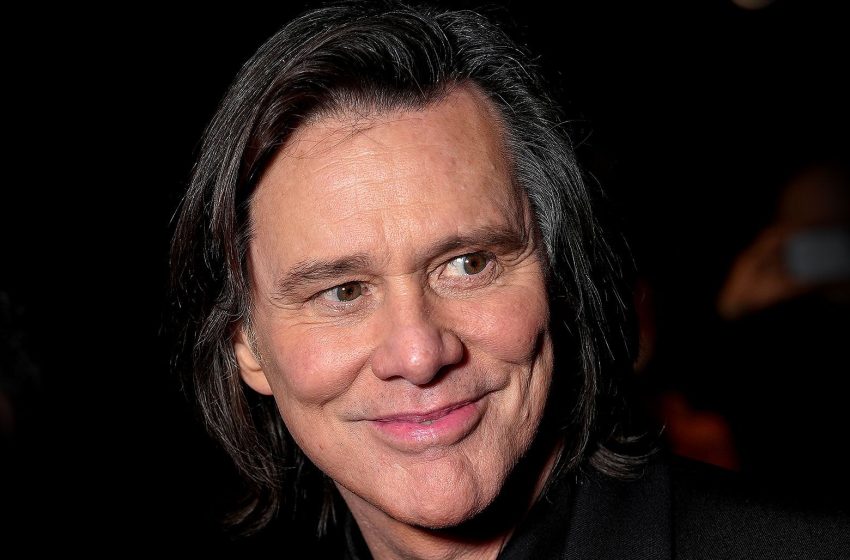
Yes, his face looks different. But it’s us who should be looking in the mirror.
Sign up for the Slatest to get the most insightful analysis, criticism, and advice out there, delivered to your inbox daily.
Some people said the man who accepted Jim Carrey’s Honorary César award last week was a clone of the actor. Some said it was a drag queen in elaborate prosthetics. Most everyone agreed that the Carrey who delivered a heartfelt speech at the Paris ceremony did not look quite like the Carrey we’ve watched on-screen for the past 35 years.
His eyes were wide, his cheeks plumped and defined, his skin strangely smooth. His eyebrows arched away from his lids in a new way. To the sane observer, it seemed obvious that he’d had work done—a brow lift, fillers, maybe a blepharoplasty? Nothing out of the ordinary for an aging film star in 2026.
But if even a fraction of the online comments supporting the various conspiracy theories were genuine, too many internet-poisoned minds were eager for a more far-fetched explanation. It didn’t help that gullible celebrities like Megan Fox, Lisa Rinna, and Katy Perry posted credulous comments on an Instagram post from the aforementioned drag queen—makeup artist Alexis Stone—who jokingly claimed to have impersonated Carrey at the awards show. “I can’t handle any more stress right now I need to know if this is real,” Fox wrote.
The bizarre speculation spun into a media frenzy, with headlines across the internet picking Carrey’s face apart. Finally, on Monday, Carrey’s publicist was forced to issue a statement to multiple media outlets to shut down the fabulists: “Jim Carrey attended the César Awards, where he accepted his Honorary César Award.”
This whole incident is a matryoshka doll of some of the most troubling impulses of modern celebrity culture. First, the plastic surgery itself: The pressure to resist normal facial aging is so intense that even celebrities who are beloved for much more than their sex appeal find it worth the risk to undergo procedures that could leave them looking like uncanny simulacrums of themselves. In certain circles, with Hollywood at the top of the list, futzing with one’s face is expected; looking one’s age is not. It may be considered a bigger failure to wrinkle and sag than to trigger an audience’s lizard-brain instinct that something unnatural is afoot.
Then, the response: The mean-spirited mockery of keyboard warriors is a pastime as old as the internet, but the effortless spread of misinformation and the public’s enthusiastic embrace of it feels newer. That Instagram post from Alexis Stone, which apparently convinced a fair number of people that Stone had dressed up as Carrey for the César Awards? The smoking-gun image—a picture of a facial prosthetic, wig, and dentures in a room overlooking the Eiffel Tower—looks like it was created with A.I. (I can’t imagine that Stone flew to Paris to stage a real photo.) Thanks to that image, what once might have been an easily dismissed joke became something truth adjacent enough to incite a mass delusion. Media outlets struggling to survive in an era of journalistic precarity were thrilled to pick up the thread. The insanity spread.
The international interest in this nonstory highlights the peculiar nature of celebrity, whereby the faces of strangers feel like they belong to us, such that their sudden transformation hits as a personal affront. Seeing the face of Ace Ventura and the Eternal Sunshine guy take on a new shape and texture feels like going back to your hometown to find that your parents have redecorated your childhood bedroom, your favorite park is now a strip mall, and Daddy has shaved his beard, no longer recognizable as the same man who once read you Corduroy.
It’s not like this for all celebrities. When Kris Jenner gets a full gut renovation, no one spares a side-eye or sheds a tear. But if Meryl Streep got her buccal fat removed? If Steve Martin got a cat eye lift? There would be mayhem. People who have made art that lodges in our brains and touches our hearts—especially through the facial acrobatics of acting—hold a special place in our memories. Their faces are taken as national treasures, suitable for cataloging in the Library of Congress. This puts actors in a bind: Should they try to preserve their famous faces by medical means, or give us incremental exposure to their aging faces, allowing us time to integrate the older version with the younger ones we remember? Even as we support a film industry that throws most women and some men in the dumpster once their collagen levels begin to dip, we expect our favorite actors to age gracefully and naturally, as long as they don’t look too different than they did before.
At one point, Carrey seemed to want to opt out of the noxious milieu of fame. Having endured the suicide of his girlfriend, a lawsuit from her family blaming him for her death, and a failed comeback, he told Access Hollywood in 2022 that he was “probably” retiring, because “I really like my quiet life and I really like putting paint on canvas and I really love my spiritual life.” He continued, “This is something you might never hear another celebrity say as long as time exists: I have enough. I’ve done enough. I am enough.”
But Carrey couldn’t resist reprising his role as Dr. Robotnik in Sonic the Hedgehog 3. “I bought a lot of stuff and I need the money,” he said by way of explanation for coming out of the world’s shortest retirement. Possibly a joke, though likely topped with a sprinkling of truth: He didn’t have enough, it turned out, and maybe he ended up feeling like he wasn’t enough, either.
The saddest part of this story is that it exposes how celebrity culture and the anti-aging industry encourage people to place value on all the wrong things. Moviegoers didn’t appreciate Carrey’s face for its symmetry, taut skin, or dramatic browline. We loved it because it was expressive and emotive, capable of making wacky shapes, eliciting laughs, and embodying characters that enriched our lives—in other words, because it was human. Now, as all the terrible conspiracy theories made clear, it’s a little less so.

First Appeared on
Source link






