


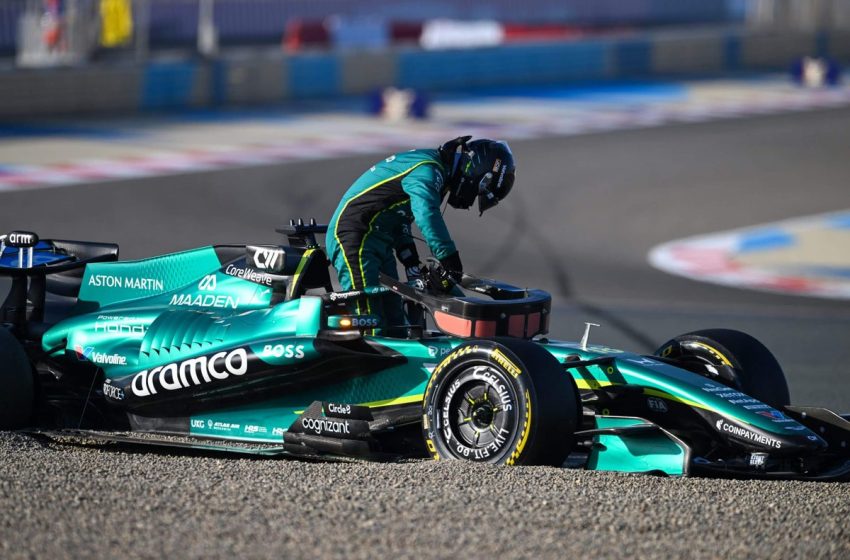
Aston Martin F1 drivers at risk of nerve damage from car vibrations, will have laps capped in Australia
MELBOURNE, Australia — Aston Martin team principal Adrian Newey confirmed Thursday that the Formula 1 team will likely be running limited laps during the Australian Grand Prix weekend due to a vibration issue in the chassis.
While this has caused reliability issues, the bigger concern is the drivers’ health. There are concerns at Aston Martin about how many consecutive laps Lance Stroll and Fernando Alonso can do. Newey shared that Alonso, 44, believes he is unable to do more than 25 laps “before he will risk permanent nerve damage to his hands,” while Stroll, 27, can run 15 consecutive laps before reaching a similar threshold.
Newey said the team is working to identify the root cause of the vibration that is causing pain in the drivers’ fingers.
“We are going to have to be very heavily restricted on how many laps we do in the race,” Newey continued, “until we get on top of the source of the vibration and improve the vibration at the source.”
Speaking in a subsequent media session, Alonso said that exposure to prolonged vibration would leave him feeling “numb” after driving the car during testing.
“Definitely, it is something that is unusual,” said Alonso. “It shouldn’t be there, and we don’t know the consequences either, if you keep driving like that for months. So a solution has to be implemented.”
The news comes after a disastrous Bahrain preseason testing outing, during which Aston Martin encountered difficulties to the point that the team ran a limited program on the final day of testing. Honda released a statement on the last day of testing that Alonso’s reliability issues and eventual stoppage the day before were due to “a battery-related issue.”
Aston Martin faced a condensed development period when creating the 2026 challenger, which Newey highlighted during his Thursday media session with Honda Racing Corporation president Koji Watanabe. The model wasn’t in the wind tunnel until mid-April, but Newey does feel there’s “huge, tremendous development potential in it,” though it’ll take time to realize that fully.
“We’ve got quite an aggressive development plan underway,” Newey continued. “So I think it’s fair to say that here in Melbourne, we are a bit behind the leaders. I would say we’re maybe the fifth-best team, so sort of potential Q3 qualifiers on the chassis side, obviously not where we want to be, but with the potential to be up front at some point in the season.”
Watanabe, though, revealed that the vibration was “unexpected” and damaged the battery-related components in the power unit. Newey later said the vibration problems also included “a few reliability problems, mirrors falling off, tail lights falling off, all that sort of thing, which we are having to address.”
But both Alonso and teammate Stroll believe that the problems could be resolved. Alonso, who previously faced issues with his Honda engine while racing at McLaren from 2015 to 2017, said he had “100% faith” that Honda would solve the performance and reliability problems.
“Deep inside, I have the feeling that problems will be fixed every time I jump in the car,” said Alonso. “I close the visor, and I really hope that everything will be better.” Following the implementation of extra precautions, Alonso said the team would likely make a decision on race mileage as the weekend progressed.
“Let’s see how things go,” said Alonso. “As I said, I have a feeling on me that it could be all fine and we can do a normal weekend, but let’s see.”
Analysis: Aston Martin’s woes are laid bare
Luke Smith, Senior Writer, F1
This was the first appearance Newey had made in front of the media since taking charge of Aston Martin as team principal over the winter, explaining the depths of its struggles for the first time.
Preseason testing proved Aston Martin was in trouble, failing to complete a full race simulation amid extreme vibrations that were damaging the battery on the engine.
Initially, during the media session — which was repeatedly interrupted by a faulty microphone — hosted at Aston Martin’s hospitality unit, Newey sought the positives. He claimed the team’s chassis was the fifth-best on the grid, and that it had “tremendous” potential. The partnership with Honda had been strengthened as a result of the issues they’d encountered and the subsequent work.
But the fact that the vibrations have extended not just through the chassis, but to the drivers’ fingers, leaving Alonso and Stroll fearing permanent nerve damage if they are to complete extensive mileage, lays bare how deep Aston Martin’s issues run.
This is more than just an unreliable car. Right now, it’s not a safe car.
Countermeasures are in place for this weekend after Honda tested some fixes on its engine dyno in Japan over the past week. But it’s unclear just what impact they may have. Unless those fixes do seriously remedy the vibration issue, then Aston Martin’s race — in the best-case scenario — could only last almost half the race.
It’s an embarrassing low for Aston Martin, a team that has plowed an enormous amount of money into becoming an F1 powerhouse. Instead, 2026, a year where F1’s car design rules have been overhauled and give ripe opportunities for the entire grid to make a step in performance, is starting in an unthinkably bad position.
Despite Alonso and Stroll having faith in Honda fixing the problems and stressing the long-term potential of the Aston Martin/Honda project, the fact that they may not stand much chance of finishing the race without risking serious injury is frankly staggering.
First Appeared on
Source link






