


Robots Just Discovered the Perfect Place to Build Human Bases on Mars…In a Lava Tunnel
Three autonomous robots were sent into a volcanic lava tunnel in Lanzarote to simulate the exploration of underground tunnels on the Moon and Mars. A European mission highlights an innovative approach for space colonization, where robotics could play a key role in finding underground refuges for future human bases. This experiment brings humanity a step closer to its dream of colonizing other planets.
With the Artemis II mission set to bring humans back to the Moon, new research is kicking off to prepare for the colonization of both the Moon and Mars. In this context, space robotics could offer ways to explore tough and hard-to-reach places, like volcanic caves beneath the surface of these planets.
A Natural Shelters Against Space Hazards
Researchers behind the study, published in Science Robotics, suggest that these tunnels offer natural protection from radiation, extreme temperatures, and meteorite impacts that are common on the surface of the Moon and Mars.
On these planets, where the atmosphere is nearly nonexistent, lava-formed cavities could serve as safe havens for human habitats, making survival possible in otherwise harsh environments.
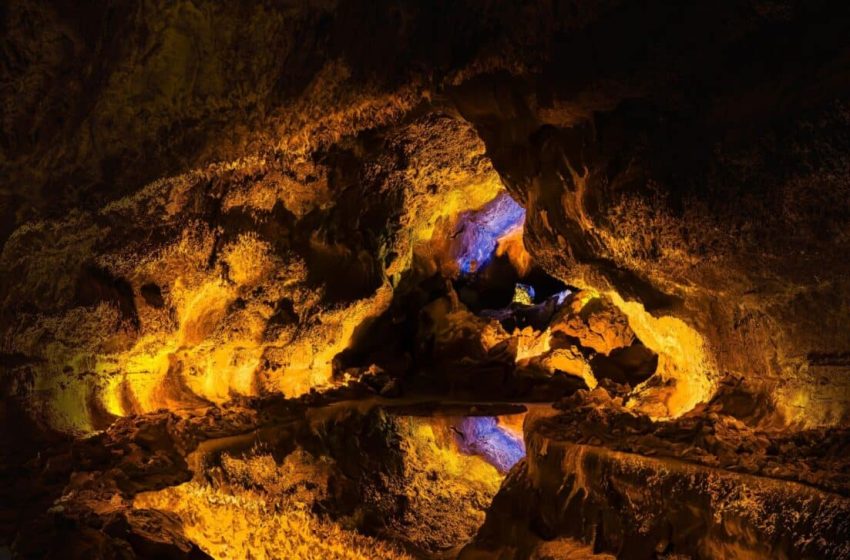
Lanzarote, in Spain, is the perfect location to test this idea, thanks to its La Corona lava tunnel, which reaches dimensions of 30 meters in both width and height. This environment, similar to what might be encountered on the Moon or Mars, allowed a European team, including theEuropean Space Agency (ESA), to conduct a pioneering mission in robotics.
An Autonomous Robotics Mission in an Extreme Environment
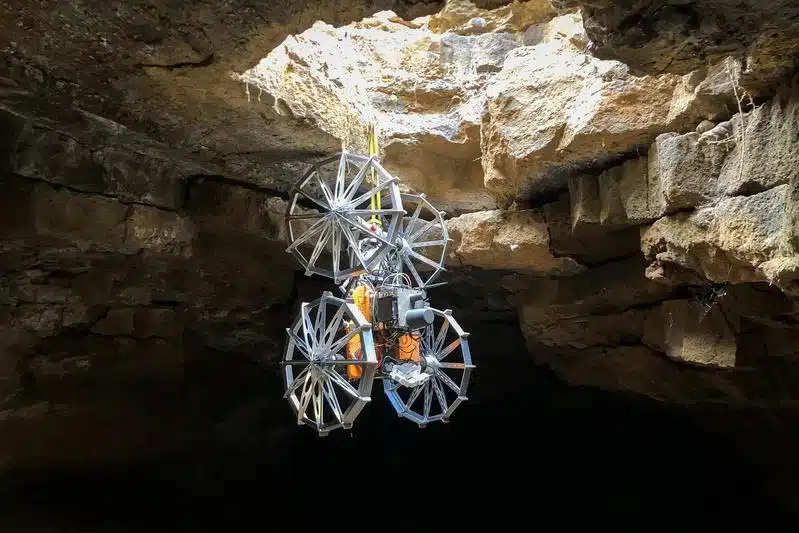
The central focus of this experiment lies in the use of autonomous robots capable of operating without direct human intervention. In the La Corona tunnel, three distinct robots were deployed, each with a specific role. According to the study team:
“This mission concept was validated in a relevant scenario, a lava cave on Lanzarote island, where the team of robots was able to build a three-dimensional model of the surrounding area and skylight.”
Since radio signals take several minutes to reach Earth, real-time communication isn’t possible. Because of this, it’s essential for these robots to be able to make decisions on their own, based on the environment they encounter.
Mapping the Terrain
The mission to explore the Martian lava tunnel is carried out in four stages, each progressively building on the previous one. The first stage involves a team of robots mapping the area around the tunnel entrance.
Next, a sensorized payload cube is dropped into the tunnel to measure vital conditions such as temperature, humidity, and gas composition. This phase is foundational, as it provides essential information about the tunnel’s potential to support human life.
The third stage sees a scout rover rappelling into the tunnel, exploring its depths while sending data back to Earth. The robots finish by exploring the tunnel deeply, mapping it in 3D to analyze its structure and identify ideal spots for human bases.
One Step Closer to Space Colonies
The mission’s findings confirmed that autonomous robotics are highly effective for exploring harsh environments, such as those found on the Moon or Mars.
“The results obtained demonstrate the proposed mission concept’s feasibility, including three next-generation planetary exploration rovers that were coordinated to obtain meaningful information about the lava cave’s external and internal morphology,” wrote the authors.
While these engines still need some adjustments, particularly in managing darkness or sensor interference, their ability to function without human guidance marks an important step toward space colonization.
Researchers are hopeful that these tech advancements will be ready for use in the next few years, making colonizing other planets possible.
First Appeared on
Source link






