We must explain to you how all seds this mistakens idea off denouncing pleasures and praising pain was born and I will give you a completed accounts off the system and expound
Slate’s Washington, 1707 L St. NW, Washington, D.C., 20036.
The still-burgeoning effort by businesses to get tariff refunds from a wary Trump administration took two notable steps forward this week.
First, on Monday, a federal court rejected the Justice Department’s efforts to pause consideration of the issue for 90 days and reaffirmed the US Court of International Trade as the clearinghouse for refund lawsuits.
Then, on Wednesday, the Manhattan-based court acted quickly and said the government must issue refunds for all illegally collected tariffs.
The trade court’s order, issued by Senior Judge Richard Eaton, was in response to one pending lawsuit — brought by a filtration company — but offered broad instructions concerning “all importers of record.”
The judge wrote that all of these businesses “are entitled to the benefit” and ordered US Customs and Border Protection to act. Eaton also said he would be the sole judge to hear cases on refund requests going forward.
The US Court of International Trade in lower Manhattan is seen in May 2025. (Spencer Platt/Getty Images) ·Spencer Platt via Getty Images
Appeals are all but certain, yet the twin rulings marked a remarkable turnabout after the week began with the Trump administration pushing to put the entire refund issue on ice for three months.
At issue are up to $175 billion in “blanket” tariffs that Trump has levied since his return to office last year, citing the 1977 International Emergency Economic Powers Act (IEEPA). The Supreme Court’s 6-3 decision last month ruled those tariffs illegal but didn’t address refunds in the majority opinion.
The legal back-and-forth this week also comes as the political stakes around tariff refunds have continued to rise, with Sen. Elizabeth Warren calling the White House’s delay tactics a “theft in broad daylight.”
The legal moves this week — especially the eyebrow-raising order from Judge Eaton — led international trade lawyers in the middle of this issue to change their outlooks, but with caution that more legal wrangling is ahead.
Greg Husisian, a partner at Foley & Lardner, is working with importers to apply for refunds. He said the Eaton order signals that “the trade courts are going to push these cases along as quickly as possible,” with the caveat that “we believe there is a 100% chance that this will be appealed.”
The focus going forward, he added, will be on whether the trade court has the authority to grant universal relief.
Ted Murphy, an international trade lawyer at Sidley Austin, wrote in his own note to clients on Wednesday that the order “is going to shift the nature of the tariff refund debate” to the question of whether broad relief is possible.
He suggested the next stop will be back in the US Court of Appeals for the Federal Circuit — the same court that earlier this week rejected the Justice Department’s request to delay the process.
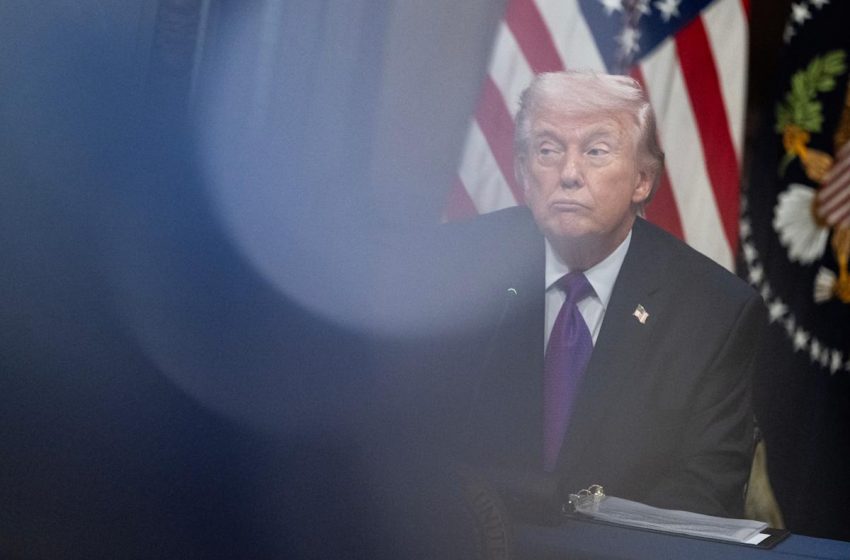
President Trump is seen during a roundtable on the White House campus in Washington on March 4. (Andrew Caballero-Reynolds/AFP via Getty Images) ·ANDREW CABALLERO-REYNOLDS via Getty Images
Murphy noted that the D.C. court has previously taken a skeptical view of the US Court of International Trade’s authority to issue universal injunctions.
For the moment, at least one group advocating for tariff refunds was cautiously celebrating the ruling as “a victory for the small businesses.” But We Pay the Tariffs, a group of small businesses seeking refunds quickly added that “the job’s not done.”
In any case, the legal wrangling marked a remarkable turnabout.
It was just a few days ago that Trump’s Justice Department was trying to put the refund issue on hold for 90 days “to allow the political branches an opportunity to consider options.”
That request was refused by the US Court of Appeals for the Federal Circuit, clearing the way for the US Court of International Trade’s consideration. Then Eaton’s order on Wednesday contained broader-than-expected language and addressed a keen question for businesses of so-called unliquidated and liquidated tariff entries.
Liquidation, in the trade context, refers to the final calculation of tariffs owed on an imported good, which generally occurs less than a year after the good itself is imported.
Even before the Supreme Court’s ruling, preemptive lawsuits had been filed specifically around the liquidation process amid concerns that this final step would make getting a refund later more difficult.
Four US Supreme Court justices attended President Donald Trump’s State of the Union address in February, days after the court struck down the administration’s tariff strategy. (Chip Somodevilla/Getty Images) ·Chip Somodevilla via Getty Images
Eaton ordered that the Trump administration act on unliquidated entries and directed that “any liquidated entries for which liquidation is not final shall be reliquidated without regard to IEEPA duties.”
All told, more than 2,000 lawsuits are reportedly pending on the issue, including from companies like Costco (COST), FedEx (FDX), Revlon, and others.
The White House didn’t respond to a request for comment, but Trump’s team has signaled they are not going to set up an automatic refund process and has repeatedly maintained that refunds will be decided in the courts.
“I guess it has to get litigated for the next two years,” Trump said previously. He also recently floated the idea on social media of a “Rehearing or Readjudication” of the Supreme Court decision.
Ben Werschkul is a Washington correspondent for Yahoo Finance.