


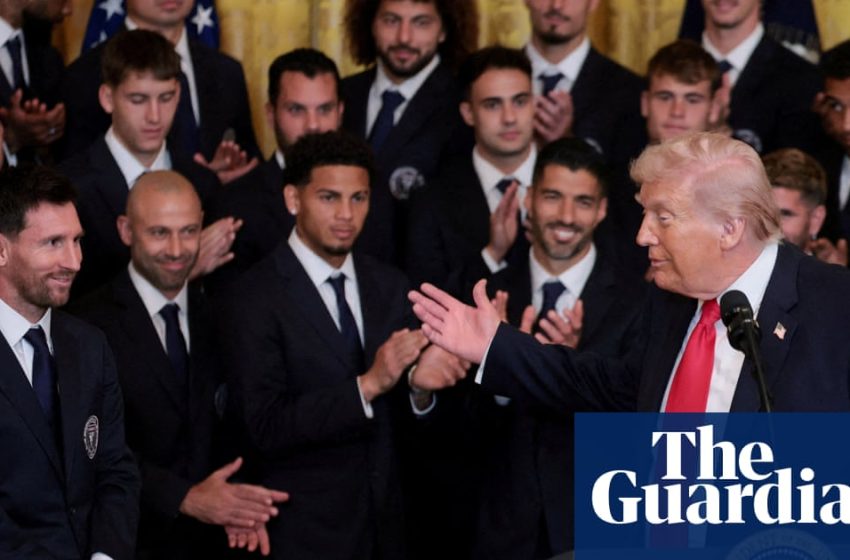
Messi and Inter Miami were wallpaper for Trump’s whims in their White House visit | MLS
Nine minutes and 43 seconds. As Inter Miami’s players stood behind the dais at the East Room in the White House with club owner Jorge Mas stood to the left and Lionel Messi to the right; with MLS commissioner Don Garber sat alongside Fifa World Cup 2026 task force executive director Andrew Giuliani in an audience replete with celebrities and sports stars, it took nine minutes and 43 seconds for US president Donald Trump to talk about why any of them were there.
Inter Miami won the 2025 MLS Cup; a solid win in an exciting final that merited this traditional visit for champions of US pro sports leagues. But in those minutes and seconds before it was acknowledged, Trump did as he did with Juventus players in an Oval Office appearance during last summer’s Club World Cup: he made sports figures the wallpaper for his political and cultural aims. Trump provided an update of sorts on his administration’s sudden and ongoing war against Iran, alluded to a potential conflict with Cuba and offered his own glowing assessment on the supposedly booming US economy. All the while, Luis Suárez, Messi and every other Miami player gazed blankly from behind him.
In some ways, the phrases Trump used in his opening remarks felt familiar to these sorts of team visits: totally demolish … they’re tough … they fight … the greatest thing anyone has seen. But Trump’s platitudes weren’t directed towards Miami. He was speaking about a military operation that has claimed the lives of Americans and Iranians alike.
Messi himself strode into the East Room walking alongside Trump, a visual that felt bizarre even by the completely warped standards of the current administration, one which has welcomed luminaries like Kid Rock, Ted Nugent, the MyPillow guy, and of course Messi’s greatest rival, Cristiano Ronaldo, to the White House.
It wasn’t Messi’s first opportunity to attend a White House event; in January 2025, he was awarded the Presidential Medal of Freedom, the highest honor the US can bestow upon a private citizen. Messi, Inter Miami said at the time, told the White House that he was “deeply honored” and called the award a “profound privilege”. Then he told them he had other plans, and didn’t attend the award ceremony.
Trump seemed to take pleasure in that absence, and maybe credit for Messi’s attendance as well.
“It’s my distinct privilege to say what no American president has ever had the chance to say before,” Trump said. “Welcome to the White House, Lionel Messi!”
Miami have one of the most diverse rosters in Major League Soccer and as they stood behind Trump, one couldn’t help but reflect on their presence given some of Trump’s past remarks. David Ruiz and Fafa Picault are of Honduran and Haitian descent respectively, “shithole countries,” as Trump called them early on in his first term, while also accusing Haitian immigrants in the United States of eating dog meat. Venezuelan midfielder Telasco Segovia stood behind Trump only months after Trump deposed the president of his home country. Former Barcelona greats Jordi Alba and Sergio Busquets have both moved on from Miami and were absent just days after Trump called their native Spain a “loser” for refusing to aid the US in its ongoing war with Iran.
For his part, Messi – whose mastery of the English language is frequently debated – nodded and smiled. He continued to do so as Trump brought up his son’s infatuation with both Messi and Ronaldo. Trump, whose interest in professional soccer started with Pelé and the New York Cosmos in the mid-1970s, asked Messi’s own teammates whether they rated him higher than the Brazilian legend. Again, Messi simply nodded and laughed.
It was deeply unsurprising. Messi has famously never publicly aligned himself with any particular political stance, and has usually declined visits to heads of state, perhaps seeking to avoid even an inadvertent attachment. Even at Barcelona – a team that has never hesitated to align itself with politics – Messi never weighed in on the subject of Catalan independence, leaving the talking to other club legends like Johan Cruyff, Pep Guardiola and Gerard Piqué. Even Messi’s comments on the use of the Catalan language seemed apolitical: “the more languages a child knows, the better.”
There are other ways to be, of course, even amongst Argentine legends of the game. Diego Maradona, Messi’s boyhood idol, never got a White House invite, having been a staunch critic of US foreign policy during and after his playing career. Maradona, who bore a tattoo of Argentina-born Cuban revolutionary Che Guevara on his calf, was denied entry to the United States in 2018 after calling Trump a chirolita – Latin American slang for “puppet.”
Messi, and each and every player, have their own reasons for attending the event. So did Jorge Mas. As he mentioned in his remarks, Mas is the son of Cuban refugees who came to the US “seeking freedom”.
“I want to express what an extreme honor and privilege it is to be in the people’s house,” said Mas, “led by you, celebrating in the presence of champions.”
Mas offered Trump the same finely honed backstory he’s given many times, about the club’s “freedom to dream”. Then he offered his own non-sporting messages, about fleeing communism and tyranny, about sitting at the dinner table with his parents and about making a “global difference”.
Trump has been referred to at times as America’s first “soccer president”. He was in his first term when the US, Canada and Mexico won their joint bid to host this summer’s World Cup and he’ll be in office when the tournament kicks off in a little over three months. He’ll also apparently be presenting the trophy to the tournament champions, having created a close relationship with Fifa president Gianni Infantino. The two of them are frequently seen together at events, and Trump, of course, is the inaugural recipient of Fifa’s Peace Prize.
Yet nobody seems to be able to find any evidence that Trump actually cares about the soccer itself. Even after those initial 10 minutes of occasional warmongering, Trump only spoke about Miami for a few more before rambling on about baseball’s New York Yankees, their long-dead owner George Steinbrenner, Andrew Giuliani’s golf game or his plans for Cuba.
In the meantime, Miami became the latest team to serve as window dressing for one of Trump’s unhinged rants, standing uncomfortably behind him, before retreating to the Oval Office.
First Appeared on
Source link






