


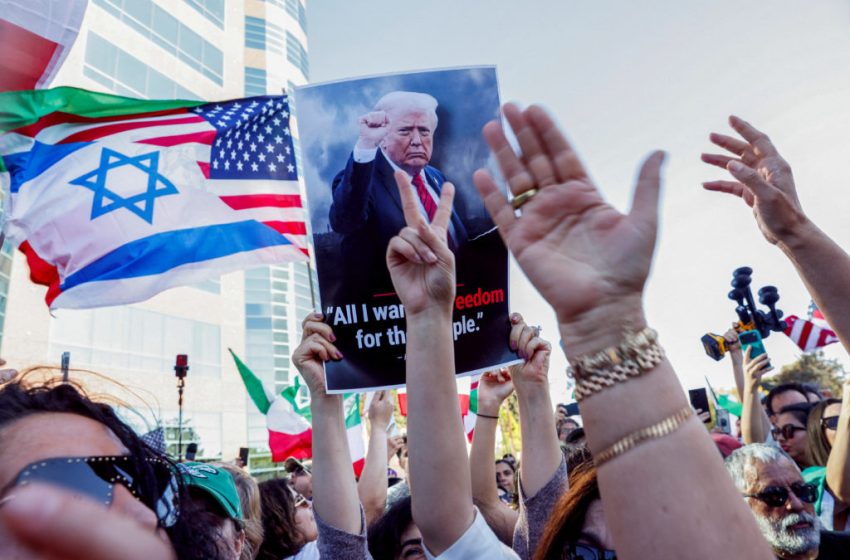
Majority of Americans oppose military action in Iran, new poll finds
A majority of Americans disapprove of how President Donald Trump is managing the U.S.-Israeli conflict with Iran and oppose the military action outright, according to the latest PBS News/NPR/Marist poll.
WATCH: As U.S.-Israeli strikes intensify, Iran says it’s no longer looking to negotiate
As Operation Epic Fury nears the end of its first week, the new survey found 56% of Americans oppose U.S. military action in Iran, while 44% support it. Support for U.S. action has remained relatively steady since January, before the attacks began. The poll was conducted in the days after an Iranian drone strike on a command center in Kuwait killed six U.S. soldiers.
U.S. and Israel have targeted Iranian military and government sites, killing Iran’s supreme leader Ayatollah Ali Khamenei. More than 1,000 civilians have also been killed in the conflict, including an estimated 175 students and staff at a girl’s school, which a preliminary U.S. military investigation suggests was caused by an American air strike, according to Reuters.
A majority — 54% — of Americans disapprove of how Trump is handling Iran. Another 36% approve and 10% are unsure, according to the latest PBS News/NPR/Marist poll. Graphic by Steff Staples/PBS News.
Trump’s approval for his handling of Iran stands at 36%, down 6 percentage points from January 2020, when tensions with Tehran spiked following a targeted U.S. drone strike that killed Qasem Soleimani, the commander of the Quds Force, a division of Iran’s Islamic Revolutionary Guard Corps.
WATCH: Iranian Americans express hope and fear about what comes next
Opinion of the current action is sharply divided along partisan lines. Strong majorities of Republicans back both the president’s approach and the strikes themselves – 79% and 84%, respectively – while 86% of Democrats are opposed to both. Among independents, roughly 6 in 10 disapprove of Trump’s handling of the situation and oppose military action.
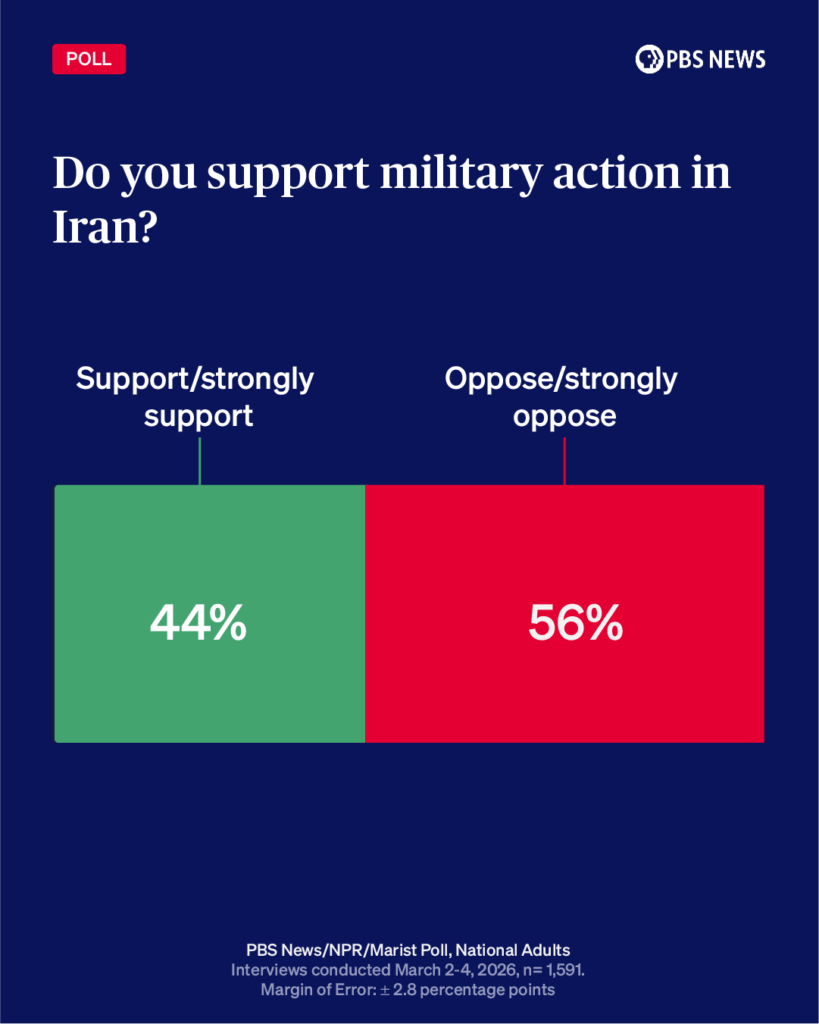
A majority — 56% — of Americans oppose U.S. military action in Iran, according to the latest PBS News/NPR/Marist poll, while 44% support it. Graphic by Steff Staples/PBS News.
The picture is more complicated when it comes to how Americans view the underlying threat posed by Iran. A plurality of Americans – 44% – say Tehran is a major threat to U.S. security. That is down from 48% last July, shortly after the U.S. targeted three Iranian nuclear facilities with bunker-buster bombs. The slight decline could suggest that some Americans see Iran as a less immediate danger as its military capabilities have been weakened.
WATCH: John Kirby on concerns about Iran’s future after the war
In the latest poll, another 40% of Americans consider Iran a minor threat and 15% see no threat at all to U.S. security.
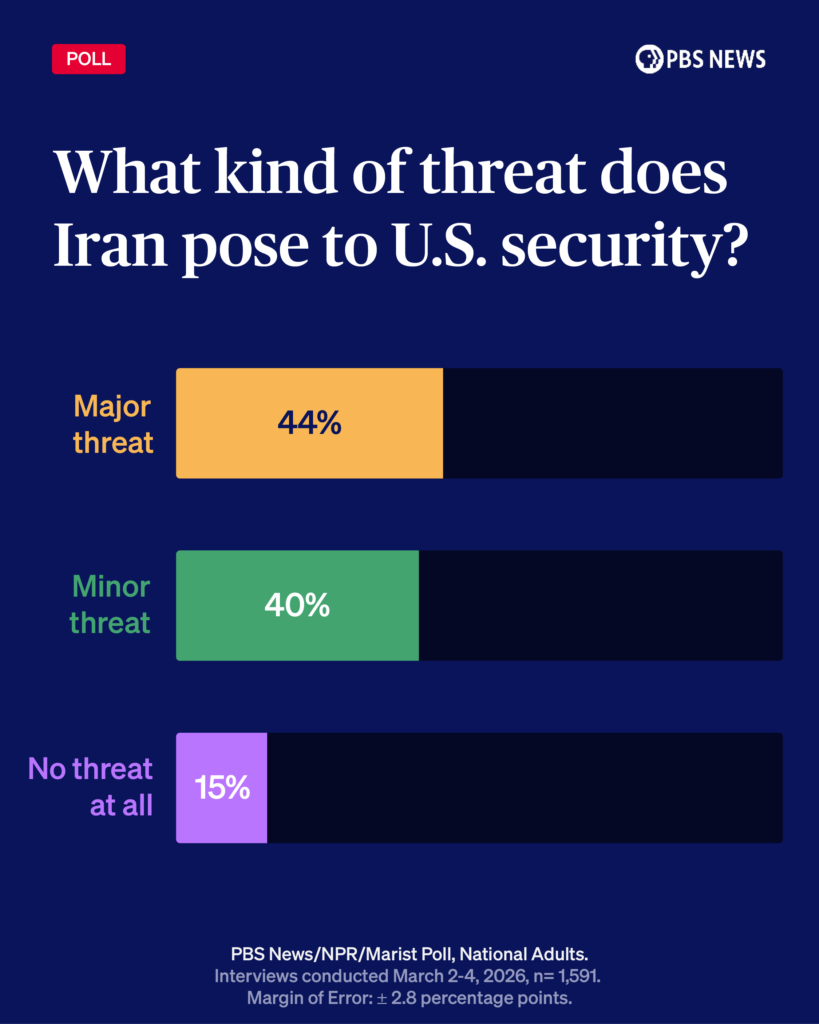
A plurality of Americans – 44% – say Iran is a major threat to U.S. security, according to the latest PBS News/NPR/Marist poll. Another 40% see the country as a minor threat, while 15% see it as no threat at all. Graphic by Dan Cooney/PBS News.
The public case for war
In the days since the president authorized military action that toppled the Iranian leadership, he has cited multiple justifications for doing so, including regime change, preventing Iran from obtaining a nuclear weapon and stopping what he described as imminent threats to American forces. Asked Tuesday whether the U.S. had acted because Israel was planning to strike first, Trump said, “No, I might’ve forced their hand.” The shifting explanations potentially may have made it harder for Americans to assess what success would look like from U.S. actions in the region.
Retired U.S. Army Col. Joel Rayburn, a former National Security Council staffer who focused on Iran policy during Trump’s first term, argued the military operation is succeeding faster than expected and is severely limiting any potential or ongoing threat from a regime intent on causing harm.
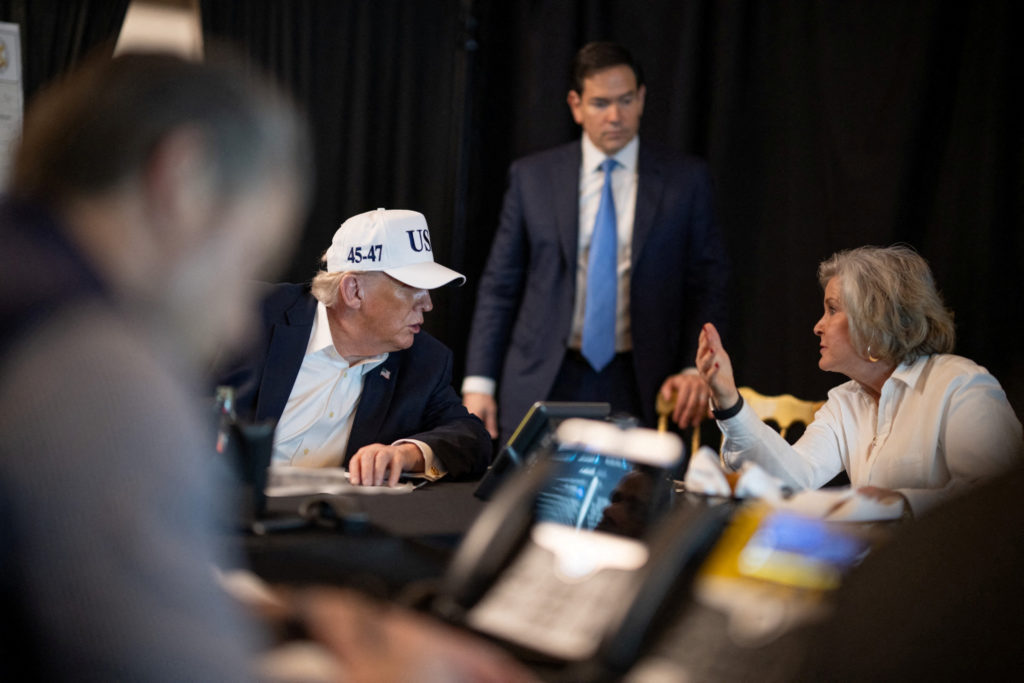
President Donald Trump speaks with White House chief of staff Susie Wiles and Secretary of State Marco Rubio during military operations in Iran, at Mar-a-Lago in Palm Beach, Florida, on Feb. 28, 2026. Photo by the White House/ Social Media/ Handout via Reuters
“If someone’s jogging toward you, firing a pistol at you, the fact that they’re missing doesn’t mean they’re not a threat to your life,” said Rayburn, a senior fellow at the Hudson Institute, a conservative think tank. “President Trump is the first president that we’ve had who actually took the Iranian threat as seriously as it needed to be taken and actually did something about it.”
Others are far less convinced. Alan Eyre, a former State Department official who helped negotiate the 2015 Iran nuclear deal during the Obama administration, said the Trump administration has offered shifting explanations for the conflict.
“To say that Iran is an imminent threat or even a major threat to the security of the United States is risible, is laughable,” Eyre said. “This administration has done a poor job of providing a convincing rationale for attacking Iran” or defining a clear end state for the conflict, he added.
Eyre, a fellow at the Middle East Institute, a nonpartisan think tank, also expressed concern with the limited role Congress has played in the decision to take military action. War powers resolutions that would have limited further involvement were rejected in both the House and Senate this week, largely along party lines.
“Our political system is largely broken,” he said. “Congress is inert and is not exercising in any appreciable way the responsibilities it’s been given under the U.S. Constitution.”
What’s next
Whether public opinion shifts may depend largely on how – and how quickly – the conflict ends. White House press secretary Karoline Leavitt said Friday the military operation should wrap up in four to six weeks, despite an internal Pentagon memo obtained by Politico that suggests it could last months.
Rayburn expressed confidence the operation would ultimately dismantle what he called Iran’s decades-long effort to destabilize the Middle East.
With the Iranian regime toppled, “you’re suddenly going to have an opportunity for stability and peace in the region,” Rayburn said. “The American people are going to see that. If they don’t see it now, they’re going to see it over time.”
WATCH: White House says U.S. ground troops in Iran are ‘not part of the plan’ for now
Eyre was more skeptical that a coherent strategic vision or explanation would emerge from the Trump administration. Without sustained resolve from Congress or the public, he said, the president has little incentive to provide one.
“The only thing that will cause President Trump to reconsider is adverse domestic political pressure,” Eyre said.
PBS News, NPR and Marist Poll conducted a survey from March 2-4, 2026, that polled 1,591 U.S. adults by phone, text and online with a margin of error of 2.8 percentage points, and 1,392 registered voters with a margin of error of 3.0 percentage points.
First Appeared on
Source link






